
The Psychology of Living in Your Head
When the most crowded place you know is the space between your ears


I was at dinner with friends when I realized I had no idea what anyone had been talking about for the last fifteen minutes.
They were laughing, animated, fully present in the moment. Meanwhile, I was three conversations deep in my own head—replaying something awkward I'd said two hours ago, planning tomorrow's presentation, and simultaneously worrying about whether I'd come across as distant by not contributing enough to this very conversation I wasn't actually having.
My best friend touched my arm. "You okay? You seem a million miles away."
She had no idea. I wasn't a million miles away. I was right there at the table, but I was also simultaneously existing in seventeen different mental dimensions, none of which were the present moment.
"Sorry," I mumbled. "Just tired."
But I wasn't tired. I was just living in my head again. Like always.
The Inner World That Never Sleeps
For as long as I can remember, my mental life has been louder, more vivid, and more consuming than my actual life. While my body moves through the world—working, eating, talking—my mind is elsewhere, running a constant stream of thoughts, scenarios, conversations, and narratives that never stop.
I live in a perpetual state of analysis. Every interaction gets dissected afterward. Every decision gets examined from forty-seven angles. Every feeling gets intellectualized, categorized, and filed away for future rumination.
My therapist calls it "being in your head." I call it my default state of existence.
Other people seem to just be—they go to the gym and think about the gym. They watch movies and experience the story. They have conversations and stay in those conversations.
I go to the gym and plan my entire week. I watch movies and critique the dialogue while simultaneously thinking about my own life's narrative arc. I have conversations while having three other conversations with myself about the conversation I'm supposed to be having.
It's exhausting. But it's also the only way I know how to exist.
The Architects of Overthinking
I wasn't born this way. Or maybe I was, but life certainly reinforced it.
Growing up, my household was unpredictable. Not chaotic in an obvious way, but emotionally volatile. I learned early that survival meant prediction—if I could think through every possible scenario, anticipate every reaction, analyze every mood shift, I could stay safe.
My mind became my refuge and my fortress. When the outside world felt uncertain, I could retreat inward, where I had complete control. I could replay conversations until I found the "right" response. I could plan futures in meticulous detail. I could create entire worlds that made sense in ways reality never did.
School rewarded this tendency. Teachers praised my thoughtfulness, my ability to see multiple perspectives, my rich inner life. "She's an old soul," they'd say. "Very introspective."
What they didn't see was that I wasn't choosing introspection. I was trapped in it.
The Prison of Possibility
Living in your head means living in infinite possibility—and infinite paralysis.
Every decision becomes monumental because I can see every potential outcome. Choosing a restaurant requires weighing seventeen variables. Sending a simple email takes an hour because I'm analyzing every word choice, every possible interpretation, every way it could be misunderstood.
My partner once joked that I could turn "Should we get pizza tonight?" into an existential crisis. He wasn't wrong.
But it's not funny when you're the one drowning in it. When your brain treats every choice like a choose-your-own-adventure book with infinite pages. When you're so busy thinking about living that you forget to actually live.
I've missed so much because I was too busy processing it. Sunsets I didn't see because I was ruminating. Conversations I didn't hear because I was rehearsing what I'd say next. Moments of joy that passed me by because I was already analyzing them, trying to capture and preserve them instead of simply experiencing them.
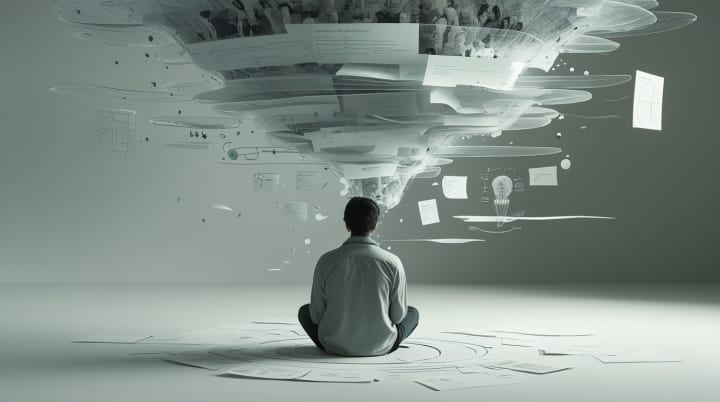
The Illusion of Control
Here's the seductive lie that keeps you trapped in your head: if you think about something enough, you can control it.
If I mentally rehearse this conversation fifty times, it will go perfectly.
If I analyze my relationship from every angle, I can prevent it from failing.
If I plan every detail of my future, nothing will catch me off guard.
But life doesn't work that way. The conversations never go how I planned. Relationships fail despite my analysis. The future I meticulously designed never materializes because life has its own agenda.
All that mental energy—the hours spent thinking, planning, analyzing, preparing—yields diminishing returns. Past a certain point, more thinking doesn't lead to better decisions. It just leads to more thinking.
My therapist once asked me, "How often do your worst-case scenarios actually come true?"
I thought about it. Honestly. "Maybe... five percent of the time?"
"And what percentage of your mental energy goes to worrying about them?"
"Ninety-five percent."
The math didn't add up. I was spending my entire life preparing for disasters that almost never came, while missing the life that was actually happening.
The Disconnection From the Body
Living predominantly in your head means becoming disconnected from your body. I became so good at intellectualizing my feelings that I stopped feeling them at all.
Anxiety manifested as thoughts, not sensations. I didn't notice my racing heart or shallow breathing—I only noticed the loop of worried thoughts.
Sadness became something to analyze, not experience. Instead of crying, I'd think about why I was sad, where the sadness came from, what it meant, whether it was justified.
Even joy got intellectualized. I couldn't just be happy. I had to examine the happiness, question whether it was authentic, worry about when it would end.
My body became just a vehicle for carrying my brain around. I ignored hunger cues, pushed through exhaustion, dismissed pain. My body would whisper, then speak, then shout, and I'd still be too busy thinking to listen.
The panic attacks finally got my attention. My body, after years of being ignored, started screaming in a language I couldn't intellectualize away.
The Social Cost
Living in your head destroys intimacy. You can't connect with people when you're not actually present with them.
My relationships suffered. Friends felt like I wasn't really listening—because I wasn't. Romantic partners felt like they were dating a ghost—because they were. I was physically there but emotionally elsewhere, lost in mental labyrinths they couldn't access.
"You're always so distant," my ex said during our breakup. "It's like you're observing your own life instead of living it. Like you're watching a movie of yourself rather than being yourself."
His words gutted me because they were true. I had become a spectator in my own life, narrating and analyzing instead of participating.
I'd be on dates while mentally drafting the story I'd tell about the date later. I'd be at parties observing social dynamics instead of being part of them. I'd be in conversations while simultaneously having meta-conversations about the conversation.
The irony was cruel: I spent so much time in my head thinking about connection, analyzing relationships, trying to understand human behavior—but all that thinking prevented me from actually connecting.
The Awakening
My turning point came during a meditation retreat I'd signed up for on a whim. Or rather, after three hours of agonizing analysis about whether I should sign up, cross-referencing reviews, considering every possible outcome, and creating a detailed pros-and-cons list.
On the third day, during a silent walking meditation, something shifted. For maybe thirty seconds—just thirty seconds—I wasn't thinking. I was just walking. Feeling my feet on the ground. Hearing birds. Noticing the way light filtered through trees.
And then my brain kicked back in: "Wow, I'm not thinking! This is amazing! I should remember this feeling so I can replicate it later. I wonder what happened neurologically. Maybe I should read more about—"
And just like that, the moment was gone.
But I'd felt it. Proof that another way of being was possible, even if I didn't know how to sustain it yet.
Learning to Descend
Getting out of my head wasn't a single revelation. It was—and continues to be—a practice. A slow, imperfect descent from the mental stratosphere back into my body, my senses, my actual life.
I started with the basics: Five senses grounding. When I noticed myself spiraling into thought, I'd stop and name: five things I could see, four I could touch, three I could hear, two I could smell, one I could taste.
It felt mechanical at first, forced. But it worked. It interrupted the thought loops and brought me back to physical reality.
I practiced "noting" during meditation—not trying to stop thoughts, but simply labeling them: "Thinking. Planning. Worrying. Analyzing." The act of naming them created distance. They were thoughts I was having, not truths I had to believe or problems I had to solve.
I started asking myself, repeatedly throughout the day: "Where am I right now? What am I actually doing?" The answer was usually mundane—I'm washing dishes, I'm walking to my car, I'm sitting at my desk—but it anchored me to the present instead of the seventeen places my mind had wandered.
The Discomfort of Presence
Here's what surprised me most about getting out of my head: presence is uncomfortable.
When you're used to living mentally, dropping into your body means feeling everything you've been avoiding. The anxiety you've intellectualized. The grief you've analyzed but never cried. The anger you've rationalized away. The loneliness you've thought about but never truly felt.
My body, it turned out, had been trying to tell me things for years. And I'd been too busy thinking to listen.
Getting out of my head meant feeling my feelings instead of thinking about them. It meant sitting with discomfort instead of mentally solving my way out of it. It meant accepting that not everything could be understood, analyzed, or controlled.
It was terrifying. But it was also liberating.
The Balance
I want to be clear: I'm not advocating for mindless existence. Our ability to think, analyze, and reflect is beautiful and uniquely human. My rich inner life has given me depth, creativity, empathy, and insight.
The problem wasn't thinking itself. It was only thinking. Living exclusively in my head while my actual life passed by unnoticed.
Recovery didn't mean killing my inner world. It meant finding balance. Learning when to think and when to simply be. Recognizing when analysis was helpful and when it was just another form of avoidance.
Some moments deserve deep thought. Others deserve deep presence. The wisdom is knowing which is which.
What I Know Now
Two years into this practice, I still spend plenty of time in my head. My mind is still active, analytical, endlessly curious. But now it's a place I visit rather than a place I'm trapped in.
I can have conversations without simultaneously narrating them. I can watch sunsets without immediately trying to capture or memorize them. I can feel feelings without immediately needing to understand them.
I still overthink sometimes. I still analyze when I should just experience. But now I notice when I'm doing it. And I can choose—not always, but often—to come back to the present moment.
For the Overthinkers
If you're someone who lives primarily in your head, constantly analyzing, planning, and ruminating, I want you to know: your mind is not your enemy. Your thoughts are not the problem.
But if thinking is all you do, you're missing the fullness of life. You're experiencing existence in only one dimension when there are so many more available to you.
Your life is not happening in your head. It's happening in your body, in your senses, in the world around you. And it's happening right now, in this moment, while you're busy thinking about the last moment or the next one.
You don't have to choose between thinking and feeling, between analysis and experience. But you do have to learn that some moments are meant to be thought about—and others are meant to be lived.
And the only way to know the difference is to occasionally, bravely, come out of your head and find out what you've been missing.
-----------------------------
Thanks for Reading!
About the Creator
Keep reading
More stories from Ameer Moavia and writers in Psyche and other communities.
Why We Imagine the Worst-Case Scenario
It started with a text message that never came. My boyfriend had said he'd call me after his interview. It was 6 p.m., then 7 p.m., then 8 p.m. By 9 p.m., I'd convinced myself he was dead. Not just hurt—dead. Car accident. Mugging gone wrong. Sudden brain aneurysm. I'd already mentally planned his funeral, imagined telling his parents, and pictured myself in black at the cemetery when my phone finally buzzed. "Sorry babe! Interview ran long, then grabbed drinks with the team. How was your day?" I stared at the message, my heart still hammering, hands still shaking. Three hours I'd spent in hell. Three hours of vivid, terrible scenarios playing on loop in my mind. And for what? He'd been fine. Happy, even. That's when I realized: my brain wasn't protecting me. It was torturing me. The Catastrophe Factory I've been a catastrophic thinker for as long as I can remember. Show me any situation, and I'll show you seventeen ways it could end in disaster. A friend doesn't text back? They've decided they hate me and are ghosting me forever. A slight headache? Definitely a brain tumor. My boss wants to "chat"? I'm getting fired, losing my apartment, and will end up homeless. Turbulence on a plane? We're going down, and I've already written my last words to my family in my head. It's exhausting. Every day is a mental obstacle course of imagined tragedies that never materialize. And yet, I can't stop. My brain insists on preparing for the worst, as if anticipating disaster will somehow prevent it. The Genetics of Worry My therapist once asked me, "Where did you learn to think this way?" The answer came immediately: my mother. Growing up, every minor inconvenience was treated like a catastrophe. If my dad was ten minutes late coming home, my mother would pace the kitchen, convinced he'd been in an accident. If I had a cough, she'd keep me home from school, certain it would turn into pneumonia. If the phone rang after 9 p.m., she'd answer it with a trembling voice, already bracing for bad news. I absorbed her anxiety like a sponge. I learned that the world was dangerous, that disaster lurked around every corner, and that the best way to protect yourself was to imagine every terrible possibility before it happened. The logic was twisted but compelling: if I could predict the worst, maybe I could prevent it. Or at least, I wouldn't be blindsided by it. But all I really learned was how to suffer twice—once in my imagination and once if it actually happened. The Illusion of Control Here's what I've come to understand about catastrophic thinking: it's not really about the future. It's about control. When life feels uncertain or chaotic, our brains scramble for a sense of agency. We can't control whether bad things happen, but we can control our mental preparation for them. Catastrophizing becomes a security blanket—uncomfortable, but familiar. I noticed this pattern clearly during the pandemic. While the world was genuinely scary, my catastrophic thinking went into overdrive. I wasn't just worried about getting sick; I was planning for economic collapse, societal breakdown, and the end of civilization as we knew it. My therapist pointed out something crucial: "You're so busy preparing for the worst that you're missing the present moment entirely. And ironically, all this mental preparation doesn't actually help you handle real problems when they arise." She was right. When actual challenges came—losing my job, my grandmother's death, a real health scare—all my catastrophic preparation was useless. The scenarios I'd imagined were never quite right, and the energy I'd spent worrying could have been spent living. The Brain's Ancient Wiring There's a reason catastrophic thinking is so common: evolution. Our ancestors who imagined the worst—who saw every rustling bush as a potential predator—were more likely to survive than the optimists who assumed everything was fine. Anxiety kept them alive. Vigilance was rewarded. But here's the problem: our brains haven't caught up to modern life. We're still operating with software designed for life-or-death situations, applying it to emails, traffic, and social media. That rustling bush is now an unanswered text. That potential predator is now a cryptic comment from our boss. Our amygdala—the brain's alarm system—can't tell the difference between actual danger and imagined threats. So it treats everything like an emergency.
By Ameer Moavia2 months ago in Psyche
Who is your "Person"?
It's important to recognize that you cannot go through life as easily on your own. My name is Elizabeth and I'm a survivor of child abuse and horrific trauma. Healing from trauma is not a quick fix and recognizing that it will take time, is part of the struggle.
By Elizabeth Woods4 days ago in Psyche
8 Subtle Signs You’re Dissociated, According to Therapists
Have you ever driven somewhere and suddenly realized you don’t remember the last few minutes of the journey? Or maybe you were in a conversation but felt mentally “far away.” These experiences might seem normal, but therapists say they can sometimes be signs of dissociation.
By Shahid Zamana day ago in Psyche


Comments
There are no comments for this story
Be the first to respond and start the conversation.