
The Psychology of Emotional Contagion
How Feelings Quietly Spread Between Minds

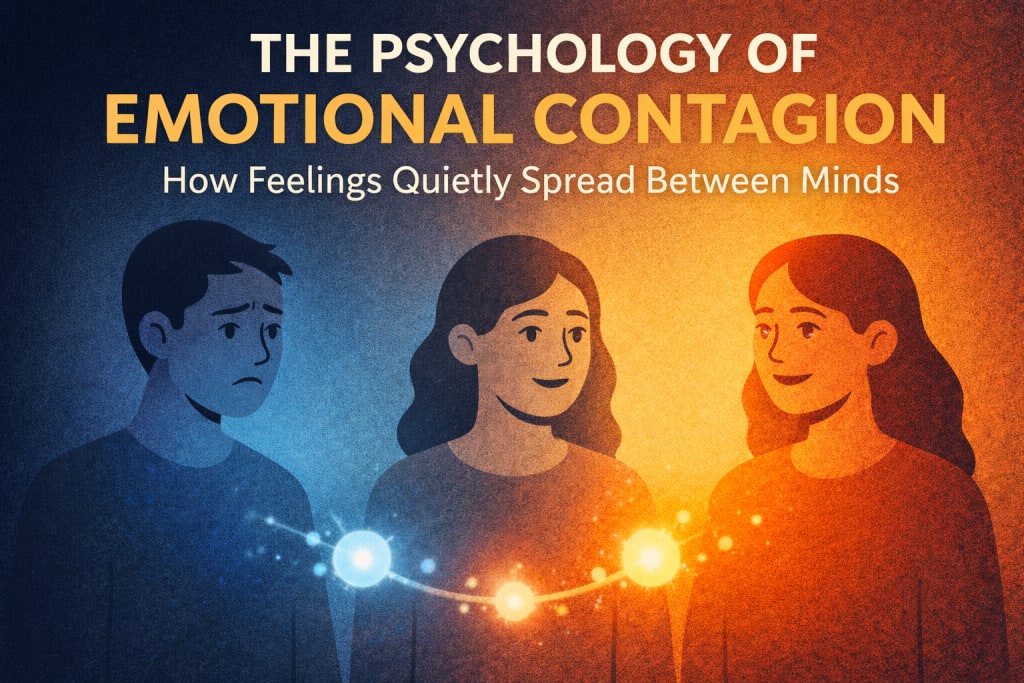
Walk into a room where tension hangs in the air, and you may feel uneasy before anyone says a word. Enter a space filled with laughter, and your mood often lifts almost instantly. This phenomenon is not coincidence or imagination; it is emotional contagion at work. Emotional contagion is a subcategory of social psychology that explores how emotions transfer from one person to another, often unconsciously. It shapes group dynamics, relationships, workplaces, and even entire societies, influencing how we feel and behave in ways we rarely notice.
At its core, emotional contagion refers to the human tendency to “catch” the emotions of others. This process does not require direct communication or intentional influence. Facial expressions, tone of voice, posture, and subtle behavioral cues all serve as emotional signals. Our brains are wired to pick up on these signals quickly, allowing us to synchronize emotionally with those around us. From an evolutionary perspective, this ability helped early humans survive by enabling rapid group coordination and shared responses to threats or opportunities.
One of the key psychological mechanisms behind emotional contagion is automatic mimicry. Humans naturally imitate the expressions and movements of others, often without awareness. When someone smiles, we may subtly mirror that smile. When someone frowns or speaks with a tense tone, our facial muscles and vocal patterns may shift in response. These small physical changes feed back into our emotional system, nudging our internal state to align with what we observe. Over time, this mirroring can generate genuine emotional change, not just surface imitation.
Neuroscience offers further insight through the study of mirror neurons. These neurons activate both when we perform an action and when we observe someone else performing the same action. While mirror neurons alone do not fully explain emotional contagion, they play a role in how we internally simulate others’ emotional states. Observing someone’s distress, for example, can activate brain regions associated with experiencing distress ourselves. This neural resonance helps explain why emotions can spread rapidly within groups, even without explicit discussion.
Emotional contagion is especially powerful in close relationships. Partners, close friends, and family members often influence one another’s emotional baseline. Over time, individuals in long-term relationships may develop shared emotional rhythms, reacting similarly to stress, joy, or disappointment. This synchronization can deepen emotional intimacy, but it can also amplify negative patterns. Chronic stress or pessimism in one partner can gradually affect the emotional well-being of the other, creating feedback loops that are difficult to break.
In group settings, emotional contagion plays a central role in shaping collective mood. In workplaces, for instance, a leader’s emotional state often sets the tone for the entire team. A calm, confident leader can foster stability and focus, while an anxious or irritable one can increase tension and reduce productivity. Importantly, emotional contagion does not depend solely on authority; emotions can spread horizontally among peers as well. A single highly expressive individual can shift the mood of an entire group through their energy alone.
Digital environments have added a new dimension to emotional contagion. Social media platforms allow emotions to spread at unprecedented speed and scale. Studies have shown that exposure to emotionally charged content—whether positive or negative—can influence users’ mood and behavior, even when they are unaware of the effect. A feed filled with outrage, fear, or despair can subtly increase anxiety and hostility, while content emphasizing connection and joy can elevate mood. Unlike face-to-face interactions, digital emotional contagion often lacks immediate feedback, making its effects harder to recognize and regulate.
Not all emotional contagion is harmful. Positive emotional contagion can strengthen social bonds, increase empathy, and promote cooperation. Shared laughter builds trust, collective excitement enhances motivation, and mutual calm helps regulate stress. In therapeutic settings, emotional attunement between therapist and client can support healing by creating a sense of safety and understanding. When people feel emotionally “met,” they are more likely to open up and engage in meaningful self-reflection.
However, emotional contagion becomes problematic when individuals lack emotional boundaries. Highly empathetic people, in particular, may absorb others’ emotions so deeply that they struggle to distinguish between their own feelings and those of others. This can lead to emotional exhaustion, anxiety, or burnout. In caregiving professions, constant exposure to distress can result in compassion fatigue, a state in which emotional resources become depleted due to prolonged emotional resonance with others’ suffering.
Self-awareness is a crucial factor in managing emotional contagion. Recognizing when your mood has shifted in response to someone else’s emotional state allows you to pause and assess whether that emotion truly belongs to you. This awareness creates psychological distance, enabling conscious choice rather than automatic absorption. Practices such as mindfulness and emotional labeling can help individuals identify and regulate emotional influence more effectively.
Another important element is emotional regulation within groups. When people learn to model calmness and emotional clarity, they can interrupt negative emotional spirals. This does not mean suppressing emotions or denying difficulties; rather, it involves expressing emotions in a grounded, constructive way. For example, acknowledging stress while maintaining a problem-solving mindset can prevent anxiety from spreading uncontrollably through a group.
Cultural factors also shape emotional contagion. Some cultures emphasize emotional restraint, while others encourage expressive emotional sharing. These norms influence how emotions are displayed and transmitted. In expressive cultures, emotional contagion may occur more visibly and rapidly, while in reserved cultures it may operate more subtly through tone, silence, or indirect cues. Understanding these cultural differences can improve cross-cultural communication and reduce misinterpretation.
Ultimately, emotional contagion reveals how deeply interconnected human psyches are. We are not isolated emotional units; we constantly influence and are influenced by the emotional landscapes around us. This interconnectedness is both a strength and a vulnerability. It allows us to share joy, support one another in hardship, and form cohesive communities. At the same time, it requires responsibility—an awareness that our emotional states can ripple outward, affecting others in ways we may never fully see.
By understanding emotional contagion, we gain insight into the invisible currents shaping our daily experiences. We become better equipped to protect our emotional well-being while contributing positively to the emotional climates we inhabit. In a world increasingly defined by constant connection, learning to navigate emotional influence with awareness and intention may be one of the most important psychological skills of all.
About the Creator
Kyle Butler
Sharing fascinating facts and insights from every category, with a special passion for longevity and healthy living. Join me on a journey to discover the secrets of a longer, better life.
Keep reading
More stories from Kyle Butler and writers in Psyche and other communities.
The Emotional Echo: How Micro-Rejections Shape Our Inner World
Most people understand the sting of major rejection. A breakup, a job denial, a falling-out with a friend—these events leave marks that are easy to recognize. But psychology has begun paying increasing attention to something far quieter: micro-rejections. These are small, often fleeting moments of social dismissal that many of us overlook or brush aside. A text left unanswered, a slightly cold tone from someone we care about, a subtle exclusion from a group conversation, a joke that doesn’t land the way we hoped—it’s easy to dismiss these experiences as trivial. Yet they leave emotional echoes that can meaningfully influence our behavior, self-perception, and overall psychological health.
By Kyle Butler3 months ago in Psyche
Top tipple tricks
Been thinking a lot about drinking, lately. Not least because of a recent episode of over-indulgence and the inevitable after effects. Some readers may recall the earlier articles I wrote about beating the booze. Here I set out an experiment in techniques for cutting down on my alcohol intake. The experiment was successful, the techniques worked, and I have armed myself with an arsenal of weapons in the war against the demon drink. I have yet to fire the first round however. It's all a question of timing (perhaps procrastination).
By Raymond G. Taylor7 days ago in Psyche




Comments
There are no comments for this story
Be the first to respond and start the conversation.