
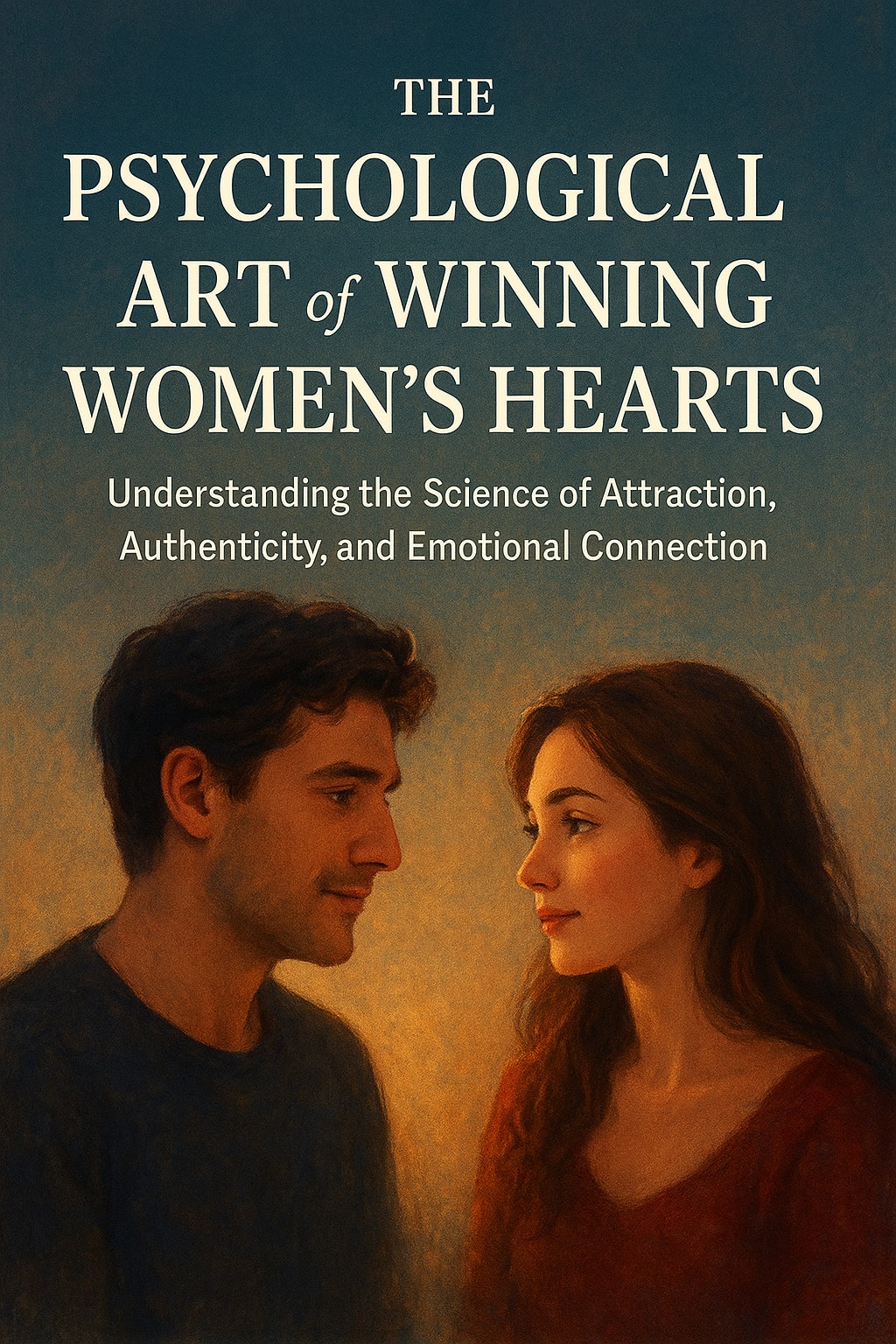
The Psychological Art of Winning Women’s Hearts
Understanding the Science of Attraction, Authenticity, and Emotional Connection

Introduction
For as long as humans have loved, they have wondered what makes two hearts align. The art of attraction — especially between men and women — has been a subject of poetry, philosophy, and science alike. Yet, despite the endless volumes of dating advice, attraction remains one of the most misunderstood human experiences.
At its core, attraction is not about manipulation, charm, or games. It is about resonance — the invisible thread between two psyches that find comfort, curiosity, and safety in each other. True connection is not built on tactics but on self-awareness, emotional intelligence, and the ability to relate with empathy and authenticity.
In this essay, we explore the psychology of attraction and the art of winning women’s hearts — not through seduction, but through understanding. It is a journey through evolutionary psychology, communication theory, and human philosophy, where attraction becomes not a conquest, but a mirror for personal growth and mutual discovery.
1. The Evolutionary Roots of Attraction
Long before modern romance, attraction served an ancient function — survival. Evolutionary psychology suggests that human attraction is a system designed to ensure the continuation of the species. Women historically selected partners who exhibited traits suggesting strength, protection, and resourcefulness. Men were drawn to signs of youth, vitality, and fertility.
Yet, in the modern era, these primal instincts have evolved into more complex emotional patterns. The traits once symbolized by physical protection are now found in emotional intelligence, ambition, creativity, and dependability. What was once about physical survival has become about psychological safety.
Modern research in evolutionary psychology reveals that qualities such as confidence, empathy, and stability are still seen as indicators of “fitness.” They suggest not just physical capability but emotional reliability — the capacity to nurture, protect, and build. In this sense, attraction has become not just a biological process but an emotional ecosystem.
2. The Psychology of Female Desire
Female desire, often misunderstood or oversimplified, is one of the most intricate expressions of human emotion. Unlike the instant spark often associated with male attraction, female desire tends to be multi-layered, integrating emotional, psychological, and social dimensions.
Psychologically, women are drawn to partners who evoke both safety and excitement — someone emotionally grounded yet capable of igniting curiosity. Emotional intelligence plays a pivotal role here: the ability to listen deeply, empathize sincerely, and respond authentically.
Neuroscientific studies show that oxytocin — the “bonding hormone” — increases during moments of emotional closeness, laughter, and trust. Thus, genuine empathy and shared joy create biological changes that amplify attraction.
Attraction, for women, is rarely about appearance alone. It is about energy, presence, and emotional resonance — the feeling that someone truly sees them, not as an object of desire, but as a whole, complex being.
3. Self-Development: The Foundation of Attraction
Before one can love others deeply, one must learn to love oneself authentically. Self-development is not a luxury — it is the foundation of attraction. Confidence rooted in genuine self-knowledge radiates a quiet magnetism that no superficial charm can replicate.
In psychology, self-esteem is often divided into two forms: defensive and authentic. Defensive confidence masks insecurity; authentic confidence arises from acceptance — of strengths, flaws, and the continuous process of becoming.
A person engaged in self-growth naturally attracts others, because self-awareness signals safety and maturity. When you are at peace with yourself, others sense it; it creates a gravitational pull of trust and curiosity.
Growth is not about perfection, but about integrity — the alignment between who you are, what you value, and how you act.
4. Building Authentic Confidence
True confidence is quiet. It doesn’t shout or demand approval; it simply is. Psychologists describe authenticity as “congruence” — the state in which one’s inner self aligns with one’s external actions.
Women (and indeed, all humans) are drawn to those who embody congruence, because it signals psychological stability. Authentic individuals act out of purpose, not performance. They can express vulnerability without fear, and strength without dominance.
Building authentic confidence involves:
Facing inner narratives: challenging inherited beliefs about worthiness and love.
Embracing solitude: learning to find peace and joy in one’s own company.
Cultivating mastery: pursuing passions and disciplines that nourish self-respect.
Confidence, in essence, is not the absence of fear but the decision to move with grace despite it.
5. Communication: The Language of Connection
Words can open hearts or close them. Communication, in attraction, is far more than exchanging information — it is the dance of empathy and energy between two beings.
Research in interpersonal psychology emphasizes that over 60% of communication is nonverbal. Tone, posture, eye contact, and micro-expressions often speak louder than words. When we speak with presence — with attention fully rooted in the moment — others feel it.
Effective communicators use language not to impress but to connect. They ask thoughtful questions, listen with intent, and respond with awareness. A conversation becomes magnetic when it transforms from a performance into an exchange of souls.
Nonverbal cues — a soft smile, an open posture, sustained yet gentle eye contact — communicate trust and warmth. When words and body language align, sincerity becomes undeniable.
6. The Role of Mystery and Intrigue
Attraction thrives on curiosity. Mystery, when genuine and subtle, stimulates the imagination — a vital component of romantic fascination. But mystery does not mean secrecy or deception; it means depth.
Philosophically, mystery is the recognition that no human being can ever be fully known — and that this unknowability is what keeps love alive. When someone reveals themselves gradually, it creates a rhythm of discovery and anticipation.
Psychologically, mystery engages the dopaminergic system — the brain’s reward center associated with novelty and excitement. When attraction evolves through gradual revelation, emotional investment deepens naturally.
Yet, balance is essential: too much withholding can create distance, while excessive openness can dissolve intrigue. Authentic mystery invites others to explore, not to chase.
7. Humor and Emotional Connection
Laughter is the language of the soul. Neuroscience shows that shared humor releases endorphins, builds trust, and strengthens emotional bonds. In many studies, women consistently rank a sense of humor as one of the most attractive qualities in a partner.
But humor’s magic lies not in the joke itself, but in the emotional safety it creates. When two people laugh together, they subconsciously affirm: I am safe with you.
Humor also demonstrates cognitive flexibility — the ability to view life from multiple perspectives. This mental agility signals intelligence and emotional balance, both key ingredients of attraction.
In relationships, humor softens tension, repairs conflict, and transforms ordinary moments into joy. It reminds us that love, at its best, is not solemn — it is playful.
8. The Significance of Touch and Physical Signals
Human beings are wired for touch. From birth, it regulates our emotions, lowers cortisol, and deepens bonding. In adult relationships, touch communicates affection, reassurance, and warmth far more powerfully than words.
The psychology of touch emphasizes context and consent. A respectful, well-timed gesture — a gentle touch on the arm, a comforting hand during laughter — signals empathy and attentiveness.
Studies from the University of Berkeley reveal that even brief, appropriate touches increase oxytocin levels, creating feelings of trust and comfort. Yet, when forced or misused, touch becomes intrusive. The beauty of physical connection lies in sensitivity — the art of feeling when and how to express it.
9. Mirroring and Rapport: The Subtle Dance
Humans unconsciously mirror one another when rapport is high — a phenomenon called the Chameleon Effect. It’s nature’s way of saying, “We’re in sync.”
Psychological research shows that when two people mirror posture, tone, or energy, their nervous systems harmonize. It fosters familiarity and trust. However, effective mirroring must be subconscious and authentic. Forced imitation feels manipulative and disrupts emotional flow.
The most powerful rapport comes not from mimicry, but from empathy — the ability to intuitively match another’s emotional rhythm without effort. In such moments, conversation becomes symphonic — two hearts beating to the same internal rhythm.
10. The Power of Compliments
A sincere compliment is an act of seeing. It affirms individuality and expresses gratitude for another’s uniqueness.
Research on social psychology reveals that genuine compliments increase dopamine levels in the brain, producing pleasure and connection. But flattery, if empty or exaggerated, quickly loses its power.
The secret lies in specificity: “I admire how you express ideas so clearly,” touches deeper than, “You’re beautiful.” When appreciation targets inner qualities — intelligence, creativity, compassion — it resonates beyond appearance.
A compliment should never be a strategy, but a reflection of awareness. When you see deeply, words naturally carry light.
11. The Importance of Purpose and Ambition
Purpose is magnetic. Individuals with a sense of direction exude vitality; their passion creates its own gravitational field.
Women (and men alike) are instinctively drawn to people who live with intention. Purpose suggests stability and maturity — the ability to transform challenges into growth. It signals that one’s life has meaning beyond ego or external validation.
From a psychological perspective, purpose fulfills the deepest human need identified by Viktor Frankl: to find meaning. When someone embodies this, they radiate inner peace. Their ambition is not frantic striving but a calm devotion to life itself.
Attraction, then, becomes less about possession and more about alignment — two purposeful souls walking parallel paths.
12. Understanding Cultural and Psychological Scripts
Each culture carries its own “scripts” about love — invisible narratives that shape our expectations. Understanding these helps us navigate attraction with wisdom instead of unconscious repetition.
For centuries, romantic myths have glorified pursuit and conquest, often distorting genuine intimacy. Modern psychology invites a new paradigm: one of equality, empathy, and conscious communication.
Recognizing social patterns — such as gender stereotypes or learned attachment behaviors — allows us to choose how we love, rather than reenacting inherited stories. Conscious love is not about perfection; it’s about awareness.
13. Red Flags and the Ethics of Attraction
Every art has its shadow, and in relationships, that shadow is manipulation. True attraction cannot coexist with coercion or disrespect.
Red flags include dishonesty, emotional dependence, boundary violations, or narcissistic behavior. Such traits erode trust — the foundation of any meaningful bond.
Psychologically, manipulation might produce temporary attraction, but never lasting intimacy. Sustainable love is rooted in mutual growth, where both individuals feel seen, respected, and free.
The ethics of attraction are simple: never treat connection as conquest. To love another is to honor their autonomy while offering your presence fully.
14. Lessons from Psychology and Real Life
From Freud to modern attachment theory, psychology has shown that love reflects our deepest internal worlds. The way we connect mirrors how we feel about ourselves.
Those with secure attachment styles — grounded in self-worth and trust — tend to build stable, fulfilling relationships. Conversely, anxious or avoidant patterns often create cycles of conflict or distance. Recognizing one’s pattern is the first step toward healing it.
Case studies reveal that individuals who combine confidence with empathy tend to experience more meaningful love lives. They listen, they adapt, and they grow. Love, for them, is a shared evolution — not a static ideal.
15. Conclusion: The Timeless Art of Connection
The art of winning a woman’s heart — or any heart — is not a science of tricks, but a philosophy of being. It is the understanding that attraction is an energetic dialogue between two souls, governed as much by biology as by consciousness.True connection arises when two individuals meet in authenticity — confident yet humble, curious yet grounded, mysterious yet transparent. It is not something you achieve, but something you allow. In the end, love favors the self-aware. The more you understand your own psyche — your fears, desires, and emotional landscapes — the more capable you become of meeting another’s. Winning hearts, therefore, is not about taking. It is about offering: your truth, your attention, your integrity. The deepest form of attraction is not between two bodies, but between two minds unafraid of being fully seen.
As philosopher Erich Fromm once wrote, “Immature love says: I love you because I need you. Mature love says: I need you because I love you.”
And that is the true psychology of attraction — not the art of seduction, but the art of sincerity.
About the Creator
Stefano D'angello
✍️ Writer. 🧠 Dreamer. 💎 Creator of digital beauty & soul-centered art. Supporting children with leukemia through art and blockchain innovation. 🖼️ NFT Collector | 📚 Author | ⚡️ Founder @ https://linktr.ee/stefanodangello
Keep reading
More stories from Stefano D'angello and writers in Psyche and other communities.
Awaken Your Inner Warrior: How to Transform Hidden Fear into Unbreakable Calm and Lasting Strength
Introduction: Society’s Myth of Unshakable Strength We live in a world that often confuses the performance of confidence with true inner peace. At school, in the workplace, and even on social media, we are taught to show strength—to project boldness, certainty, and control. And yet, beneath even the most iron-willed exteriors, many struggle with private, persistent fears. Sometimes, it’s a sudden anxiety before a big meeting, a shaky voice during conflict, or a restless heart at night. Fear, though deeply human, is still mistakenly seen as a flaw. But what if fear were not our enemy? What if it could become our most powerful inner ally?
By Stefano D'angelloExclusive • 4 months ago
When Saying “No” Feels Strange
He did not plan to smoke that day. He was standing outside his school gate, bag on his back, waiting for the van. A boy from his class took out a vape. Another smiled and asked him to try. He refused at first. Everyone laughed, not loudly, not cruelly just enough to make him feel small.
By Muhammad Ayaan about 17 hours ago in Psyche



Comments
There are no comments for this story
Be the first to respond and start the conversation.