
🎯 The Nostalgia Paradox: Why We Keep Looking Back in a Forward-Moving World
🧠 From retro aesthetics to emotional time-travel, our obsession with the past says more about our present than we think.

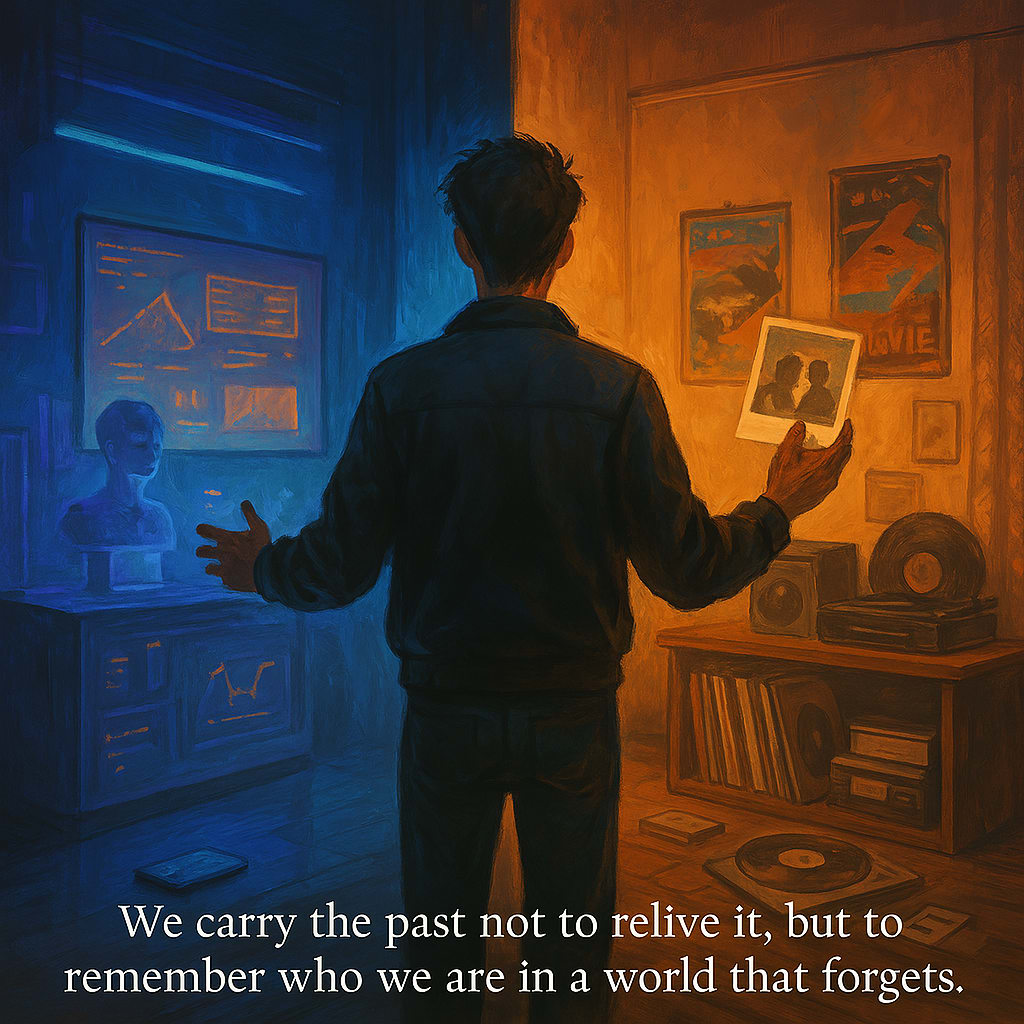
"Nostalgia is a file that removes the rough edges from the good old days."
— Doug Larson
We live in a paradox. Every day, we wake up in a world that is accelerating forward—technologically, socially, and even existentially. We have artificial intelligence completing sentences, space tourism in development, and near-daily breakthroughs in science. Yet, amidst all this futuristic noise, our cultural compass points backwards.
We wear vintage clothes. We listen to vinyl. We binge-watch shows about the '80s and '90s while scrolling through apps designed this year. The past has become not only a safe place but a stylish one. But why are we so obsessed with looking back when everything around us screams “future”?
This isn’t just a trend—it’s a symptom. And nostalgia is the lens through which we need to examine it.
What Exactly Is Nostalgia?
Originally coined in the 17th century, nostalgia was once considered a neurological disease—a form of melancholic homesickness that afflicted soldiers and students who had left home. Today, it's far more romanticized, often described as a warm, fuzzy emotion.
But nostalgia isn’t just about “missing the good old days.” It’s about reconstructing the past into something emotionally coherent. It’s a survival tool—a psychological defense mechanism that gives us continuity in a rapidly changing world.
Neuroscientific research shows that nostalgia activates areas of the brain linked to emotion, memory, and reward. In other words, remembering feels good—sometimes even better than living in the present.
The Modern Condition: Anxious, Overstimulated, and Rootless
Modern life is fragmented. We’re always online, always comparing, always updating. There’s a certain irony in how digital overload has pushed us toward analog comfort. Polaroid cameras, hand-written journals, floppy disks sold as ironic accessories—none of these make sense in a practical way. But emotionally? They’re gold.
Our obsession with the past is a rebellion against the coldness of the present. It’s a way of anchoring ourselves when everything feels up for grabs.
Consider how the 2020s have unfolded so far: pandemics, climate crises, economic instability, war. Nostalgia becomes an emotional sedative—a way to mute the existential noise.
Cultural Time Travel: How Media Keeps Us Stuck in Loops
Hollywood is arguably the clearest example of the nostalgia loop. Think about the endless remakes, sequels, reboots, and spin-offs. It’s not just a lack of originality—it’s market psychology. Studios know that familiarity sells. Audiences aren’t necessarily demanding new stories; they’re demanding comfort.
Music follows the same pattern. Gen Z is listening to cassette tapes. Artists release albums that mimic lo-fi aesthetics from the ‘90s. Even our TikTok trends sample audio clips from decades ago.
The result? A strange cultural stasis. The future looks like the past, dressed up in modern filters.
The Neuroscience of Nostalgia: More Than Just Memories
So, what happens in the brain when we experience nostalgia?
Neuroscientists have found that nostalgic memories often involve autobiographical recall—the kind of memory that reinforces our identity. When you remember a birthday party from your childhood or a road trip with friends, you're not just recalling facts—you're reinforcing who you are.
Nostalgia also triggers the dopaminergic system—the same system that activates when we fall in love or eat chocolate. It feels safe, rewarding, and emotionally grounding.
But there’s a twist: nostalgia can also be selective and unreliable. The brain tends to smooth over the rough edges. What we remember isn’t the past itself, but a story about the past—a curated, emotionalized narrative.
Nostalgia as Resistance: The Re-Enchantment of the Everyday
There's something subversive about nostalgia, too. In a world governed by efficiency, productivity, and surveillance, choosing to engage with slow, analog, or “outdated” things is a kind of soft rebellion.
To write with a fountain pen instead of a laptop.
To listen to jazz on vinyl instead of Spotify's algorithm.
To watch a silent film instead of a CGI blockbuster.
These aren’t just aesthetic choices—they’re existential ones. They are acts of re-enchantment, where we seek to restore meaning in a world that often feels drained of it.
The Danger of Idealizing the Past
However, nostalgia is not without its pitfalls.
Historical nostalgia can be politically dangerous. Entire ideologies are built on mythologizing “better times.” When leaders evoke the past as a justification for the present (“Make X Great Again”), they’re not promoting memory—they’re promoting amnesia. A filtered version of history that excludes pain, struggle, and injustice.
On a personal level, too much nostalgia can result in psychological stagnation. If we’re always looking back, we stop creating new experiences. We become passive spectators of a life that’s no longer happening.
Memory as a Creative Act
Here’s the thing: memory is not a filing cabinet. It’s a canvas. Every time we remember something, we alter it slightly—like a painter adding new brushstrokes to an old portrait.
This means that nostalgia, while rooted in the past, is always a commentary on the present. We remember not just because we lived it, but because we need to remember it now. Nostalgia becomes a form of emotional storytelling, shaped by our current fears, desires, and longings.
So instead of asking, “Was it really better back then?” maybe the better question is: “What am I missing now that I think I had then?”
The Past as a Mirror, Not a Cage
Nostalgia, at its best, isn’t about escape—it’s about perspective. It reminds us of who we were so we can navigate who we are. It shows us the values, relationships, and moments that shaped us, not to trap us there, but to guide us forward.
Like all mirrors, it depends on how you use it. Stare too long and you lose touch with reality. But glance thoughtfully, and it may reflect a truth you’ve forgotten.
Final Thoughts: Making Peace with Time
In a culture obsessed with speed and progress, perhaps nostalgia is our secret plea to slow down. It’s a way of saying: “I’ve been here before. I remember what mattered. I’m trying to find my way.”
We cannot live in the past. But we also can’t live well without it. The challenge, then, is not to resist nostalgia, but to engage with it wisely. To let it enrich, not erase. To let it inform, not control.
Because the past is not a place to return to—
It’s a compass to carry forward.
About the Creator
Ahmet Kıvanç Demirkıran
As a technology and innovation enthusiast, I aim to bring fresh perspectives to my readers, drawing from my experience.
Keep reading
More stories from Ahmet Kıvanç Demirkıran and writers in Psyche and other communities.
Title: The Psychology of Belonging
We live in an era that glorifies the individual. "Be yourself," they say. "You don't need anyone." We champion the self-made entrepreneur, the solitary genius, the fiercely independent thinker. And yet, beneath the glossy Instagram quotes and TED talks about self-reliance, a quieter truth persists—humans desperately need to belong. Not just to survive, but to feel whole.
By Ahmet Kıvanç Demirkıran10 months ago in Psyche
When Saying “No” Feels Strange
He did not plan to smoke that day. He was standing outside his school gate, bag on his back, waiting for the van. A boy from his class took out a vape. Another smiled and asked him to try. He refused at first. Everyone laughed, not loudly, not cruelly just enough to make him feel small.
By Muhammad Ayaan about 17 hours ago in Psyche


Comments (2)
very best story
Fab story I tried to like it also but when I press the heart nothing happens ♦️♦️♦️