
The Dark Side of Overthinking: How It Destroys Happiness
Unmasking the Silent Mental Trap That Steals Your Peace
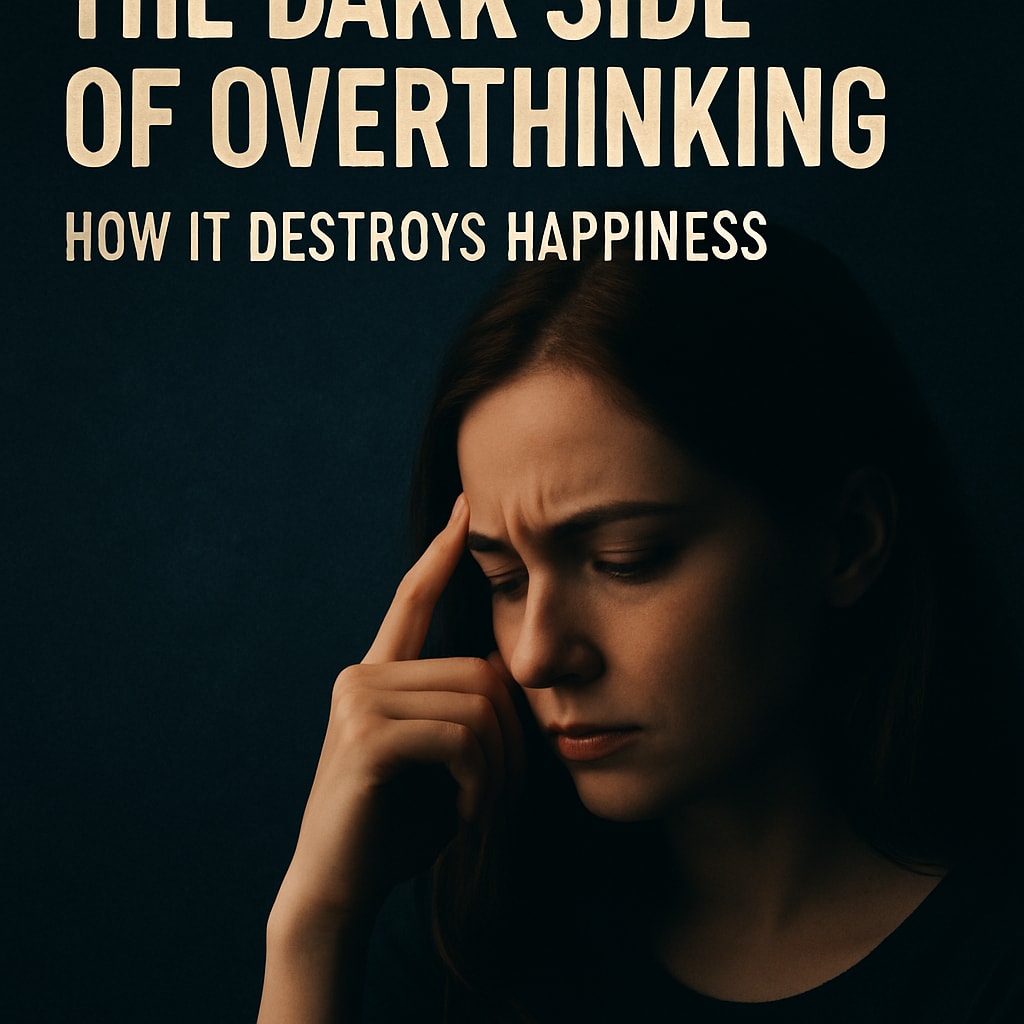
We’ve all been there—lying in bed, staring at the ceiling, replaying that one conversation from earlier, wondering if we said something wrong. Or obsessing over a decision we made, doubting ourselves even when the facts say we’re fine. This is overthinking, a mental habit that quietly creeps into our lives, often disguised as caution or carefulness. But while being thoughtful is good, overthinking is not the same as thinking clearly. It’s a destructive loop that can sabotage our peace, confidence, and most dangerously—our happiness.
What Is Overthinking?
Overthinking means dwelling excessively on your thoughts, problems, past mistakes, or potential outcomes. Unlike healthy reflection, which involves learning and problem-solving, overthinking traps you in endless loops of “what ifs,” “should haves,” and worst-case scenarios.
There are two main types of overthinking:
1. Ruminating – Reliving the past and beating yourself up over what you did or didn’t do.
2. Worrying – Fearing what might happen in the future, often with no solid basis.
While both seem harmless on the surface, they can cause real emotional and mental damage if left unchecked.
---
How Overthinking Destroys Happiness
1. It Amplifies Stress and Anxiety
When you constantly analyze every situation, your brain stays in a state of alertness. You start imagining problems that don’t exist and inflate the importance of small issues. This leads to chronic stress and anxiety, making you feel mentally exhausted even if you haven’t done anything physically demanding.
Over time, overthinking conditions your brain to respond to normal situations with panic, fear, and hesitation—robbing you of inner peace.
2. It Traps You in the Past or Future
Happiness lives in the present moment. But overthinkers rarely live in the now. They either replay the past, wishing they’d done something differently, or fear the future, assuming the worst. This mental time-travel means you miss out on real joy—whether it's a family dinner, a walk in the park, or a quiet evening.
Your body may be present, but your mind is somewhere else. And that’s how happiness slips away unnoticed.
3. It Erodes Self-Confidence
Overthinking makes you second-guess yourself constantly. “Did I sound stupid?” “Should I have said that?” “Am I even good enough for this?” These doubts can become a daily internal monologue, slowly killing your self-esteem.
When you don’t trust your own decisions, you begin to hesitate, avoid challenges, and even fear success. This creates a life full of missed opportunities and regret.
4. It Paralyzes Decision-Making
Ironically, the more you think, the harder it gets to make decisions. Overthinkers analyze every outcome, obsess over potential consequences, and fear making the wrong choice. This leads to decision paralysis, where you do nothing at all.
Life is a series of choices. When you’re stuck in limbo, you’re not moving forward—which is the opposite of growth, satisfaction, and happiness.
---
The Physical Effects of Overthinking
Many people don't realize that overthinking also affects the body. The mind-body connection is powerful, and when your thoughts are in chaos, your body responds:
Poor sleep from racing thoughts at night
Headaches or muscle tension from mental stress
Digestive issues due to anxiety
Weakened immune system from chronic cortisol release
Happiness isn't just emotional—it's physical too. And overthinking takes a toll on both.
---
Why Do We Overthink?
There’s no single reason, but several common factors include:
Fear of failure or rejection
Childhood conditioning (e.g., overly critical environments)
Perfectionism
Past trauma or unresolved guilt
Low self-worth
Overthinking is often a misguided attempt to stay safe or avoid mistakes. But instead of protecting us, it isolates us from joy and genuine living.
---
How to Break the Overthinking Habit
Thankfully, overthinking isn’t permanent. Like any habit, it can be unlearned and replaced with healthier thinking patterns. Here are some effective strategies:
1. Practice Mindfulness
Mindfulness means being present—right here, right now. You can train your mind to stay grounded by focusing on your breath, your senses, or what you're doing. Meditation, yoga, or even mindful walking can bring your attention away from stressful thoughts and into the peace of the moment.
2. Set Time Limits for Thinking
Give yourself a time limit (e.g., 10 minutes) to reflect on a problem. Once that time is up, take action or let it go. This prevents you from spiraling into endless thought loops.
3. Challenge Negative Thoughts
Ask yourself:
Is this thought based on facts or fear?
Is there a more positive or realistic way to see this?
Will this matter a year from now?
This helps weaken irrational beliefs and trains your brain to focus on solutions rather than worry.
4. Distract Yourself with Purposeful Activity
Sometimes the best way to stop overthinking is to do something else. Engage in a hobby, read a book, go for a walk, or help someone. Shifting your focus gives your mind a break and often brings clarity.
5. Talk to Someone
Whether it's a friend or a therapist, talking things out can help organize your thoughts and provide a new perspective. You’re not alone, and sometimes just expressing your worries out loud helps deflate their power.
---
Final Thoughts
Overthinking may feel like being responsible or careful, but in reality, it’s a silent happiness killer. It magnifies your fears, distorts reality, and keeps you stuck in a cycle of worry and regret.
Breaking free starts with awareness. Once you recognize the pattern, you can begin to change it—step by step. You deserve peace, clarity, and joy—not a mind that’s always at war with itself.
Let go of the illusion that thinking more always helps. Sometimes, the real wisdom lies in thinking less—and living more.
About the Creator
Senan Khan
Passionate storyteller turning ideas into impactful words.
From thought-provoking articles to creative narratives, I bring stories to life.
Driven by curiosity, inspired by everyday wonders.
Let’s explore, Express one story at a time
Keep reading
More stories from Senan Khan and writers in Psyche and other communities.
Evolving Within: The Art of Growing Through Life's Challenges
Life is not a smooth highway; it’s a winding, unpredictable journey filled with turns, bumps, and crossroads. Everyone faces challenges—some expected, others not. But what distinguishes those who merely survive from those who thrive is the ability to evolve from within. Self-growth is not just a personal development buzzword—it’s a lifelong process that enables us to respond to adversity with strength, wisdom, and grace.
By Senan Khan9 months ago in Motivation
What exactly is Alzheimer's disease?
Alzheimer’s disease (AD) was a disputatious topic since long time ago which some researchers such as Jay W. Pettegrew, Matcheri S. Keshavan, Nancy J. Minshew and so forth who put forward the statement of AD was origin by nature factors while some researchers such as Krysten K. Fulcher, Michael L. Alosco, Lindsay Miller and etcetera propose that AD was cause by nurture factors. Even though there are more than 70 diseases that lead to dementia, AD is the most serious compare to the other disease and accounts for 50-70% of dementia (Akter, Rani, Nordin, Rahman, Aznan & Rathor, 2012). The characteristics of AD which involve the patients in numerous areas has become a medical and social challenge for nowadays society, follow with the need for diversity of professional development in fulfilling the need of patients and their caregivers (Cobos & Rodríguez, 2012). AD is considered as multifactorial disease, with no single cause known, and some modifiable and non-modifiable risk elements are connected with the development and progression of AD (Korolev, 2014). As there was a finding which the prevalence, incidence of AD, brain structure and function were vary by the sex and gender as well (Mielke, Vemuri & Rocca, 2014).
By Ng Teck Senabout 15 hours ago in Psyche
Thoughts on Vocal and the way the world is
"Death cannot stop true love, only delay it." – Wesley in The Princess Bride. I decided to come back to Vocal on a very cold and dark night at the end of December. I had been, and still am, convalescing from a horrible staph infection that had gone misdiagnosed for months. This, paired with the increasing challenges of being healthy, making the best choices for my co-parented child, being a wife, and being a director at a new job, was a lot to manage.
By Jazzy 4 days ago in Confessions


Comments
There are no comments for this story
Be the first to respond and start the conversation.