treatments
The past, present and future of psychiatric diagnosis and beliefs about treatment in every culture and pocket of society.
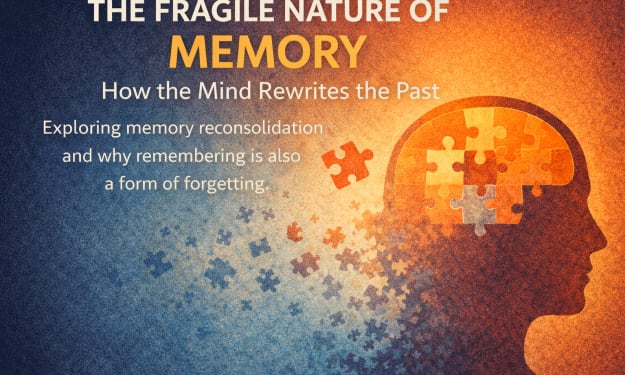
The Fragile Nature of Memory: How the Mind Rewrites the Past
We often view memory as a recording device. Something happens, and the brain stores it. Later, we recall it unchanged, like opening a file. Psychology presents a different picture. Memory is not fixed; it is fluid, reconstructive, and surprisingly fragile. One interesting aspect of cognitive psychology is memory reconsolidation, which is the process that alters our memories every time we recall them. This instability is not a flaw; it shows how our minds adapt, protect themselves, and reshape our identity over time.
By Kyle Butler24 days ago in Psyche
When Thinking Feels Like Action
There is a particular satisfaction that comes from understanding something clearly after wrestling with it for a long time. The mind settles. Tension releases. Pieces line up. In that moment, it can feel as though real movement has occurred, as though something meaningful has been accomplished. That feeling is not imagined. Cognitive resolution is a real event. The danger appears when that internal resolution is quietly mistaken for external change, and thinking begins to substitute for action rather than prepare the way for it.
By Peter Thwing - Host of the FST Podcast24 days ago in Psyche
Am I unwell? or, is the Australian Mental Health System?. Content Warning.
Content Warning: The following article discusses suicide and may be triggering for some readers. If you, or someone you know is in danger or needs support, please call 000 or a crisis helpline such as Lifeline on 13 11 14 immediately. More information on support can be found at Lifeline’s website: https://www.lifeline.org.au/
By Rowan Huxley26 days ago in Psyche
Watch Out Wednesdays - 2/4/26 (Opinion)
We are smack dab into the first week of February! I hope that everyone is preparing to watch Super Bowl LX (60) on Sunday between the Seattle Seahawks and the New England Patriots. This game will definitely be decided in the fourth quarter.
By Adrian Holman27 days ago in Psyche
Homework Assignment - Right, Wrong, or Grey-zone?
So my autism therapist gave me some homework for a new form (to me at least) of therapy. It is an Internal Family Systems parts mapping exercise and I have no idea if I am doing it correctly or not, but I just wanted to write about my experience... *smile*
By The Schizophrenic Mom28 days ago in Psyche
A Headache, New Medication, and a Happy Outcome
As of Saturday, I had a headache. Again. Or maybe still? I had a new prescription that was finally approved that I was really hoping would help with my headache, but was a headache to be approved for in and of itself. The paperwork had been delayed by a week. The paperwork had been completed - and then rejected because one item wasn't "clearly" marked.
By The Schizophrenic Momabout a month ago in Psyche
Pancreatic Cancer Cure: Truth, Hope, and Hard Questions
When people search for a pancreatic cancer cure, they are rarely just browsing. They are often scared, awake late at night, reading quietly while the house sleeps. This disease carries a heavy reputation, and the words around it feel sharp and final. But the full picture is more complex than the fear suggests. Outcomes are changing. Treatments are improving. Some patients do reach long-term survival, and in certain cases, doctors can remove the disease completely. Hope exists, but it lives beside realism, not fantasy. This article explains what a pancreatic cancer cure really means today, how treatment works, when cure is possible, and why research still matters deeply. Clear information does not remove fear, but it replaces confusion with understanding.
By Muqadas khanabout a month ago in Psyche