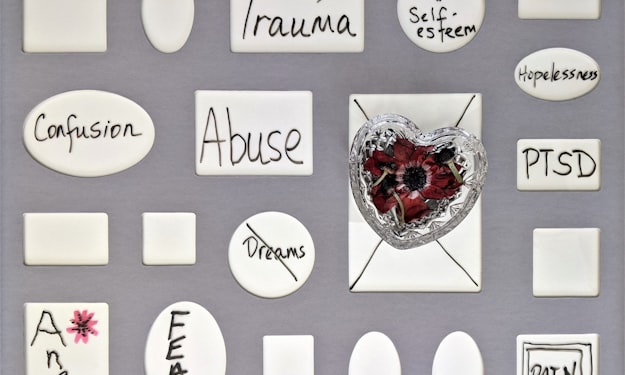
trauma
At its core, trauma can be thought of as the psychological wounds that persist, even when the physical ones are long gone.
The Gloomy House
My eyes feel a cool breeze as my best friend removes her moist, sticky hands from my face. I slowly open one eye, and as my top eyelashes are slowly separating from my bottom, I see what looks like an icy blue box. I quickly opened the other eye, and there lay the most beautiful box in the world. The box is so blue that it would become one with the Caribbean sea. On top of the box, there was a bow that was so silky and like milk, it was almost tempting to eat.
By Belle Luis4 years ago in Psyche
The Candle By The Window
“The cabin in the woods had been abandoned for years, but one night, a candle burned in the window. The air and night were brumous as darkness quickly approached the night sky, like a barren woman, desolate from stars. All that painted the canvas of the night sky was a full moon shared with a vague glimpse of the flickering of light from its candle. My feet began walking, steadily but slowly about, and like an autonomic response, I made my way towards the cabin. I wasn’t sure what had come over me; nonetheless, I felt compelled to know more. Instantly, I feel my body tighten, paralyzed with horror, as my next step forward revealed the encounter between my shoe and that of a suspicious sound. My eyes look beneath me and my hands retrieve a letter. I quiver and with shaking hands, I bring the letter within close proximity. The letter was typed on card stock like paper and my fear arose as I pondered, “Why hasn’t this letter been touched by midnight’s snow?” Working up the courage, my tongue utters as I read aloud, “ Purgatory is the hardest riddle of them all.” With no time to reflect on the meaning behind the cryptic message I hold within my hands, a sudden gust of wind causes the letter to fall away from me and as my eyes slowly make their way up, I catch a quick glance of an elapsing silhouette, making its way towards the cabin, but just like smoke, it fades. If ever a time to turn back, it was now. But instead, I wince at memories I wish I could forget, consequently, my mind becomes flooded of times when I coward down in the face of school bullies. “Not this time,” I affirmably but softly whisper to myself... “No waving of the white flag here!” I nod my head in determinacy, and with a deep breath, I bend down in hopes of retrieving the letter. Though I’m convinced the message is the same, my vision now deceives me, for each time my mind attempts to transcribe the words contained within this letter, I find that I’m as blind as a bat! A wave of nausea crashes over me, the cabin that stands before me is now distorted as my world goes vertigo. And just like that, my world turns black, and there I lay, unconscious deep in the woods.
By Taylor Zak4 years ago in Psyche
7 years ago I nearly died
It had been a full week with my ex, my birthday and we got engaged. Heading home after a great week we hit the central reservation, bounced across a dual carriageway and hit a crash barrier at around 70 mph. We ended up sitting sideways across the busy road with the airbags deployed in front of us. My ex looking through the smashed window at the traffic braking suddenly .
By ASHLEY SMITH4 years ago in Psyche
A Letter to My Dad
Dear Dad, It has been almost forty years since you stepped out of my life in the most cliché-ridden manner possible. Not just a bad heart that attacked you; not just on the day that you were to be released from hospital; not just when all the signs were good for you and your health. It was the day itself that stays with me.
By Kendall Defoe 4 years ago in Psyche
Emotional Abuse
What Is Emotional Abuse? When most people think of emotional abuse, they usually think of one or both partners belittling or criticizing the other. But emotional abuse is much more than verbal abuse. Emotional abuse can be defined as any nonphysical behavior that is designed to control,intimidate, subjugate, demean, punish, or isolate another person through the use of degradation, humiliation, or fear. Emotionally abusive behavior ranges from verbal abuse (belittling, berating, constant criticism) to more subtle tactics like intimidation, manipulation, and refusal to be pleased. Here are some examples of emotional abuse in intimate relationships: • Humiliation and degradation • Discounting and negating • Domination and control • Judging and criticizing • Accusing and blaming • Trivial and unreasonable demands or expectations • Emotional distancing and the “silent treatment” • Isolation Emotional abuse can also include more subtle forms of behavior such as: • Withholding of attention or affection • Disapproving, dismissive, contemptuous, or condescending looks, comments, and behavior • Sulking and pouting • Projection and/or accusations • Subtle threats of abandonment (either physical or emotional). Emotional abuse is not only made up of negative behaviors but negative attitudes as well. Therefore, we need to include the word attitude in our definition of emotional abuse. A person who is emotionally abusive need not take any overt action whatsoever. All he or she needs to do is to exhibit an abusive attitude. Here are some examples: Believing that others should do as you say Not noticing how others feel Not caring how others feel Believing that everyone else is inferior to you Believing that you are always right So emotional abuse is any non physical behavior or attitude that is designed to control, intimidate, subjugate, demean, punish, or isolate another person. But there are also some types of physical behavior that can be considered emotional abuse. These behaviors have a name: symbolic violence. This includes intimidating behavior such as slamming doors, kicking a wall, throwing dishes, furniture, or other objects, driving recklessly while the victim is in the car, and destroying or threatening to destroy objects the victim values. Even milder forms of violence such as shaking a fist or finger at the victim, making threatening gestures or faces, or acting like he or she wants to kill the victim carry symbolic threats of violence.
By Obajuwon Israel4 years ago in Psyche
Introduction To PTSD
Post-traumatic stress disorder or PTSD is a condition that results from a terrifying event, either witnessed or experienced firsthand. As it was thought only to affect people in the militaryit has in the past been called Combat Disorder. Symptoms can include anxiety, depression, nightmares, flashbacks and irrational or uncontrollable thoughts of the event. It is important to note that some people who go through a terrifying event may only have a temporary time with difficulties with coping. Through a support network and good self-care they may shake off the event. However if the symptoms worsen or do not get better and last months to even years, it is likely to develop into PTSD. PTSD in most cases affects a person’s day-to-day functioning. Here is a look at common behaviours associated with it.
By Sid Aaron Hirji4 years ago in Psyche
Helicopter Parents
It is a natural phenomena for parents to be very invested and interested in their child’s activities. However some parents may seem overly paranoid and be toxic to their children. With parenthood comes such a huge responsibility that parents may start feeling inadequate. They may then overcompensate for these inadequacies by being helicopter parents. While all parents should take interest in their children, it should never come to the point where they take control of the child and live their own dreams through the child. As we should all understand, our parents suffered traumas from their parents and likewise their parents may have suffered as well. In short trauma bleeds through generations. This is a look at the toxic things helicopter parents put their children through.
By Sid Aaron Hirji4 years ago in Psyche