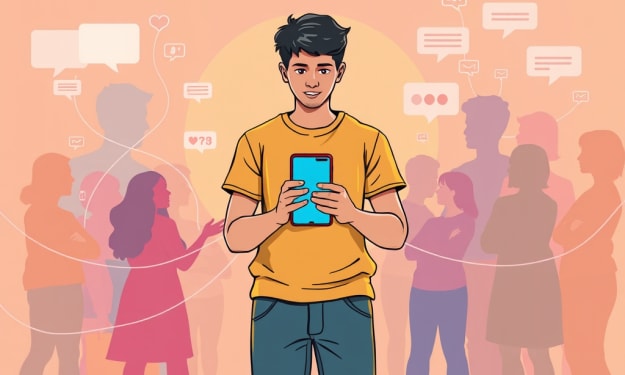
social media
Social media dramatically impacts our offline lives and mental well-being; examine its benefits, risks and controversies through scientific studies, real-life anecdotes and more.
Algorithmic Social Media and the Restructuring of Early Adult Development
Early adulthood, typically defined as ages 18–29, is a critical developmental period characterized by identity exploration, instability, and the gradual assumption of adult social roles (Arnett, 2000). During this stage, individuals form enduring self-concepts, evaluate progress across educational, occupational, and relational domains, and calibrate expectations about what constitutes a “normal” life trajectory. Historically, these processes unfolded within geographically and socially bounded environments. Over the past decade, however, smartphones and social media platforms have become dominant social contexts, fundamentally reshaping how young adults encounter social information.
By Whitman Drake10 days ago in Psyche
How Social Media Is Shaping Teen Mental Health in the Digital Age
Social media has become a defining part of modern adolescence. For today’s teenagers, platforms are not just tools for entertainment—they are social arenas, identity-building spaces, and information hubs.
By Stories Today12 days ago in Psyche
When Thinking Feels Like Action
There is a particular satisfaction that comes from understanding something clearly after wrestling with it for a long time. The mind settles. Tension releases. Pieces line up. In that moment, it can feel as though real movement has occurred, as though something meaningful has been accomplished. That feeling is not imagined. Cognitive resolution is a real event. The danger appears when that internal resolution is quietly mistaken for external change, and thinking begins to substitute for action rather than prepare the way for it.
By Peter Thwing - Host of the FST Podcast20 days ago in Psyche