humanity
Mental health is a fundamental right; the future of humanity depends on it.
Lily’s patterns
Once upon a time in a quaint little village, there lived a young woman named Lily. She had always been fascinated by the mysteries of life and the universe. Her curious mind often led her to ponder the concept of synchronicity - the idea that events could be meaningfully connected beyond mere coincidence.
By Emeka Aloy2 years ago in Psyche
The Illusion of Past and Future: Embracing the Eternal Now.
Time, the elusive and intangible concept that governs our lives, has fascinated humanity for millennia. The past, with its memories, lessons, and regrets, and the future, with its dreams, aspirations, and uncertainties, seem to dictate our actions and emotions. However, when we delve deeper into the nature of time and the human experience, we come to realize that both the past and the future are mere illusions, and the only reality is the eternal present or the "now."
By Armando Rios2 years ago in Psyche
11 Fascinating Facts About How People Think and Act
Introduction: Have you ever wondered why we act the way we do? Our minds are incredible, and they shape everything we think and feel. Let's explore some exciting facts that reveal the wonders of human behavior and thought process. These facts will not only inspire you but also tug at your heartstrings.
By santhos kumar veldhanda2 years ago in Psyche
Stop Projecting
I have been wanting to address this topic for the longest. Projection. It’s such a poisonous phenomenon in our society today. Projection can ruin a lot of friendships and relationships. I did not realize that most people were projecting onto me until I became a lot more socially aware.
By Chrysantheum 2 years ago in Psyche
Mental Health System Vs. Clairvoyance and Sexuality
There are many prejudices in this world. This affects the lives of everyday people constantly. I spent 15 years under the mental health services after being sectioned via a court at the age of 18. I was born with a form of Autism. I was only diagnosed at 16 with Asperger Syndrome after my father had to get the MP involved due to CAMHS assuming that I was probably on the spectrum without providing an official diagnosis. I had to obtain a diagnosis from a forensic team after the police kept getting involved for my behaviour issues relating to my undiagnosed Autism. I have just managed to get out of the mental health system after requesting to come off the section 117 aftercare. I wasn’t provided with any services for the past 7 years therefore the council agreed to end the section after 15 years. I want to go into how I may have got myself into the system by accident alongside the behaviours associated with my Autism. I was labelled a criminal due to a stupid attempt at trying to get revenge on someone who had rejected me when I was a teenager. I tried to get a tutor from college arrested for carrying a bomb when another student had told me that she was due to go on holiday that day. I emailed the airport saying that I had information that a passenger was carrying a bomb. Luckily, the court downgraded my charge to providing false information. I also got charged with Harassment a few times for how school had encouraged me to communicate as a child. I was told to write things down if I couldn’t talk to the teachers in circumstances where I was being bullied etc.
By Emma-Lucy Thomson2 years ago in Psyche
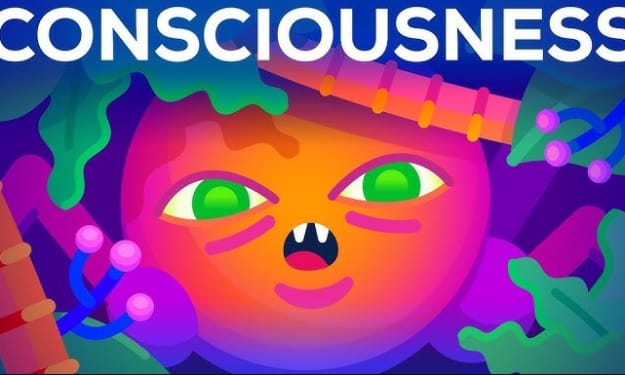
How Unconscious Things Became Aware: The Origin of Consciousness
Perhaps the biggest mystery in nature is consciousness. When reduced to its purest form, consciousness is what enables us to be aware of both our external environment and our inner condition. However, contemplating consciousness tends to lead us in circles. Intuitively, we are all aware of what consciousness is. This is it. You are currently going through it here. But as soon as we attempt to nail it down, we find ourselves grasping at air. We're not the only ones who struggle to define consciousness; scientists and philosophers do too. Thoughts and schools compete with each other, but none has figured it out yet. Realizing that we don't know what causes us to be conscious of ourselves as well as the outside world is disconcerting. Even though they are not the same, intelligence and awareness are likewise associated in this hazy area. In later videos, we'll go into more detail about theories of consciousness and intelligence. Our mind presumably evolved from less complicated forms as a result of natural selection, much like many other aspects of what makes us human. It most likely came into existence over a long succession of micro-steps that lasted for more than 100 million years and combined to form a kind of gradient of consciousness. What was the initial step on this journey from non-awareness to fundamental consciousness, which eventually evolved into the complex consciousness we experience as humans today? [Intro] Pick up a stone. The general opinion is that a stone is not thinking. But even on this, not everyone agrees. Some panpsychists assert that a piece of rock might have a soul. However, as stones never exhibit behavior, there are no actual justifications for any such claim. It is impossible to confirm or refute their inner lives. Starting with live things is a more frequent starting point. An element of the world known as a living creature or a self maintains itself and produces more of its kind. It needs energy for this. So this is where having a global perspective is useful. The primary purpose of consciousness was likely to guide a mobile self in need of nourishment to a fresh source. You do not require to be conscious to find food on the lower scales of existence. One of the most basic mammals, Trichopax adhaerens, wanders around aimlessly. When there is food nearby, it slows down, and when there isn't, it speeds up. This is successful and causes the little creature to spend greater amounts of time where there is food than where there isn't. However, it never advances in a specific direction toward a specific destination, and it is not required to be aware of its surroundings. Mobile self likely took their first significant step towards consciousness when they began to move in a particular direction. Moving away from what was less desirable, such as someone else who believed they were food, and towards what was better for them, such as food. Consider Dugesia tigrina, a tiny worm distinguished by a comical visage. The worm may or may not be hungry at any one time. This implies that when the worm self moves, it is not only responding automatically to external stimuli; rather, the worm self's movements are determined by its internal, physiological condition, such as whether it is hungry or full. The worm is less active after being eaten, but after going without food for a period, it will crawl toward appetizing objects. It navigates its environment by using chemoreceptors on its head to detect the fragrance of food and point it in that direction. When our worm friend finds and consumes a meal, it returns to a dark, protected area to safely digest it until it becomes hungry again. However, animals who follow their sense of smell irrationally don't have a clear goal in mind. They are still clueless as to where they are going. The addition of distant perception like vision is the next rung on the ladder of awareness. Vision gives our world more context and richness. Vision gives us a feeling of the environment in which we and our food are located. It greatly expands awareness and moves consciousness closer to more common consciousness. We can visualize and focus on our objective with the use of an optical device, like an eye. A self can only pursue its food while it is visible, even at this stage. The logical next step must therefore take place internally. For instance, a self must construct some kind of internal model of the outside world to visualize food absent from it. An animal can now keep searching for food even after leaving its sensory range. It can keep its attention on its food and its hunger for it because of its internal picture of what is important in the outside environment. Now that it exists, we can settle into this new environment. The memory capacity has developed. Animals can be briefly diverted from the pursuit due to memory, but they swiftly resume their course afterward. 'Object persistence' is a related phenomenon. This expresses our understanding that things exist even when we are unable to see them. Some mammals, birds, and maybe other species enjoy using this cognitive ability. Baby chickens begin to demonstrate this skill within a day or two of birth, but human infants often begin to do so around the time they are eight months old. The ability to recall something while it is not there shows at least a fundamental understanding of time. On the path to consciousness, having a sense of time is a significant step. It could also provide someone the ability to look ahead from the present and anticipate the future. Adult chickens, for instance, might avoid being served food if they believe they will eventually be rewarded with a larger meal. Even for mature humans, this type of delayed gratification requires the ability to picture a reward that won't materialize for some time. Western scrub jays are masters of postponed pleasure. When they bury food in a cache to collect it later, they exhibit an even more sophisticated sense of the future. If the scrub jays suspect a possible burglar has been monitoring them, they may even rehide their food. This implies that they are aware of other hungry selves who are conscious and have a unique view of the world. Scrub jays are cunning birds that can almost read the thoughts of other birds. Deeper levels of consciousness need to be able to read minds. You may outsmart a wealthy rival or relate to a hungry friend by placing yourself in their shoes. Language allows us to portray what is missing and read minds at a whole different level. We may create elaborate plans and theories about the world using words, and we can share those plans with others. We'll be thinking more about our awareness in upcoming videos, as well as about who we are, where we fit in the cosmos, and other things thanks to words. So where does our consciousness come from? It presumably started as a hungry person moving deliberately in the direction of a food source. With the advantages for survival, this gave it an advantage over rivals who moved randomly or not at all. It all most likely began with the need for more food. Because of this, it is not strange that humans are constantly worrying about where we will acquire our next food despite having a complex mind that enables us to fantasize about space, construct skyscrapers, or get obsessed with books. We have collectively invested so much thought and creativity into obtaining food that we can now do it with minimal conscious effort.
By Ian Sankan2 years ago in Psyche
Love is Cooperation Rather Than Competition
Love, the profound emotion that has transcended the boundaries of time, culture, and generations, is a force that shapes human connections and enriches our lives. Traditionally, love has often been depicted as a competitive pursuit, where individuals vie for affection and attention. However, a closer examination reveals that love is fundamentally rooted in cooperation rather than competition. Love thrives on unity, selflessness, and empathy, fostering harmonious relationships and nurturing the well-being of all involved. This essay explores the idea that love's essence lies in cooperation, emphasizing its transformative power to build stronger bonds and create a more compassionate and understanding world.
By Armando Rios2 years ago in Psyche
5+ Phrases That Make You Sound Unprofessional (or Naive). Content Warning.
I need this to be perfect if you repeat this phrase too often it can make you sound like you’re not smart or grounded enough, those who expect perfection set themselves up for failure intelligent people prefer completing tasks step by step and watching what they can improve on the way they don’t impose unrealistic expectations on themselves and others and avoid manipulating and demanding tone it’s not fair using this phrase in conversations with your colleagues and friends you risk making an impression of a naive person everyone around knows that life is unfair.
By Muhammad Asim2 years ago in Psyche
The Human Boundaries: Unraveling the Limitations on the Path to Superhuman Abilities
The concept of becoming a "superhuman" typically refers to achieving extraordinary abilities or capabilities beyond the norm. While, we, humans possess remarkable potential, several factors limit individuals from becoming true superhumans:
By Armando Rios2 years ago in Psyche
"Technological Leap: Unlocking the Mysteries of Dreams"
The enigma of dreams has captivated humanity for millennia, leading us down a fascinating path of psychological exploration and introspection. However, it is the technological advancements of recent decades that have truly amplified our understanding of this nocturnal phenomenon.
By Aida Josephine2 years ago in Psyche