
Run Forrest, run!
Attachment, coping and the interplay of Fate and Free will in one of modern cinema’s classics.


The other day, I finally watched “Forrest Gump” , and noticed a theme that, to my knowledge, isn’t part of the mainstream conversation about this film - namely the developmental psychology thread running through the storyline and shaping the lives of the main characters.
As the story goes, the protagonist, Forrest, had a loving and devoted mother who truly believed in him. And so despite his disabilities - both physical and mental, he achieved a remarkable success on a national level. Quite literally, against all odds. Even the substantial bullying he endured during his developmental years didn’t seem to leave lasting scars, likely because his primary attachment figure, his mother, was consistently available and supportive.
His heart also remained open to love, even though his childhood sweetheart was emotionally unavailable.
Enter Jenny - a very beautiful and brilliant girl; a motherless child, sexually abused by her father, who has spent a great deal of her short life partying, taking drugs, jumping from one abusive relationship to another, and flirting with death.
Sweet friendship with innocent Forrest was the only consistency in her life. Perhaps it was even true love, which she didn’t feel worthy of for the most part, due to her history.
While the film may not have been made with modern awareness of attachment theory, the contrast communicated on the screen hits the nail on the head.
In psychology, ‘attachment’ refers to the way our earliest relationships shape how safe, loved, and worthy we feel later in life.
Of course none of this means that one’s childhood is a life sentence, and in this day and age we certainly have more modalities than ever to gradually work through developmental trauma. However, its profound impact on all aspects of one’s life cannot be underestimated - a truth that was largely ignored in the society back in the day when this film was made, which makes this observation even more interesting.
Now let’s look at how one of the central features of the film - namely Forrest’s running plays into this. According to the popular culture, running in this case symbolises freedom, resilience, and the act of moving through life without needing to know the destination.
All of this is valid of course, but I feel there is more.
“Run, Forrest, run” - an inspirational phrase originally delivered by Jenny, to empower Forrest to run away from his childhood bullies, and to miraculously overcome his physical disability. As an adult, running made him an athlete, saved lives during the Vietnam war, helped him cope with Jenny abandoning him after their intimacy, and elevated him to a national celebrity status.
I think this communicates few things. Running is his safety net and a comfort zone in a world that can be very cruel and confusing. It is closely linked to his love Jenny, and her caring side, even when her later behaviour majorly contradicts it. Still, his running gift was born out of their connection, and so emotionally it ties him to her.
Ultimately, running is his coping mechanism for all kinds of situations, and it is no doubt a very healthy one, in a stark contrast to the self-destructive escapism patterns of Jenny. It is tragically ironic that while Jenny helped him to discover his gift, one that saved him countless times, she couldn’t do the same for herself due to her developmental deficits. And the well intentioned Forrest could only do so much to protect her, at times physically confronting her abusive partners.
Their different attachment histories have a lot to do with this contrast.
Gender roles and differences, as well as the political and social climate no doubt play into this too to a certain degree, but in this article I am focusing on the theme of attachment alone.
In a way, if his mother provided him with plenty of grounding and gave him his roots, Jenny gifted him with his wings. The former served as the foundation, upon which everything else can be built, and so the extra positive input of Jenny was able to generate momentum and resilience. All the while she kept self-sabotaging, and going back to what’s familiar - chaos, abuse, drama. Eventually the self-destruction manifested as a terminal illness.
On a positive note, as I have mentioned before - early attachment wounding isn’t a life sentence, and with the right tools and support, we can learn to be securely attached even later in life. Trouble is, none of this was even acknowledged, let alone addressed until very recently.
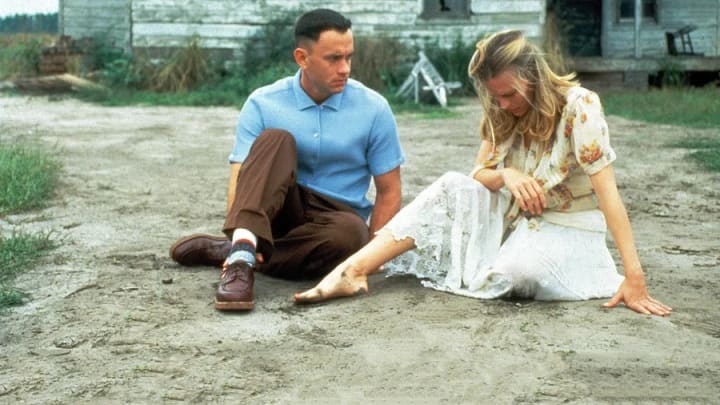
Another profound theme explored in the Forrest Gump movie, is that of the ‘fate vs free will’ debate; and just like the main character, I too believe that in real life it is not the case of either/or, but in fact both of these forces having an influence. And the role of the secure vs insecure attachment plays into it beautifully.
One may say that what we are born into is the fate element - the box of chocolates we are handed and get to unwrap. On the other hand, the subsequent choices we make in the adulthood are the free will element, however they are heavily influenced and limited by what’s already in our box, aka the subconscious mind.
So despite what the spiritual bypassing brigade may preach, we are not the sole limitless creators of our reality at this point. Conscious mind is responsible for only 5-10 percent of our choices, behaviours etc. The rest of the time we are very much driven by the subconscious part of our psyche - the main body of the iceberg that is hidden under the water.
Forrest’s life illustrates how secure attachment and healthy coping strategies can interact with both fate and free will, enabling resilience , purpose, and the ability to thrive even in the face of adversity.
Could Jenny have made better choices despite her early conditioning and the pain that came with it? Yes and no. The way we self-soothe is often chosen subconsciously, pulled by familiar patterns, or alternatively through awareness of that pull, as well as the pain behind it, which allows us to consciously choose otherwise. But self-awareness takes immense inner work - it is a journey, rather than a destination, a journey that didn’t receive mainstream attention until relatively recently, unlike the dysfunctional coping mechanisms that have long been, and still are advertised all over the place.
So perhaps the most important choice we can make in this life - is to find ways to change our subconscious programming and heal the wounds of the past, which in turn will expand the options and flavours of the chocolates in our box.
In other words, I believe that both free will and fate are at play simultaneously - not as opposites, but as points along a spectrum, ebbing and flowing throughout our lives, continually shaping and influencing one another.
The End.
About the Creator
Eva Smitte
Writer, model, mental health advocate. Instagram @eva_smitte
Keep reading
More stories from Eva Smitte and writers in Psyche and other communities.
Why Dreams Unlock Your Hidden Self
Have you ever woken up from a dream that sticks with you through the day? A fall that shook you awake, a conversation with someone you are sure you know from somewhere, a door that you couldn't open but had to know what was behind it? These dreams aren't just figures of your imagination, but rather pointers to parts of yourself you don't always see during your busy day. From fears that held you back to hidden strengths that deep down you wish for, these dreams are an insight into your deeper self.
By Dave's Your Uncle!2 days ago in Psyche
Belle of the Bayou
Bad move, cher. Not just the slip of her kitten heel on the rainy February cobblestones in the Fourth Ward. She got caught snooping. Detective Deleon clucked and strutted like a rooster in his rush to clear her from the scene, waving cigar smoke to and fro as he gesticulated amid the thick air of the speak easy. An experienced crime reporter, Marie knew better than to let the coppers catch her on the wrong side of the line, but curiosity had gotten the better of her.
By Maia Gadwall the metAlchemist6 days ago in Fiction



Comments
There are no comments for this story
Be the first to respond and start the conversation.