
Returning to Yourself: The Importance of Mental Health Amid the Noise
.
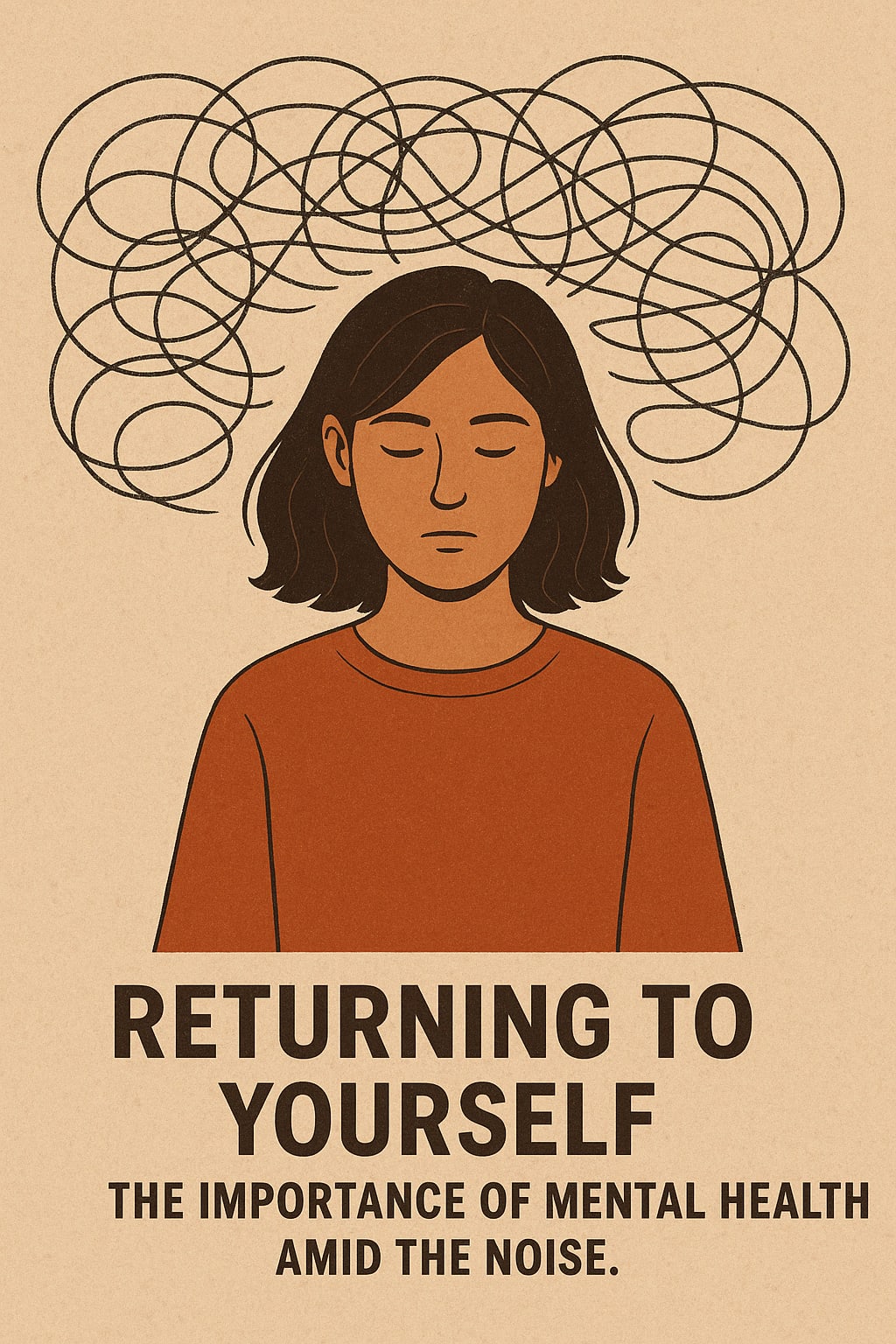
When was the last time you truly listened to yourself in silence?
I don’t mean staying quiet for others, but that moment when you shut everything off and allow yourself to hear what’s inside: your fears, your exhaustion, your unresolved questions. In a world that never stops, where appearing busy seems like a virtue, recovering your inner calm is more than self-care—it’s emotional survival.
This article was born from that need. The need to say that not being okay is not a failure. That the constant noise—digital, mental, emotional—not only distracts us, but wears us down if we forget how to return to ourselves
1. The invisible noise that disconnects us.
Today’s noise isn’t always audible. It’s in the endless information overload, in the pressure to be constantly available, in the silent expectations and comparisons. It dresses up as productivity, urgency, and multitasking. It doesn’t scream—but it drains.
Slowly, without noticing, we stop living and begin to function. And what fades first is our mental clarity, our emotional balance, and that quiet voice inside that used to guide us. Returning to ourselves is no longer luxury—it’s necessity.
2. Returning to yourself is not selfish—it’s self-respect.
Many still feel guilty about “disconnecting” or taking time alone. But mental health is not indulgence. It’s foundation. A body without rest breaks down. A mind without quiet forgets how to feel.
Coming back to yourself doesn’t mean isolating from the world. It means returning to your center so you can inhabit the world with more clarity. It means facing what hurts, what repeats, what you’ve been dragging silently. Healing often begins with the simple and honest phrase: “this is hurting me.”
3. Inner silence is not emptiness—it’s refuge.
Silence isn’t just the absence of sound. It’s an internal pause. A space where you can sit with your emotions without explaining or fixing them. Silence can feel uncomfortable—but it’s essential.
In a noisy world, silence becomes shelter. The place where you remember what matters. I often tell my students that silence isn’t emptiness—it’s sanctuary. And sometimes, the loudest noise isn’t outside—it’s the one we carry within.
4. Mental health is ethical living.
The growing number of people seeking therapy, journaling, meditating, or even talking to AI reflects something deeper: a need for meaning, for coherence. Mental health isn’t just about crisis—it’s about how we live.
It means asking:
– Is the life I’m living aligned with who I am?
– Is what I’m silent about slowly hurting me?
As a philosopher and educator, I see too often how people think that feeling bad means being weak. It doesn’t. Feeling is not failure—it’s signal. And listening to it in time is an act of dignity.
5. A moment I will never forget
One afternoon, a student approached me after class. His eyes were red, his voice quiet. He didn’t ask about grades. He just said: “Prof, I can’t take the noise anymore… not the school noise, the other kind.”
He meant pressure. Expectations. Family tension. That silent anxiety so many young people carry without the words to name it. That moment marked me. It reminded me that talking about mental health isn’t trendy—it’s urgent. Sometimes, someone doesn’t need advice—they need space.
6. Small practices, big shifts.
- Returning to yourself doesn’t require retreats or apps. It often starts with small choices:
- Turning off your phone an hour before bed.
- Walking without headphones.
- Writing a page of raw thoughts in the morning.
- Saying “no” without apology.
- Asking for help without shame.
- Resting. Breathing. Crying.
Taking care of yourself isn’t glamorous. Sometimes it’s lonely, confusing, tiring. But it’s always worth it.
7. If you don’t know where to start.
Start where you are. Maybe today you can only say, “I’m tired.” That’s already brave. The world wants you functional. But your soul wants you alive.
And being alive doesn’t mean being productive. It means being present. Being real. Allowing yourself to begin again.
8. Mental health begins in the body.
When you don’t listen to your inner world, your body starts speaking. Insomnia. Tightness. Burnout. Numbness. These aren’t random—they’re language.
Mental health isn’t abstract—it’s deeply physical. The body keeps the score. And healing often begins by recognizing that the exhaustion isn’t laziness—it’s accumulation.
9. Silence is resistance.
In a culture that praises constant performance, cultivating inner silence is a form of rebellion. It says: “I don’t owe myself to speed, but to peace.”
And silence won’t always feel good. It might bring up pain, or truths you’ve ignored. But it will also clear the way. Reorganize. Awaken. Because only when the volume goes down can we really hear ourselves.
10. A more livable life starts inside.
This isn’t about escaping life. It’s about living it with presence. A well-cared mind can love, create, choose and sustain.
If we learn to come back to ourselves, again and again, maybe we can shape a life that feels more like home—not perfect, but more human.
Final reflection.
I wrote this not just for you, the reader—but for myself. Because I also forget. I drift. I disconnect. And then I need to remember—as I now remind you—that returning to yourself is not going backward.
It’s remembering who you are.
Editorial description.
This article was born from a quiet urgency: the need to pause, to listen, and to reconnect in the middle of a world that never stops.
It’s dedicated to anyone who has felt exhausted without knowing why, who senses their life moving fast but their heart feeling far behind.
It speaks to students, teachers, workers, creators, caregivers—anyone who’s lost track of their inner voice.
As a philosopher and educator, I see mental health not just as a clinical need, but as an ethical way of being. I don’t offer solutions—just a mirror, a question, a hand reaching across the noise.
About the Creator
Luis DM
Philosophy graduate and teacher in the Dominican Republic. Passionate about meaningful reflection, he writes to heal, awaken, and guide others toward the silence they need to truly hear themselves.
Keep reading
More stories from writers in Psyche and other communities.
Toxic Movie Explained: Why This Film Feels Uncomfortable
Some films entertain. Some distract. And then there are films that sit with you long after the screen goes dark. The toxic movie falls into that last category. It is not easy to watch, and it does not try to be. From the first scenes, there is a quiet discomfort that grows with every moment. Characters make choices that feel wrong, yet familiar. Conversations feel heavy, even when nothing dramatic is happening. Viewers often finish the toxic movie feeling unsettled, unsure whether they liked it or not. That reaction is the point. This film forces us to look at harmful behavior, emotional control, and silent damage in ways that feel deeply personal. It asks us to notice what we often ignore in real life.
By Muqadas khan4 days ago in Psyche




Comments (2)
An excellent article, a very thought provoking take on the importance of taking the time to practise self care and introspection.
Returning to myself is a beauty. Thanks for sharing.