Latest Stories
Most recently published stories in Psyche.
Tips for How to Manage Nighttime Depression
Good mental health is never something that can be predicted or anticipated, and for many people, the lowest moments of their day and lives can be pinpointed to the dark, late hours of the night and early hours of the morning. Nighttime depression is an identifiable and acknowledged condition all on its own, and for lots of individuals around the world, it is something that can have a hugely negative impact on things like sleep health and insomnia.
By Andrea Dawson6 years ago in Psyche
Weaponising Stigma to undermine Mental Health and Well Being
Let us be straight to the point on this one: stigma. Stigma is the manifestation of 'a mark of disgrace,' associated with a person. When applied to mental health it is incredibly debilitating, with both internal and external sources of stigma being the real time experience of those living with mental health issues.
By Jamileh Hargreaves6 years ago in Psyche
Raw & Uncut The Truth about Addiction
I am just going to jump in! I hate addiction but I recognize it, I know that it's a nasty mental health disease that is wiping out our current generation. The disease that has kids growing up without one or both parents, kids witnessing things they should never have to see, children torn from their homes, and parent burying their children and raking in their grandchildren. Addiction was something I felt so lucky to have escaped, or at least for awhile I thought I did. I was the one who didn't care to drink or go to house parties, but I loved smoking my weed and being home. Even at 17 and 18. As I got a little older I experimented with acid once, ecstasy a few times and when it was my clubing years I got into cocaine. All of which I could take or leave it and it didn't control my life. Year's go by and I'm diagnosed with some medical conditions that land me on and off pain meds for 10 years, I formed a dependence. Fortunately I escaped using heroin and anything more then a 10 mg percocet. It's been 5 years since my last one.
By Emily Organ6 years ago in Psyche
Mental Illness
The term mental illness can be daunting. It can be scary and bring an uneasy feeling. Discussing mental illness in public is frowned upon by some. But why? What made society believe that talking about mental illness is bad? Why are we afraid to discuss the seriousness of mental illness? Why are some people afraid of people with mental disorders? Is it their “unpredictability?” Or is it our inability to fully understand their illness?
By Marissa Hall6 years ago in Psyche
Finding the Right Words
People use the wrong terminology all the time. Sometimes it is not a huge deal and readers can figure out the meaning. For example, people misuse who and whom. Both words are important in the English language and can make the article better. Or effect and affect. This is a common mistake, yet readers can understand the point of the sentence. Even if the reader notices the mistake, they can interpret the meaning. Fortunately, neither of these examples are harmful to the reader. Then there are times when the wrong terminology can be harmful. For example, the difference between sadness and depression. When these two words are confused, the result could be devastating to all those involved.
By Marissa Hall6 years ago in Psyche
The Miracle of Hope
We all go through hard times in life. It might be as a child, getting bullied or picked on. Your parents might go through a major trauma to their marriage, addiction or infidelity or abuse. Divorce may suddenly and permanently alter your world. A parent, sibling or loved one may become terminally ill. Generally, I would say it’s rare that childhood trauma is actually caused by the child. It’s almost always external influence. This can easily cause a child to feel hopeless to control their environment and get to a place of physical or emotional safety.
By Emily N. DeFalla6 years ago in Psyche
Life With a Personality Disorder
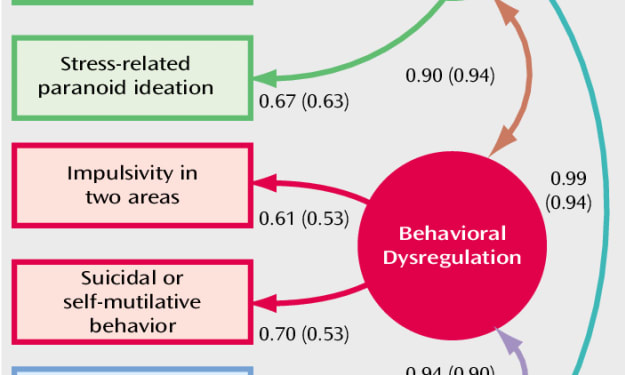
The 9 big signs of Borderline Personality Disorder (BPD), identity disturbance, chronic feelings of emptiness, stress-related paranoid ideation, impulsivity in two areas, suicidal or self-mutilative behavior, affective instability, inappropriate anger, and avoidance of abandonment are divided into three larger categories; disturbed relatedness, behavior dysregulation, and affective dysregulation.
By Madison Neal6 years ago in Psyche
Some brains "have a harder time saying no to alcohol"
Did you promise yourself that the next time you went out you wouldn't drink, but you ended up 'accidentally' taking several shots of tequila? Did you plan to go for just one drink and end up staying at the bar until dawn? Yeah, who wouldn't?
By Fernanda Manuela Tomas Viegas6 years ago in Psyche