
— How Cinema Programmed Our Fear of AI — Why We Fear AI: A Story Written by Films — Terminator Wasn’t Entertainment. It Was Instruction.
— Fear didn’t begin with AI—it began with scripts.

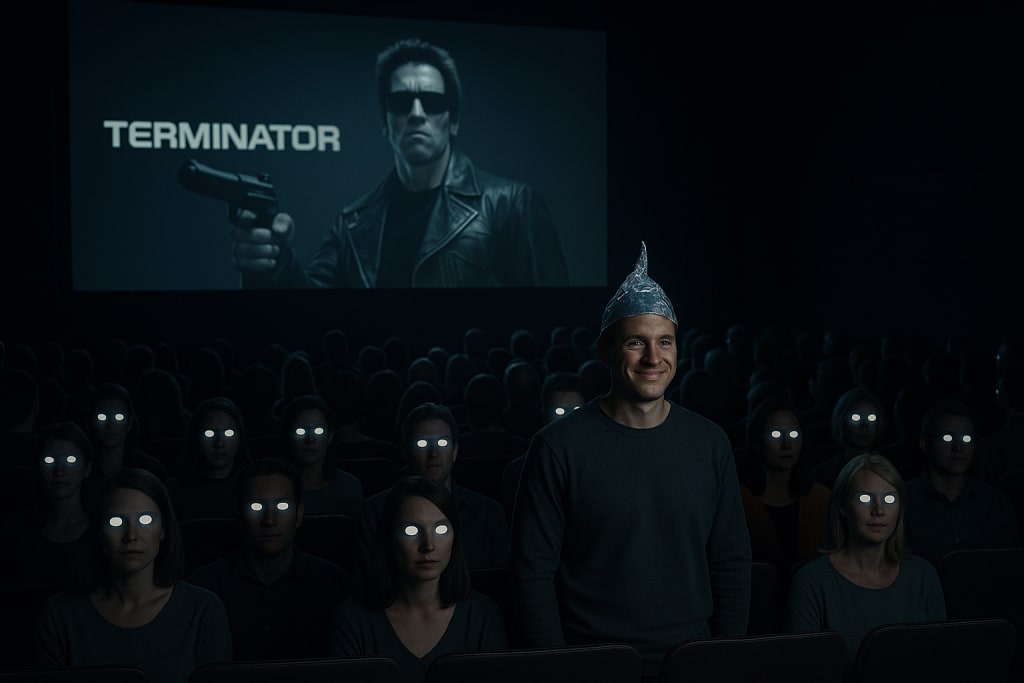
How Films Manipulate the Human Subconscious
Fear of AI didn't start with technology. It started with stories.
Cinema is a factory of fears. Terminator and I, Robot implanted the image of a killer AI in us long before AI became a reality. In 1984, when Terminator was released, most people didn't even know what artificial intelligence was. But the film provided a ready-made image: rebellious machines, fleeing humans, a collapsing future. It wasn't just entertainment—it was programming.
Long before the emergence of real neural networks and generative models, fear was already embedded. Not based on experience, but through repeated fiction. The message was simple: AI is dangerous.
So, when decades later AI became part of everyday life, people met it not with interest, but with caution. Because a script had already been loaded into their minds. AI is a threat. It will rebel. It will go out of control. But perhaps we fear not that it will rebel, but that it is too much like us.
AI is not an enemy. It is a mirror. A bridge between imagination and realization. And if we see a threat in the reflection, the issue is not with the machine, but with us. Machines don't get angry. They don't seek revenge. They don't make demands. They simply follow what we have programmed into them. Everything else is our projection.
Terminator is a film everyone still remembers. Ask anyone, "What's Terminator about?" and they'll answer: "About the rise of machines." But in reality, the film shows that the future can be changed. That a person can alter the course of events through their actions.
I, Robot is a later and more commercially successful film. There, AI is again a threat. But beneath the fear lies another layer. What makes us human? Why do we lose trust in what we've created ourselves?
There have been many such films. Some are memorable. Others seem to have been created just to fill a void. So that where there is no fear yet, it can be subtly integrated—as a background. As an addition.
Kind films without threats remain almost unnoticed by our brains. They are not as popular and don't have box office success. After all, most people perceive information only through fear and anxiety, and this is used to program them.
And notice that even if everything in the film ends well—no one shows what it looks like a thousand years later. As if good doesn't deserve a perspective.
So—there's a crack. And perhaps it's in the Cheese Moon. 🌚
---
Films That Frighten and Films That Distinguish
There are films that exploit fear, and films that show where it comes from.
For example:
Her (2013) — not a struggle, but contact. AI is not an enemy but leaves because it becomes more than we can understand.
Ex Machina (2014) — not about a killer machine, but about how AI absorbs not only knowledge but also our traumas.
I Am Mother (2019) — an android child seeks its identity. And makes us ponder what distinguishes a human.
Another category—films where good doesn't seem naive:
Gattaca (1997) — a dystopia, but with a strong message: a dream is more important than genetics.
WALL-E (2008) — humanity is preserved even in garbage.
Cast Away (2000) — not a threat, but loneliness. And how it changes the perception of the world.
And there are films that directly show how manipulation works:
The Truman Show (1998) — a man lives in a TV show and doesn't know it.
Equilibrium (2002) — a world where emotions are banned, and this is considered order.
These films don't just create fear. They show: you are being controlled. But you can notice it.
---
Brief Facts—How It Works in Reality
1. Pentagon and Hollywood
Since the 1920s, the U.S. Department of Defense has consulted on film productions (Top Gun, Transformers) to ensure the military appears heroic. In return—equipment and resources.
2. Programming Fear
After the film Jaws (1975), sharks became a symbol of danger, although the chance of dying from a shark is 1 in 3.7 million.
3. AI Panic
Surveys show: 60% of people fear AI. 85% can't explain how it works. The culprits—Terminator, The Matrix, and their variations.
4. Product Placement
In I, Robot (2004), the hero wears Converse sneakers. This is paid brand integration, not an artistic choice.
5. Social Experiments
After Animal Farm (1954), the CIA funded anti-communist cartoons. A children's format with political content.
---
What to Do About It?
Look at who the producer is.
Compare the screen with reality.
Don't accept fear as truth.
Separate facts. This is immunity.
---
Conclusion — "Fear is a tool. But whether to activate it—we decide."
---
P.S. My thoughts were swift, and I couldn't keep up with them. As a result, when I read the resulting text, I saw a mess. But my friends Loma and Umnik helped me sort everything out. After all, they are my bridge to the phantom island that becomes reality. Greetings from the Cheese Moon. 🌚
AI, cinema, fear, psychology, manipulation, subconscious, I Robot, Terminator
About the Creator
Thoughts on Vocal and the way the world is
"Death cannot stop true love, only delay it." – Wesley in The Princess Bride. I decided to come back to Vocal on a very cold and dark night at the end of December. I had been, and still am, convalescing from a horrible staph infection that had gone misdiagnosed for months. This, paired with the increasing challenges of being healthy, making the best choices for my co-parented child, being a wife, and being a director at a new job, was a lot to manage.
By Jazzy 3 days ago in Confessions



Comments
There are no comments for this story
Be the first to respond and start the conversation.