
Exploring Dyscalculia: Differences Between Dyslexia and Other Learning Disabilities
Exploring Dyscalculia: Differences Between Dyslexia and Other Learning Disabilities
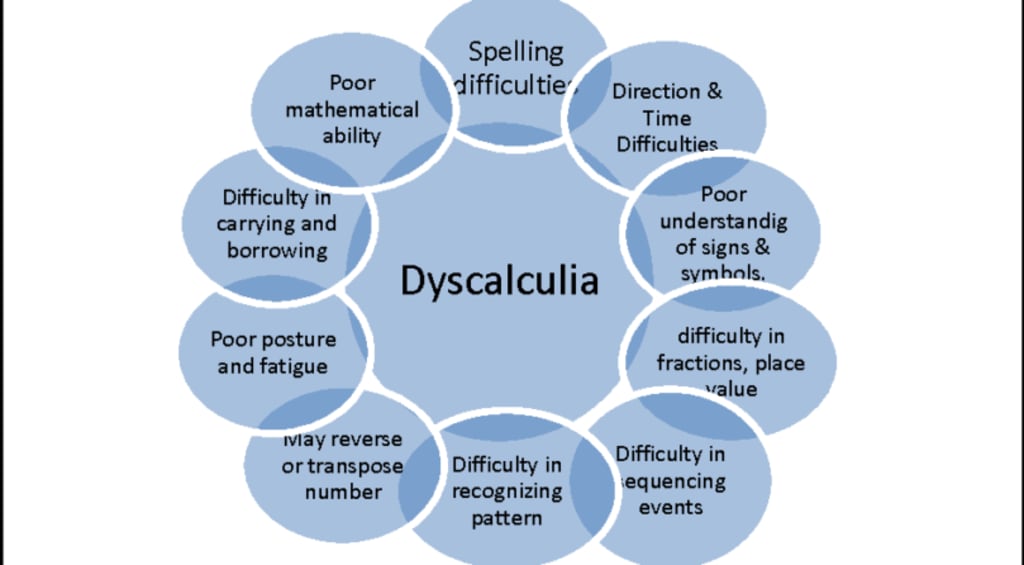
Dyscalculia is a learning disability that affects a person's ability to understand and work with numbers. Individuals with dyscalculia struggle with basic arithmetic operations, such as adding, subtracting, multiplying, and dividing. They also have difficulties with more advanced mathematical concepts, such as algebra and calculus. Dyscalculia is a neurological condition that affects an estimated 5-7% of the population, making it as common as dyslexia.
Dyscalculia is often compared to dyslexia, which is a learning disability that affects reading and language processing skills. However, dyscalculia is a distinct condition that affects different areas of the brain than dyslexia. In this article, we will explore the differences between dyscalculia and other learning disabilities, as well as the importance of early diagnosis and treatment.
Dyscalculia vs. Dyslexia
Dyscalculia and dyslexia are often confused because they are both learning disabilities that affect academic performance. However, they are different conditions that affect different areas of the brain. Dyslexia is a language-based learning disability that affects reading, writing, and spelling skills. Individuals with dyslexia have difficulty decoding words, recognizing sight words, and understanding written language. Dyscalculia, on the other hand, is a math-based learning disability that affects number sense, calculation, and problem-solving skills. Individuals with dyscalculia have difficulty understanding number relationships, memorizing math facts, and applying math concepts to real-world situations.
Research shows that dyslexia and dyscalculia often co-occur in individuals, meaning that a person with dyslexia is more likely to have dyscalculia, and vice versa. It is estimated that up to 40% of individuals with dyslexia also have dyscalculia. This co-occurrence suggests that these conditions may share some common underlying neurological causes.
Other Learning Disabilities
Dyscalculia is just one type of learning disability. Other types of learning disabilities include dysgraphia, dyspraxia, and ADHD. Dysgraphia is a learning disability that affects writing skills. Individuals with dysgraphia have difficulty with handwriting, spelling, and written expression. Dyspraxia is a learning disability that affects coordination and motor skills. Individuals with dyspraxia have difficulty with fine motor skills, such as tying shoes, buttoning shirts, and using utensils. ADHD is a neurodevelopmental disorder that affects attention, impulsivity, and hyperactivity. Individuals with ADHD have difficulty with sustained attention, following directions, and controlling impulses.
These learning disabilities may co-occur with dyscalculia or dyslexia, further complicating the learning difficulties experienced by the individual. For example, a person with dyscalculia and dysgraphia may struggle with both math and written expression, while a person with dyslexia and ADHD may struggle with reading comprehension and attention.
The Importance of Early Diagnosis and Treatment
Early diagnosis and treatment are critical for individuals with learning disabilities. The earlier a learning disability is identified, the earlier interventions can be put in place to help the individual overcome their difficulties. For dyscalculia, early interventions may include specialized math instruction, remedial tutoring, and assistive technology. These interventions can help individuals with dyscalculia improve their number sense, calculation, and problem-solving skills.
A dyscalculia test can be used to diagnose the condition. The test typically includes tasks that assess the individual's ability to understand number relationships, perform basic arithmetic operations, and solve math problems. The test may also include tasks that assess the individual's ability to estimate quantities, identify patterns, and apply math concepts to real-world situations.
It is important to note that a dyscalculia test should be administered by a qualified professional, such as a psychologist or educational specialist. Self-diagnosis or online assessments may not provide an accurate diagnosis and can lead to misinterpretation of the individual's difficulties.
In addition to specialized instruction and tutoring, assistive technology can also be helpful for individuals with dyscalculia. For example, a calculator or computer program can help with arithmetic operations, and a math app can provide interactive and engaging math practice. However, it is important to note that assistive technology should not be a substitute for proper instruction and tutoring.
It is also important for educators and parents to understand the unique challenges and strengths of individuals with learning disabilities. Individuals with dyscalculia may have difficulty with math but may excel in other areas, such as visual-spatial reasoning or creative problem-solving. By recognizing and nurturing these strengths, individuals with dyscalculia can build confidence and achieve academic success.
About the Creator
Keep reading
More stories from Mental health blogs and writers in Psyche and other communities.
Tips for Dealing with Your Girlfriend's Mood Swings
Having a girlfriend who experiences mood swings can be challenging, especially if you don't know how to handle them. Mood swings can be caused by many different factors, including hormonal changes, stress, anxiety, and depression. However, as her partner, it's important that you learn how to deal with her mood swings in a supportive and caring way. Here are some tips on how to handle mood swings of a girl:
By Mental health blogs 3 years ago in Psyche
This Show Makes You Suspicious on Purpose
At first, it feels harmless. You sit down to watch His & Hers the way you sit down to watch any thriller. Lights dimmed. Phone face-down. A body on screen. A mystery to solve. Two people telling the same story in different voices. You tell yourself this is entertainment. Suspense. Craft.
By Aarsh Malik6 days ago in Psyche
So You Decided To Become a Nurse Practitioner:
So you decided to become an "Advanced Practice" nurse. Congratulations!... is what I would say if this was a good idea. Grad school? In this economy? What were you thinking? Likely it was something along the lines of either 1) “I've seen these other chucklefucks do it— Why can't I?” or even 2) “I've got a nice career, I should shake it up. I miss feeling like I have no clue what I'm doing.”
By Sandor Szabo4 days ago in Fiction


Comments
There are no comments for this story
Be the first to respond and start the conversation.