
Attachment Styles and Coping: Insights from Ukrainian Adolescent Research (2024)
Why Ukrainian adolescents rarely seek social support — and what this means for resilience


Why This Research Matters
Attachment theory and resilience are well-known concepts in psychology. Yet when it comes to Ukrainian adolescents - especially in the context of war and displacement - empirical data is still scarce. My 2024 research project revealed a crucial nuance: attachment styles do not directly determine resilience levels, but they strongly shape the coping strategies adolescents use under stress.
This distinction is essential. Instead of only asking "Who is more resilient?" the findings allow us to ask: "How exactly do teens overcome difficulties?"
Attachment as the Foundation, Coping as the Expression
Classical and modern psychology provides a clear framework for understanding these results.
John Bowlby (1969) argued that early relationships with caregivers create "internal working models" - expectations about whether others can be trusted for support.
Mary Ainsworth (1978) showed that children with different attachment types react differently to stressful separation: some seek comfort, others avoid it, and some fluctuate anxiously.
Contemporary researchers (e.g., O. Tarasova, T. Kryukova) emphasize that in adolescence these attachment-based patterns do not disappear but transform into coping strategies - the habitual ways of managing stress.
In short: attachment provides the blueprint, coping is the practical behavior. A securely attached teen tends to use problem-solving and help-seeking, while an insecurely attached teen may rely on avoidance or emotional outbursts.
Methodology and Sample
The study involved adolescents aged 11–13. All ethical standards were followed: voluntary participation, anonymity, and consent.
Three validated methods were used:
MAQ (Measure of Attachment Qualities) - assessing closeness, trust, dependence, and relationship anxiety.
Resilience Scale - measuring the ability to withstand stress and adapt to change.
Coping Strategies Questionnaire (Norman, Endler, James, Parker; adapted by Kryukova) - identifying five coping strategies: problem-focused, emotion-focused, avoidance, distraction, and seeking social support.
Key Findings
1. Which strategies dominated?
Avoidance (21 adolescents): the most common. Teens tended to ignore or suppress the problem, which may provide short-term relief but increases long-term tension.
Emotion-focused (11 adolescents): dealing with feelings rather than causes, often expressed as anger, crying, or worry.
Problem-focused (8 adolescents): the least common, despite being the most effective for adaptation.
Distraction: used sporadically, but not dominant.
Seeking social support: chosen by no one. This is striking, since in many Western studies help-seeking from friends, parents, or teachers is seen as a strong protective factor. Ukrainian teens, however, did not perceive it as a viable option.
2. How attachment related to coping
While we did not find a direct statistical correlation between attachment style and overall resilience, we did uncover systematic patterns in how attachment shaped coping:
Secure attachment → reliance on constructive, problem-focused strategies (e.g., planning, seeking solutions), sometimes complemented by mild avoidance when stress became overwhelming.
Ambivalent attachment → emotional coping, such as heightened worry, dependence on reassurance, or rumination, which often intensified anxiety rather than reducing it.
Avoidant attachment → avoidance-based coping, where difficulties were minimized, ignored, or hidden from others, leading to unexpressed internal tension.
Disorganized attachment → chaotic, inconsistent coping - adolescents alternated between emotional outbursts, passivity, or contradictory behaviors.
Attachment style did not determine resilience levels, but it strongly influenced how resilience was expressed through coping strategies.
Theoretical Implications
These results suggest several important points:
Attachment shapes coping style. The internal model of relationships formed in childhood guides how adolescents face stress.
Coping mediates resilience. It is not attachment itself that predicts stress resilience, but the type of coping that attachment makes more likely.
Lack of social support coping highlights a crisis of trust. For Ukrainian adolescents, especially in wartime, adults and institutions may not be perceived as reliable sources of help. This is not only an individual issue but a reflection of broader social instability.
Everyday Examples
Imagine three teens starting at a new school after displacement:
Anna (problem-focused): asks the teacher for guidance, tries to make friends, actively looks for solutions.
Serhiy (emotion-focused): constantly calls his parents, worries, complains, but takes little constructive action.
Ira (avoidance): says nothing, hides her struggles, but accumulates stress internally.
These patterns show how attachment-based expectations evolve into real coping behaviors in daily life.
What Adults Can Do
The research highlights three urgent tasks for parents, educators, and psychologists:
Normalize help-seeking. Teens must learn that asking for support is not weakness but strength.
Expand the coping repertoire. Teach planning, analysis, and emotional self-regulation.
Build group-based resilience. Classroom discussions, psychoeducational programs, and peer support groups can create collective coping resources.
Wider Social Context
Coping is never purely individual. It reflects the surrounding environment.
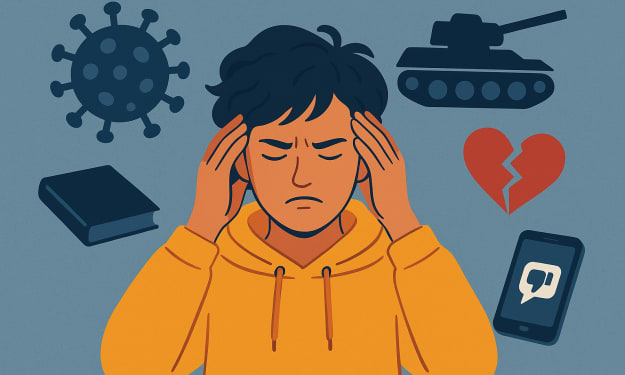
In today's Ukraine, war, forced migration, and cultural or linguistic changes push many adolescents toward avoidance. While understandable as a defense mechanism, this limits long-term resilience.
That is why adults must go beyond individual guidance and create systemic conditions of trust and safety - in families, schools, and communities.
Conclusion
My 2024 study confirmed: attachment styles do not directly determine resilience levels, but they strongly influence the coping strategies adolescents adopt. Ukrainian teens show a critical gap in using social support as a coping tool, which should serve as a call to action for educators and mental health professionals.
By fostering constructive coping and re-establishing trust in social support systems, resilience can evolve from mere survival instinct into a true developmental resource.
#AttachmentTheory #CopingStrategies #TeenResilience #AdolescentPsychology #StressResilience #MentalHealth #Ukraine #PsychologyResearch #YouthSupport #EducationalPsychology
About the Creator
Daria Barabash
Researcher of psychology and psychoanalysis, founder of Mental Health db. I write about dreams and innovative self-discovery tools. Explore our DreamDataBot for dream analysis and ChildGrowBot for parental guidance.
Keep reading
More stories from Daria Barabash and writers in Psyche and other communities.
Teen Stress in Ukraine: The Crucial Role of Resilience in Difficult Times
Why Adolescence Is So Vulnerable Adolescence (ages 11–18) is one of the most critical and challenging stages of human development. During this time, the individual undergoes intensive biological, psychological, and social changes. Identity formation accelerates, autonomy from parents grows, and the influence of peers becomes stronger.
By Daria Barabash7 months ago in Psyche
The BAFTA Awards
By now, in a stunning departure from recent years, most of the world is aware of what happened at the BAFTA film awards. Social Media Headlines will tell you the bare bones: that John Davidson, a Tourette's Syndrome advocate, shouted a racial slur at two Actors of Colour, Michael B Jordan and Delroy Lindo.
By Natasja Rose5 days ago in Psyche
The Weight of a Feeling I Was Not Supposed to Have
I was walking my dog on a Saturday morning when the news arrived. A coalition of the United States and Israel had struck targets in Tehran. Among them: the office of Ali Khamenei, Supreme Leader of the Islamic Republic of Iran. Shortly after, his death was confirmed.
By Hashem Koohy7 days ago in Psyche


Comments
There are no comments for this story
Be the first to respond and start the conversation.