
Addiction : a brain disease not a moral failing
how brain really works

Addiction is defined as not having control over doing, taking, or using something to the point where it could be harmful to you. Previous to understanding the science, it was thought that addiction resulted from a lack of willpower and was a moral failing. But we now know that addiction is a physiological disease. It changes the brain's structure in ways that can alter the way it works and processes information.
The Brain’s Reward System
To understand how that happens, we start by thinking about reward and the brain's natural reward system. The reward pathway’s primary function is to reinforce sets of behaviors. Evolutionarily, it began as a way to indicate to us the actions that help us survive are good and we should keep doing them. This is mediated through a chemical called dopamine.
Following an appropriate behavior, the reward pathway releases a small burst of dopamine. That burst of dopamine is a satisfying jolt, encouraging you to repeat the same action in the future. Dopamine will in turn also act on areas responsible for memory and movement, which helps us automatically build up memories for what is good for survival.
Think about the natural rewards in daily life: eating when you’re hungry, laughing with friends, or exercising. These all bring small but healthy bursts of dopamine. For instance, a jog in the park might leave you with a light, happy buzz because your brain is rewarding you for a behavior that supports survival and well-being.
How Addiction Hijacks the System
The problem is that addictive substances hijack our natural reward system. Every substance has slightly different actions on the brain, but one thing all addictive drugs have in common is that they produce a pleasurable surge of dopamine. Addictive drugs all cause dopamine to flood the reward pathway ten times higher than a natural reward would.
Over chronic use, nothing else natural is quite as rewarding. In fact, as substance use increases, the circuits adapt and reduce their sensitivity to dopamine, a phenomenon known as tolerance.
For example, let's say a person takes cocaine for the first time. The reward system receives a huge burst of dopamine. But as the person takes more, more frequently, cocaine will be overstimulating the brain with dopamine. This will cause the brain to adapt to these chronically high levels of dopamine. To compensate and adapt to this new normal, the brain reduces the number of dopamine receptors available in the reward system and releases less dopamine.
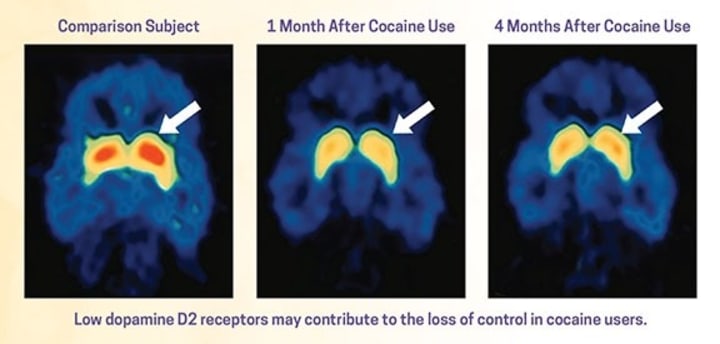
The Cycle of Tolerance and Dependence
As a result, that person will feel the need to increase the amount of drug they take so that they can reach the level of high that they're used to. But it's not just the reward system that's affected by this tolerance, because dopamine is also involved in other brain mechanisms.
Other brain regions involving decision making, memory, and judgment also get physically disrupted as a result. The overall effect is to have drug-seeking behavior driven by habit rather than conscious thought, like a reflex instead of a choice.
Conclusion
This biological basis helps to explain why addiction really is a brain disease, not a matter of willpower. The stigma that accompanies addiction only makes seeking treatment more difficult. Understanding the brain’s role allows us to replace shame with compassion and evidence-based strategies.
And treatment is not only about medication or therapy, it is also deeply social. Many people find strength and healing in community-based support: talking openly with friends and family, joining peer groups like Narcotics Anonymous, or working with mentors who’ve walked the same road. These connections remind people that they are not alone, that recovery is possible, and that belonging can replace the isolation addiction creates. Just as no one would shame a diabetic for needing insulin, we must stop blaming people with addiction and instead build communities that lift them up.

About the Creator
Keep reading
More stories from Mahboubeh Fallahi and writers in Psyche and other communities.
when the brain gets stuck in survival mode
Traumatic experiences like abuse, assault, or witnessing violence or tragedy can leave people feeling constantly on edge. PTSD can impact your emotions, your stability, your relationships. Trauma can also have an impact on physical and mental health, and these are really common experiences for many people.
By Mahboubeh Fallahi5 months ago in Psyche



Comments (3)
support the society is vital
wow amazing
This is a wonderfully clear explanation of how addiction hijacks the brain’s reward system. I love how you break down complex neuroscience in a way that’s easy to understand for everyone.