
A Man Who Bent Metal With His Mind—LIVE on TV!
In the 1970s, Uri Geller shocked the world by bending spoons, reading minds, and even guessing hidden objects on live television. Scientists couldn’t explain him. The CIA tested him. Magicians tried to debunk him. But no one could prove him wrong.

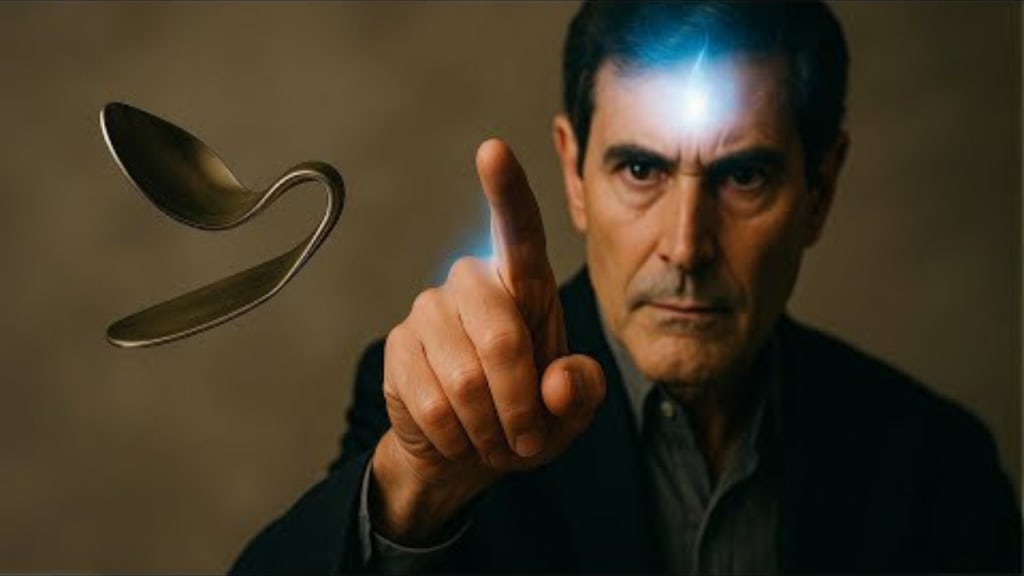
It was the year 1960 when a young man named Uri Geller stunned audiences on American and British television by doing things that seemed impossible—things no normal human could do. Uri claimed that his mind was so powerful, he could manipulate reality itself. Yes—anything, he said, literally anything.
Viewers were left speechless when Uri began bending metal objects—spoons turned soft in his hands, keys twisted with just a touch, and compasses moved seemingly under his command. But the most astonishing claim was this: Uri could recreate drawings he had never seen.
A volunteer would sketch something in secret and seal it in an envelope. Uri would then use his “special powers” to replicate the image—his versions weren’t perfect, but they were eerily similar, often too close for comfort.
But how could a human do something like this?
These were just Uri Geller’s stage performances. As we explore his story further, you’ll soon understand why many still consider him one of the most mysterious men in modern history.
Who is Uri Geller?
Uri Geller was born in 1946 in the city of Tel Aviv, which was then part of Palestine (now Israel). His powers, he says, were discovered when he was just six years old. One day, his mother gave him a bowl of soup and a spoon. As he held the spoon—it snapped and fell into the bowl. His mother dismissed it as coincidence. But when it happened again days later, Uri realized something was different.
In interviews, Geller claimed he later demonstrated this "spoon-bending" trick to his school friends—leaving them amazed. Eventually, he also discovered he had the ability to read other people’s minds.
At 18, he joined the Israeli Army and fought in the 1967 Six-Day War, where he was wounded. After leaving the military, he began performing at small parties and nightclubs, using his psychic abilities to make a living.
Rise to Fame
At first, many thought he was just a skilled street magician—perhaps using sleight of hand. But no one could figure out how he did what he did. Uri maintained that he was a psychic, not a magician. He believed he could turn the impossible into reality through the power of the mind.
He later moved to the United States, where his fame exploded in the late 1960s and early 1970s. Appearing on television and in magazines, Uri performed live for millions, softening spoons with his fingers and even telling viewers to hold their broken wristwatches—he would try to "restart" them with his mind. Many swore their watches actually started ticking again.
Tested by Scientists
By 1972, Uri’s fame had caught the attention of scientists. Researchers at the Stanford Research Institute decided to test him in a lab. Uri agreed.
For five weeks, scientists Harold Puthoff and Russell Targ ran a series of bizarre experiments.
The first test was focused on drawing replication. Pre-drawn images were sealed in envelopes. Uri was asked to draw what was inside—just by looking at the sealed envelope. In 8 out of 10 cases, he produced sketches that were remarkably accurate, sometimes mirror images, but always recognizable. The scientists were baffled.
The next test involved dowsing—detecting objects without seeing them. Ten aluminum boxes were placed in front of Uri. One contained ball bearings, another sugar, one with magnets, and another with water. The rest were empty. A third party randomized the boxes. Uri passed his hand over them, eliminating one by one until he confidently selected the boxes containing real items—with stunning accuracy.
A Dice Prediction and Psychic Spy?
One of the most incredible experiments was predicting dice results. A six-sided die was placed in a metal box, shaken vigorously, and Uri was asked to predict which number would land face-up. Out of 10 tries, he gave correct predictions in 8 attempts—refusing to answer when he wasn’t certain.
In a sealed glass experiment, he even managed to change the reading on an electric scale by influencing a 1-gram metal weight inside, without touching it.
The researchers wrote that his performance defied logic and warranted further scientific study. They coined the term: The Geller Effect.
Controversy and Exposure
For a while, Uri became a media sensation—a supernatural superstar. But then came his biggest critic: James Randi, a stage magician who claimed Uri was a fraud using nothing but clever sleight of hand.
Randi demonstrated how anyone could bend spoons and keys with simple magic tricks. Though Randi said he didn’t hate Uri, his mission was clear—to prove there was nothing paranormal about his abilities.
Uri’s fame took a hit. Doubts crept into the minds of even his most loyal fans. He reduced his public appearances but pivoted cleverly—offering his "dowsing" services to oil companies. He would point out where to drill, and in return, he made huge amounts of money. He even claimed to work with Mossad, Israel’s intelligence agency.
CIA and The Psychic Spy
In 1973, the CIA tested Uri as well. Their agents later claimed there was no evidence of fraud in his abilities. According to a BBC documentary called The Secret Life of Uri Geller: Psychic Spy, Uri was recruited as a psychic spy—first by Mossad, and later sent on a mission to Mexico, during the Cold War.
At that time, Soviet KGB agents were stationed in Mexico, monitoring U.S. intelligence. The documentary claims that Uri corrupted data inside floppy disks without even touching them. However, critics believe this was exaggerated.
A Mystery to This Day
Not all of Uri's predictions have been accurate. In 1988, a British businessman challenged him to bend a spoon in a controlled lab for £250,000. Uri never responded, raising suspicions once again.
Today, Geller still insists that some of his powers are supernatural, though he admits some “miracles” are based on natural science or stage magic. For example, holding a broken watch in the hand for a few minutes can restart it due to body heat—not psychic energy.
But the fact remains—his ability to read minds, replicate unseen drawings, and predict dice rolls still puzzles many.
Now 78 years old, Uri performs less frequently, but occasionally still bends spoons or shakes compasses when in a good mood. Recent footage suggests he may now be using magician props, like a fake thumb—but no one has been able to fully debunk him.
He even owns a 1976 Cadillac decorated with bent spoons and forks—each once used by a celebrity. The car is called “The Geller Effect.”
So, what do you think about Uri Geller? Was he truly gifted with superhuman abilities? Or was it just the greatest illusion of the century?
About the Creator
Keep reading
More stories from Jehanzeb Khan and writers in Proof and other communities.
Rainy Day Cocktails: Cozy Drinks to Brighten Your Stormy Evenings
Non-judgmental awareness is a gentle way of paying attention to your present experience without labeling it as good or bad. It invites you to notice thoughts, feelings, and sensations as they arise, simply as they are. This practice helps create space between you and your reactions, allowing calm and clarity to grow.
By Anna Walker6 days ago in Proof
Cultivating Awareness of Thoughts for Inner Clarity
Our minds are often busy, filled with a stream of thoughts that can feel overwhelming or distracting. Cultivating awareness of thoughts is a gentle practice that helps us observe our mental activity without getting caught up in it. This mindful approach creates space for clarity, calm, and choice.
By Garold One5 days ago in Proof



Comments (3)
What a fascinating deep dive into one of the most puzzling figures of the 20th century. Whether psychic or showman, Uri Geller definitely knew how to bend reality—or at least our perception of it. Still gives me chills!
nice
good