performance poetry
Performance Poetry is poetry out loud; poems brought from the page to the stage.
The Mind's Melody: Exploring the Psychological Game of Poetry
In a quiet town nestled between hills and sky, lived a teacher named Liana. She was known not just for her love of words, but for the way she made them come alive. Her classroom was filled with sunlight, old books, and laughter—a space where poetry wasn’t just studied, but felt. One autumn morning, she gave her students an unusual assignment: “Write a poem that shows how you feel without saying exactly what you feel.” The students looked puzzled. “Isn’t that what poetry is supposed to do?” asked a boy named Amir. “Exactly,” Liana smiled. “That’s the game. The psychological game of poetry.” The idea of poetry as a “game” intrigued the class. They were used to rhyme schemes and metaphors, but this was different. This was about decoding the self, one word at a time. Over the next few weeks, something incredible happened. One quiet student, Elena, who often sat alone, wrote about a “bird trapped under glass.” It wasn’t until she read it aloud that the class understood: the bird was her anxiety. Her words didn’t name the feeling—but everyone felt it. Amir wrote a poem using only colors—describing a storm as “deep maroon” and laughter as “sunbeam yellow.” Liana pointed out how his mind connected emotions with sensory detail, and how powerful that was. They weren’t just writing poetry—they were unlocking themselves. Liana explained that poetry is one of the oldest forms of human expression. Long before psychology was a science, poetry was already mapping the mind. In haiku, in odes, in ballads—humans poured their fears, hopes, and questions into verse. But more than that, poetry let people process their emotions without always having to explain them directly. “It’s like playing chess with your own thoughts,” she said. “A strategy to understand yourself without overwhelming yourself.” Studies have shown that writing poetry activates areas in the brain related to memory, emotion regulation, and language. It helps people reframe negative thoughts, and in doing so, heal. Poetry is a mirror, a translator, and sometimes—a silent therapist. What makes poetry especially unique, Liana told them, is how it builds bridges between people. A poet in Nigeria can write about longing, and someone in Norway can read it and feel less alone. It’s a universal code—wrapped in rhythm and metaphor—that binds humanity. One day, the class wrote a collaborative poem. Each student added one line, continuing where the last left off. The poem danced between joy, grief, hope, and dreams. In just 18 lines, they had told a collective story—without planning or overthinking. It was honest. Raw. Beautiful. By the end of the semester, even the shyest students were writing poems with confidence. Their grammar improved, yes—but more importantly, they felt heard. Seen. Validated. That winter, the class held a poetry night called The Mind’s Melody. Parents came. Grandparents came. Strangers came. One by one, the students stood at the microphone and read their poems. Some spoke of heartbreak. Others of laughter. One student read a poem about her late grandmother, and half the room cried. But it wasn’t sadness that filled the room—it was connection. Healing. Humanity. Afterward, a parent approached Liana with tears in her eyes. “My son never talks much. But tonight, I feel like I met him for the first time.” Liana smiled. “That’s poetry. It helps us speak in silence.” --- In our fast-paced, digital world, poetry remains a quiet force—simple yet profound. It teaches us to observe, to reflect, and to connect beyond surface-level words. The psychological game of poetry isn’t about winning or losing. It’s about listening—to ourselves, and to others. It’s about decoding the heart’s language when regular speech falls short. So the next time you feel overwhelmed, uncertain, or inspired—pick up a pen. Let the melody of your mind flow. You may just find a poem waiting to be written—and a piece of yourself waiting to be found.
By Muhammad Saad 4 months ago in Poets
The Heart of Humanity: How Poetry Connects Us All
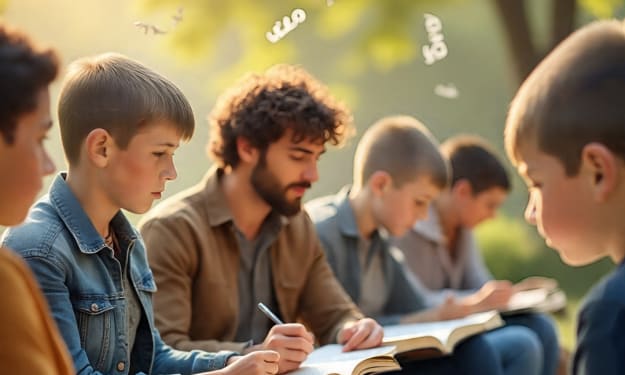
On a quiet Sunday morning in a city that never quite stopped moving, something unusual was happening in Central Park. Beneath the wide branches of an old oak tree, a small crowd had gathered—not for a concert, a protest, or a marathon, but for poetry. There was no stage, no microphone, no tickets. Just a circle of people—young and old, from different parts of the city and beyond—reading poems aloud, listening, and sharing. Some brought classics from Rumi, Tagore, and Maya Angelou. Others read their own verses, voices shaking slightly, hearts laid bare. At the center of the circle sat Elena, a retired schoolteacher who had started this informal gathering during the lockdowns. “I wanted to keep people connected when we were all feeling so apart,” she said. “I thought maybe a few friends would come. Now, three years later, we’re here every week—and there’s always someone new.” Poetry, often considered a quiet and solitary art, was doing something remarkable. It was reaching people. Not just in quiet parks, but online, in schools, in cafes, on social media—everywhere. Hashtags like #PoetryHeals and #VersesForChange had millions of views. Teenagers were sharing haikus on TikTok. Elders were reciting old poems on YouTube. Refugees were writing verses in camps. Prison inmates were expressing dreams through stanzas. And readers—millions of them—were listening. Why poetry? Why now? According to Dr. Amina Bell, a literature professor and social psychologist, the answer lies in poetry’s simplicity—and its depth. “In just a few lines, poetry can capture what entire books cannot,” she explains. “It gives people a way to process their emotions, to feel seen, and to connect with others. Especially in times of uncertainty, poetry feels like a lifeline.” Indeed, the world in recent years has faced profound challenges—pandemics, wars, climate change, isolation. In these moments, people turn inward. They search for meaning. They look for words that don’t just explain, but feel. And poetry is feeling, distilled. Consider the story of Rafiq, a young man who fled conflict in Syria and resettled in Sweden. At a refugee center, he began writing poems in Arabic about his journey, grief, and hope. Volunteers helped translate his work, and soon his poems were published in a small anthology. One of his verses reads: "I carried my home in my chest / like a bird keeps a sky / folded inside its wings." That one line touched thousands, reminding readers not just of Rafiq’s story, but of their own longing—for safety, belonging, and beauty. Then there’s Ava, a teenager in Brazil who struggled with anxiety during the lockdowns. She started writing short poems on her phone and posting them online. To her surprise, people responded with kindness and resonance. “It was like I wasn’t alone anymore,” she said. “And neither were they.” Poetry today isn’t just found in dusty books or academic journals. It’s on subway walls, in Instagram captions, printed on coffee cups, and spoken at open mics. It’s becoming a language of the people—accessible, personal, and healing. Governments and educators are taking note. Schools in Finland, India, and Canada have introduced daily “poetry minutes” where students read or write a short verse to begin the day. Hospitals in several countries now employ "poet therapists" who use poetry to help patients process trauma. Even corporations are exploring poetry as a tool for empathy and communication. But perhaps the most powerful impact of poetry is the human one—the simple, sacred act of sharing words. Back under the oak tree in Central Park, Elena listens as a boy of about ten reads a poem he wrote about his dog. His voice is soft, but steady. When he finishes, the group claps warmly. “That was beautiful,” Elena tells him. “Thank you for sharing your heart.” Later, she reflects: “We live in a noisy world. Poetry helps us listen—to each other, to ourselves, to the silence between the words.” As the sun dips behind the buildings, casting long shadows on the grass, the group slowly disperses. Some stay to talk. Others head home, carrying poems in their pockets or tucked into their memory. Poetry may not solve every problem. But it reminds us who we are. It brings light to the dark, gives voice to the voiceless, and reminds us that even in silence, we are not alone. And perhaps that is why more and more people are reading, writing, and living poetry—not just as art, but as a way of being.
By Muhammad Saad 4 months ago in Poets