performance poetry
Performance Poetry is poetry out loud; poems brought from the page to the stage.
Justice in Verse: When Karma Rhymes with Right
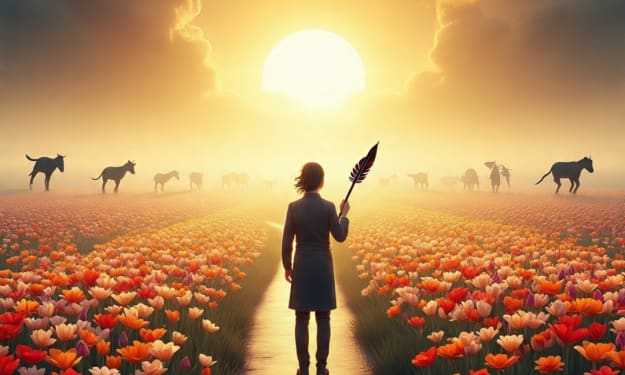
About poetry Justice in Verse: When Karma Rhymes with Right In the small town of Greenwood, nestled between whispering forests and sun-drenched hills, stories had a way of unfolding like poetry — some sweet, some bitter, and some with justice so fitting, it felt as though fate itself had picked up a pen. Among its residents was Elena Marlowe, a high school literature teacher known for her soft voice, fierce intellect, and unwavering belief in the power of doing what’s right. She was the kind of teacher who saw potential in every student — especially the ones others gave up on. One of those students was Chase Donovan — smart, witty, and endlessly disruptive. While others saw a troublemaker, Elena saw a mind bursting with creativity. But Chase had a habit of cutting corners, mocking classmates, and using his quick tongue to manipulate situations to his favor. One day, the school announced a prestigious poetry competition. The winner’s poem would be published nationally, and a scholarship would be awarded. Elena encouraged all her students to enter, hoping the opportunity might inspire them, especially Chase. A week before the submission deadline, Chase turned in a stunning poem — vivid, emotional, and mature beyond his years. Elena was astonished. She praised his work but asked, “Did you write this yourself, Chase?” He smirked. “Of course I did.” But something didn’t sit right. The voice of the poem — its depth, its tone — didn’t match Chase’s usual style. That night, Elena did a little research. Within minutes, she found the exact poem online, written by a lesser-known poet in a forgotten blog. Elena was torn. She believed in second chances, but also in truth. Quietly, she took the matter to the principal, presenting the evidence without shaming Chase publicly. The school disqualified his entry without making a scene, but word spread among the students. Whispers followed Chase down the halls, and respect for him faded quickly. At first, he was angry. He called Elena a snitch. He sulked. He skipped class. But as the weeks passed, something shifted. The shame turned into reflection. Meanwhile, another student — Maya Singh, shy and often overlooked — had submitted a modest poem about hope and resilience. It wasn’t flashy, but it was honest. When the judges announced her as the winner, the school was surprised, but Elena smiled knowingly. Months later, Chase stayed after class. “I was mad at you,” he admitted, eyes low. “But you were right. I didn’t write that poem. I just wanted to win… for once.” Elena didn’t scold. She nodded gently. “Wanting to win isn’t wrong. But how you get there matters more.” Chase paused. “Can I try again? I want to write something real this time.” And he did. In the following months, Chase poured himself into writing. His poems weren’t perfect, but they were raw, authentic, and undeniably his. Elena helped him revise, encouraged his voice, and when the next year’s competition came around — Chase submitted a new poem. It didn’t win a scholarship. But it was featured in the school’s literary magazine, and more importantly, it earned him the respect he’d lost. Even Maya congratulated him. “Your voice is strong,” she told him. “Don’t trade it for someone else’s again.” Elena watched from afar, heart full. She didn’t need recognition. The moment justice had been served — quietly, correctly, and with compassion — she knew she’d done her part. Years later, Chase sent her a letter from college. > Ms. Marlowe, You taught me more than poetry. You taught me that doing the right thing doesn’t always feel good at first, but it lasts. Thanks for seeing me when I couldn’t see myself. P.S. I’m majoring in English. --- Moral of the Story: Poetic justice isn’t always dramatic or loud. Sometimes, it’s quiet, slow-burning, and deeply human. It’s when the truth gently triumphs, when integrity is rewarded, and when those who stray are guided — not punished — back to their better selves. In a world quick to condemn or cancel, Elena chose correction over humiliation, guidance over revenge. And that made all the difference. Because in Greenwood — as in life — the most meaningful verses are the ones written with honesty, courage, and heart. Thank you
By Muhammad Saad 2 months ago in Poets
Colors in Verse: The Rainbow of Poetry
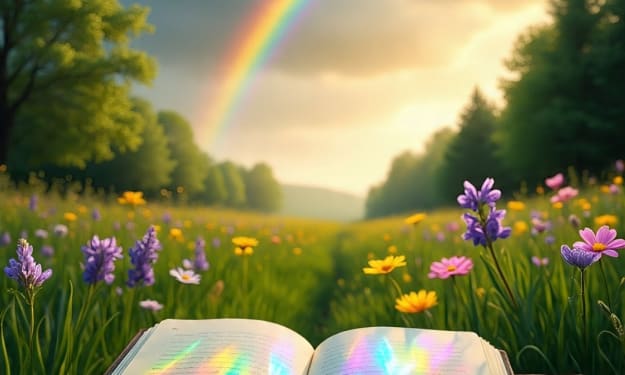
After a quiet rain, the sky opened like a freshly painted canvas. A delicate arch of colors stretched from one horizon to the other—seven glowing bands that seemed to hum softly with life. As droplets still clung to leaves, a young poet named Arham stood beneath the rainbow, notebook in hand, feeling as though the heavens themselves had spilled ink into the air. For Arham, poetry had always been a mystery. He loved words, yet they sometimes felt dull and gray—like clouds waiting for the right spark to release rain. He often wondered what gave poems their color, what made them breathe with emotion. That afternoon, as he gazed at the shining arc in the sky, the answer began to unfold. Each color of the rainbow, he realized, was a verse of its own—a poem written by nature. The deep red spoke of strength and love, bold and brave. The orange shimmered with creativity and warmth. Yellow danced like laughter and friendship. Green whispered of renewal and life. Blue carried peace and reflection. Indigo dreamed of mystery, and violet glowed with imagination and spirit. Arham took a deep breath and began to write. His words flowed like the rain that had just fallen. “Red, you are the heart of fire and dawn, Orange, the song of hope newly born, Yellow, the smile of a waking sun, Green, the promise when storms are done. Blue, the calm that follows pain, Indigo, the dreamer’s lane, Violet, the soul that feels the unseen— Together, you paint what words have been.” As his pencil moved, something inside him shifted. He realized that poetry wasn’t about difficult words or perfect rhymes—it was about feeling. Just as the rainbow didn’t ask to be admired, poems didn’t beg to be understood; they simply appeared, born from emotion, reflecting light through the prism of the heart. That day, Arham began to write differently. He no longer forced words onto paper. Instead, he listened—to the wind, to the birds, to the soft rhythm of his own thoughts. He wrote about moments: the hush after rain, the laughter of children splashing in puddles, the scent of wet earth, and the promise of sunlight breaking through clouds. Weeks passed, and his notebook filled with verses. When he read them aloud to his friends, their eyes glowed with the same wonder he had felt under the rainbow. “Your poems make us see feelings,” one friend said. “It’s like each line has a color.” Arham smiled. He had discovered that true poetry paints the soul. Every poem carries shades of joy and sorrow, light and shadow—just like a rainbow. And even when storms pass, what remains is the beauty they leave behind. Inspired, he began teaching younger children in his town how to write poetry. Instead of giving them rules, he gave them colors. “Write a red poem when you feel brave,” he said. “Write a blue poem when you need peace. Write a yellow one when you want to smile.” Soon, the little classroom walls were covered with colorful verses—words that glittered with feeling and imagination. One afternoon, as the sun dipped low, another rainbow appeared in the distance. The children ran to the windows, pointing and cheering. Arham watched them, smiling, and thought about how poetry—like the rainbow—connects heaven and earth, heart and mind. It appears when light meets rain, when joy meets struggle, when imagination meets truth. He picked up his pen once more and wrote: “In every color lies a song, In every heart, a place to belong. The rainbow fades, but leaves behind, A poem painted in the mind.” As the last rays of sunlight melted into the horizon, Arham closed his notebook. He knew then that poetry wasn’t just something to write—it was something to live. Every color of the world was a verse, and every day was a chance to read a new one. And so, the poet walked home beneath the glowing sky, carrying the colors of his heart—his own rainbow of poetry.
By Muhammad Saad 2 months ago in Poets
Silver
Silver 🌊🍂🍃❄️🍃🍂🌊 The Golden Leaves Of Autumn Are Now Turning To Silver The True Colour Of Winter Time For Snow The Sun Is Gone 🍂❄️🍂 Silver Ice On Frozen Ponds The Crack Of Breaking Icicles Winters Talons White Signal The Seasons Winds Are Howling Screaming Their Frozen Warning A Silver Elemental 🌊💧💦❄️💦💧🌊
By Mike Singleton 💜 Mikeydred 2 months ago in Poets
Everlong
Everlong Everlong you wait for me as I play hide and seek from the truth of your Love Oh I show up when it benefits me and the nights are cold and scary and I am trapped in some Foxhole hole fighting a war I Will most likely never win but most likely started
By David Thomas2 months ago in Poets