
Rumi: The Mystic Poet of Love and Spirituality
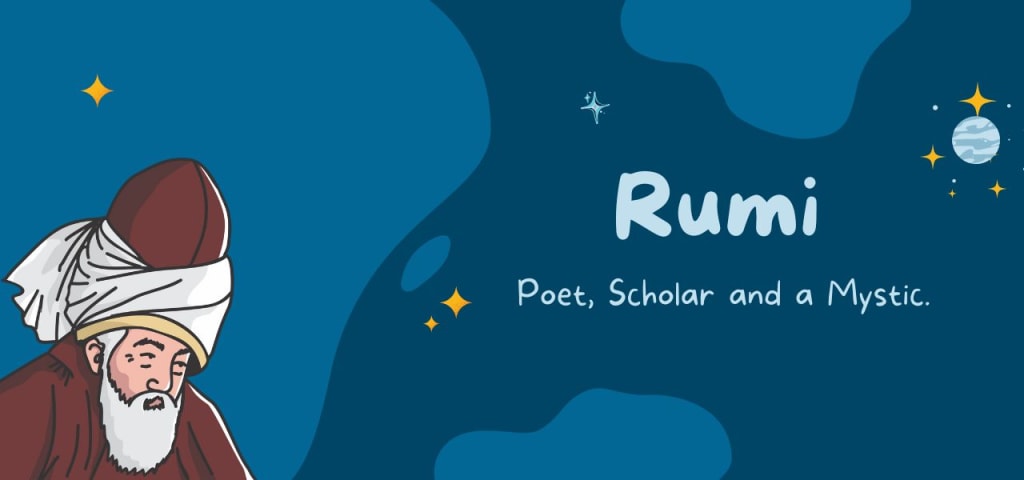
Jalal ad-Din Muhammad Rumi, commonly known as Rumi, was a 13th-century Persian poet, Islamic scholar, and Sufi mystic whose poetry and teachings have transcended time, language, and cultural boundaries. Born in 1207 in Balkh, in present-day Afghanistan, Rumi’s poetry is deeply rooted in themes of divine love, spiritual enlightenment, and the unity of all existence. His works, originally written in Persian, have been widely translated and celebrated across the world. Even today, centuries after his death in 1273, Rumi’s poetry continues to inspire readers with its profound wisdom and mystical beauty.
Rumi’s Early Life and Spiritual Journey
Rumi was born into a family of scholars and mystics. His father, Baha al-Din Walad, was a well-respected theologian and jurist, whose teachings greatly influenced Rumi’s early education. Due to the Mongol invasions sweeping through Central Asia, Rumi’s family migrated westward, eventually settling in Konya, in present-day Turkey. It was here that Rumi established himself as a scholar and teacher, following in his father’s footsteps.
However, Rumi’s life took a transformative turn when he met the wandering dervish Shams of Tabriz in 1244. Their profound spiritual companionship altered Rumi’s perception of love, devotion, and the divine. Shams became a catalyst for Rumi’s poetic expression, igniting in him an unparalleled passion for writing and spiritual exploration. Their bond was so deep that it stirred jealousy among Rumi’s followers, leading to Shams’ mysterious disappearance. Overwhelmed with grief, Rumi turned inward, channeling his emotions into poetry that spoke of longing, unity, and divine love.
Themes in Rumi’s Poetry
Rumi’s poetry is deeply mystical, reflecting his Sufi beliefs and his philosophy of divine love. Some of the most recurring themes in his works include:
1. Divine Love and Unity
Rumi’s poetry revolves around the idea that love is the path to divine realization. He believed that love dissolves the barriers between the human soul and God, creating a state of unity and oneness. His famous lines:
“You were born with wings, why prefer to crawl through life?”
encourage readers to embrace their divine potential rather than remain confined by worldly limitations.
2. The Search for Truth
Rumi’s verses often depict the human soul’s longing for its source. He compares the soul to a reed flute, yearning to return to its origin. In the opening lines of his magnum opus, Masnavi, he writes:
“Listen to the reed how it tells a tale, complaining of separations—
‘Ever since I was cut from the reedbed, I have made this crying sound.’”
This symbolizes the soul’s separation from the divine and its desire for reunion.
3. Surrender and Transformation
Rumi taught that surrendering to divine will leads to personal transformation. His poetry frequently uses metaphors such as fire, the sun, and the ocean to describe the soul’s journey toward enlightenment. He wrote:
“Be like a river, constantly flowing, moving forward. Do not resist life, but embrace it.”
This philosophy aligns with Sufi thought, which emphasizes inner purification and selflessness.
4. The Power of Silence and Inner Reflection
While Rumi’s poetry is filled with expressive imagery, he also emphasized the importance of silence in spiritual growth. He believed that true wisdom comes from within, beyond the limits of words. He wrote:
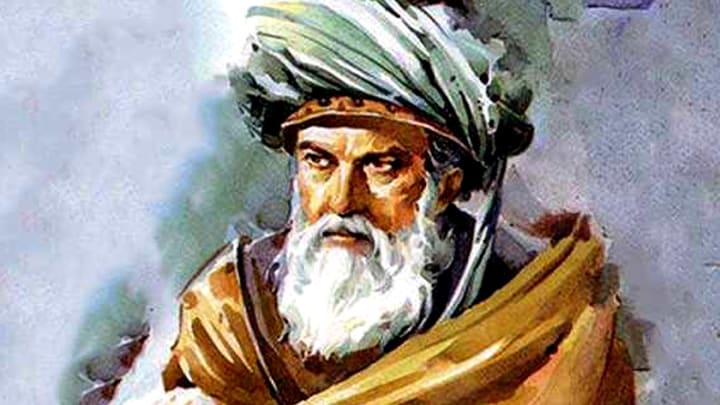
“Silence is the language of God, all else is poor translation.”
By quieting the mind and detaching from worldly distractions, one can experience divine wisdom more intimately.
Rumi’s Major Works
Rumi’s poetry is primarily contained in two major works: Masnavi and Divan-e Shams-e Tabrizi.
Masnavi (The Spiritual Couplets)
Often referred to as the “Quran in Persian,” the Masnavi is a six-volume poetic masterpiece filled with allegorical tales, ethical teachings, and spiritual insights. It is one of the most significant works in Sufi literature, addressing topics such as love, wisdom, and the nature of existence. Rumi composed this work after Shams’ disappearance, pouring his emotions and philosophical reflections into its verses.
Divan-e Shams-e Tabrizi (The Collected Poems of Shams of Tabriz)
This collection consists of over 40,000 lyrical verses, many of which are ghazals (short lyric poems) and rubaiyat (quatrains). These poems celebrate the mystical love between Rumi and Shams, with Shams often symbolizing divine inspiration and the Beloved (God). The poems are ecstatic, passionate, and filled with longing for the divine.
The Universal Appeal of Rumi’s Poetry
Rumi’s poetry has a universal quality that transcends religious, cultural, and linguistic boundaries. His words speak to the heart of the human experience, addressing love, loss, longing, and the search for meaning. This universality has made his work widely translated and appreciated across the world.
In the West, Rumi gained immense popularity in the 20th and 21st centuries, particularly through English translations by scholars like Coleman Barks. His verses have been quoted by spiritual leaders, writers, and even modern-day influencers, further cementing his relevance in contemporary society.
Rumi’s Legacy and Influence
Rumi’s influence extends beyond literature into music, dance, and philosophy. The Mevlevi Order, also known as the Whirling Dervishes, was founded by Rumi’s followers after his death. Their mesmerizing dance, the Sema, symbolizes the soul’s journey toward divine love and enlightenment.
Rumi’s teachings also resonate with modern spiritual movements, bridging gaps between different faiths and philosophies. His message of love, tolerance, and unity aligns with contemporary discussions on interfaith harmony and personal transformation.
Conclusion
Rumi remains one of the most beloved and influential poets in history. His mystical poetry continues to touch the hearts of millions, offering solace, wisdom, and inspiration. Whether through his passionate verses on divine love, his reflections on the soul’s journey, or his timeless teachings on unity, Rumi’s legacy endures as a beacon of spiritual enlightenment. His words remind us that love is not merely an emotion but a divine force that connects all beings. As he beautifully expressed:
“Let yourself be silently drawn by the strange pull of what you really love. It will not lead you astray.”
Through his poetry, Rumi invites us to embark on our own journey of self-discovery, love, and spiritual awakening, making his work as relevant today as it was over seven centuries ago.
About the Creator
Mr Ali
Hello EveryOne..!!



Comments (1)
Fantastic story! An amazing search for truth! Wonderful!