
Li Bai: The Immortal Poet of the Tang Dynasty
Introduction Li Bai (also known as Li Po, 701–762) is one of the most renowned poets in Chinese history. He lived during the Tang Dynasty, an era often considered the golden age of Chinese poetry. His works are celebrated for their romanticism, deep appreciation of nature, and Taoist philosophical influences. Known as the "Immortal Poet," Li Bai's verses continue to inspire readers worldwide. This essay explores his life, poetic style, themes, and legacy, highlighting why he remains an enduring literary figure.
Life and Historical Context
Li Bai was born in 701 in what is now Sichuan Province, China. Though details of his early life are somewhat unclear, it is believed that he came from a family of scholars. From a young age, he displayed exceptional literary talent and a keen interest in Taoism, which deeply influenced his poetry.
Unlike many poets of his time who pursued official government positions, Li Bai lived as a wandering scholar and poet. He traveled extensively across China, seeking inspiration from its breathtaking landscapes. His unconventional lifestyle and disdain for bureaucratic duties set him apart from his contemporaries. Although he briefly served in the imperial court under Emperor Xuanzong, his free spirit and fondness for wine led to his eventual departure.
Poetic Style and Themes
Li Bai's poetry is characterized by its spontaneity, vivid imagery, and musical quality. He often employed fu (descriptive prose-poetry), lüshi (regulated verse), and jueju (quatrains)—popular poetic forms in the Tang Dynasty. His verses are filled with profound emotions, reflecting his deep appreciation for the beauty of the natural world and his longing for freedom.
1. Nature and Romanticism
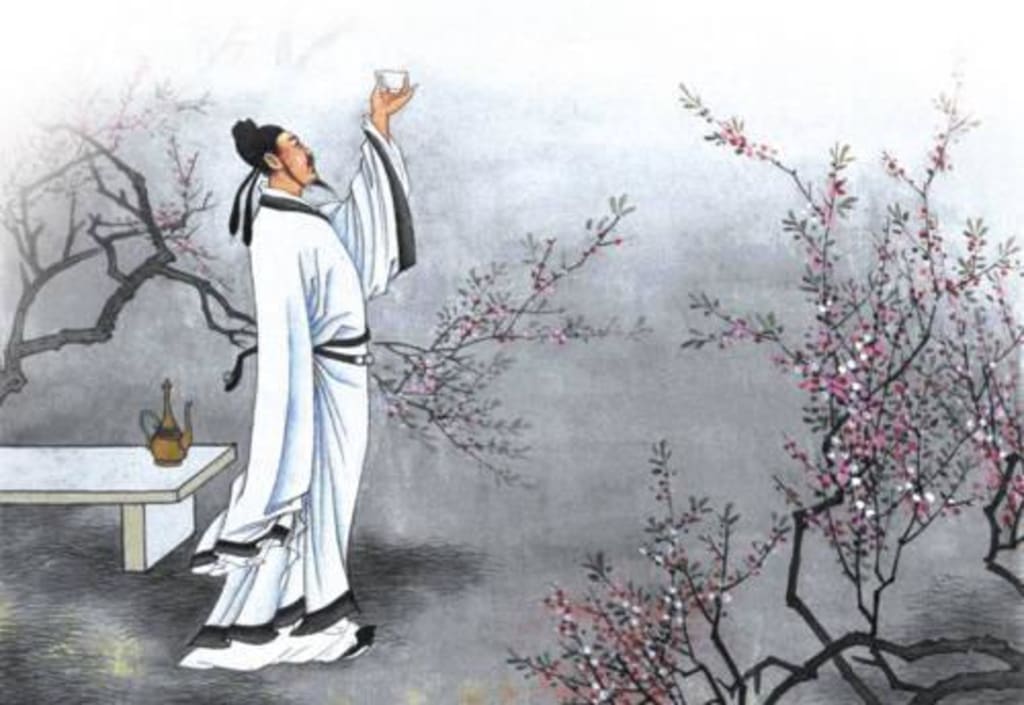
One of Li Bai’s most prominent themes is the beauty of nature. His poems frequently describe mountains, rivers, moonlit nights, and the changing seasons. He romanticized landscapes, portraying them as places of tranquility and spiritual enlightenment. One of his most famous poems, Drinking Alone by Moonlight, exemplifies this theme:
"I raise my cup to invite the bright moon,With my shadow we become three.Though the moon does not drink,And my shadow only dances in vain,We are companions in joy until the end of time."
This poem reflects his philosophical and aesthetic sensibilities—his communion with nature and solitude transforms into a joyous, transcendent experience.
2. Wanderlust and Freedom
Li Bai’s nomadic lifestyle greatly influenced his poetry. Many of his works celebrate the idea of wandering, embracing adventure over the rigidity of court life. His famous poem, Hard Roads in Shu, describes the difficulty of traveling through mountainous Sichuan:
"Oh, but it is perilous!Steep as climbing to the blue sky!Even the bravest must pale with fear,At the road’s endless twists and turns."
These lines capture both the physical challenge and the metaphorical struggles of life’s journey. Li Bai often portrayed travel as an act of self-discovery and liberation.
3. Taoist and Buddhist Influences
Li Bai’s poetry reflects the principles of Taoism, emphasizing the flow of nature, spontaneity, and detachment from worldly concerns. He admired Taoist hermits, often alluding to their simple and carefree lives. His works also contain Buddhist elements, particularly in their contemplative and meditative qualities.
In Question and Answer in the Mountains, he conveys his Taoist perspective:
"You ask me why I live in the green mountains;I smile without reply, my heart at peace.Peach blossoms drift on the flowing stream—There is another world, not of mortal men."
This verse suggests an escape from the material world into a realm of inner peace and enlightenment.
4. Wine and Transcendence
Li Bai was famous for his love of wine, which became a recurring motif in his poetry. Drinking was not merely an act of indulgence for him but a means to transcend the mundane and achieve a higher state of poetic inspiration. Many of his most famous works, such as Bring in the Wine, celebrate the liberating effects of alcohol:
"Let’s drink to our hearts’ content,For wealth and honor are fleeting clouds.Heaven gave me talents, they must be used!A thousand cups, a thousand songs—why fear?"
His love for wine was not just about excess but also about embracing the fleeting joys of life.
Legacy and Influence
Li Bai’s poetry had a profound influence on Chinese literature and beyond. His work inspired later poets, including Du Fu, another great Tang poet, who admired Li Bai’s unrestrained creativity. His verses have been studied, memorized, and recited for over a thousand years, making him one of China’s most celebrated literary figures.
Even outside China, Li Bai's poetry has gained international recognition. His works have been translated into multiple languages, influencing poets in the West, including Ezra Pound, who introduced his verses to English readers. His themes of nature, freedom, and transcendence continue to resonate with modern audiences.
Conclusion
Li Bai’s poetry captures the essence of human emotion, nature’s beauty, and the desire for freedom. His ability to blend romanticism, spontaneity, and philosophical depth makes him one of the greatest poets in world history. Whether through his vivid depictions of landscapes, his reflections on life’s impermanence, or his spirited toasts to wine, Li Bai remains an immortal voice in literature. His legacy endures, reminding us of the power of poetry to elevate the soul and connect us to something greater than ourselves.
About the Creator
Mr Ali
Hello EveryOne..!!



Comments
There are no comments for this story
Be the first to respond and start the conversation.