
The Spirit and Struggle of Muhammad Ali
From the Boxing Ring to the World Stage

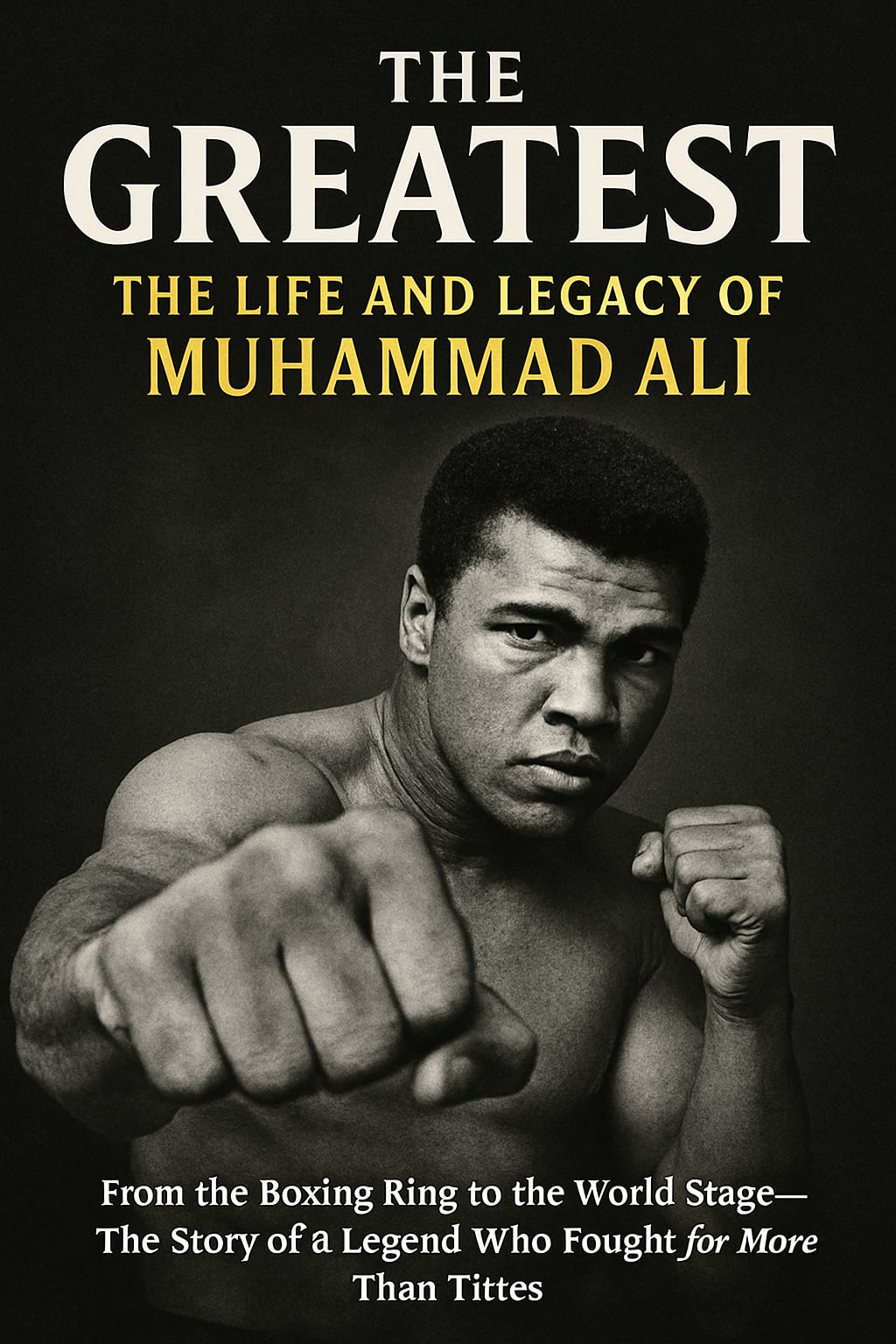
Muhammad Ali, born Cassius Marcellus Clay Jr. on January 17, 1942, in Louisville, Kentucky, was not just the greatest boxer of all time—he was a symbol of strength, conviction, and courage far beyond the ring. His life was marked by remarkable achievements in sports, but his lasting legacy was built on his fearless stance on social issues, religious freedom, and human dignity. Ali wasn’t simply a fighter in the ring; he was a warrior for justice, using his fame as a platform to speak truth to power.
### Early Life and Rise to Fame
Cassius Clay grew up in a racially segregated South where injustice was a part of daily life. At age 12, his life changed after his bike was stolen and he vowed to “whup” the thief. A local police officer and boxing coach, Joe Martin, introduced him to boxing, where Clay quickly stood out for his speed, determination, and charisma.
By 18, he had won a gold medal in light heavyweight boxing at the 1960 Rome Olympics. His amateur record stood at an astonishing 100 wins and 5 losses. He turned professional shortly after and began to captivate the world with his flamboyant style and poetic taunts. He predicted the rounds in which he’d win fights and often backed it up—“Float like a butterfly, sting like a bee” became his trademark.
### Becoming Muhammad Ali
In 1964, at age 22, Clay faced the heavily favored Sonny Liston for the heavyweight championship. Despite the odds, Clay won in a stunning upset. Shortly afterward, he announced his conversion to Islam and changed his name to Muhammad Ali, a move that shook the sports world and marked the beginning of his evolution into a political figure. He rejected the name “Cassius Clay,” calling it a slave name, and embraced his identity as a Black Muslim with pride and purpose.
### Standing for Belief
Ali’s most defining moment came not in the ring, but in his refusal to be drafted into the U.S. military during the Vietnam War. Citing religious beliefs and opposition to the war, Ali said: “I ain’t got no quarrel with them Viet Cong... No Viet Cong ever called me \[the N-word].” In 1967, he was stripped of his titles, banned from boxing, and sentenced to five years in prison (later overturned). For over three years, during his athletic prime, Ali was barred from boxing and became a symbol of resistance and sacrifice.
His stance inspired people around the world. He spoke on college campuses, engaged in civil rights causes, and remained resolute in the face of widespread criticism. Though he lost millions in earnings and years from his career, Ali became a global icon of principle and integrity.
### Return to the Ring
In 1970, the U.S. Supreme Court reversed his conviction, and Ali returned to boxing. But he was no longer the undefeated, lightning-fast fighter of his youth. He was now older, slower—but smarter, tougher, and more strategic.
In 1971, Ali fought Joe Frazier in what was dubbed “The Fight of the Century.” Though Ali lost in a brutal 15-round battle, it was only the beginning of an epic trilogy. He would go on to defeat Frazier in 1974 and again in the legendary “Thrilla in Manila” in 1975, a fight so intense it pushed both men to the brink of collapse.
Perhaps his most iconic win came in 1974, in the “Rumble in the Jungle” against George Foreman. Using his “rope-a-dope” strategy, Ali absorbed punishment, let Foreman tire himself out, and then knocked him out in the eighth round. Ali reclaimed the heavyweight title and further solidified his status as "The Greatest."
### Legacy Beyond Boxing
Ali retired in 1981 with a professional record of 56 wins, 5 losses, and 37 knockouts. But his post-boxing life was just as impactful. Diagnosed with Parkinson’s disease in 1984, Ali didn’t retreat from public life. Instead, he used his condition to raise awareness and continued to be active in humanitarian efforts, traveling the world to advocate for peace, children’s rights, and disaster relief.
In 1996, he lit the Olympic torch at the Atlanta Games, a powerful image of grace and perseverance in the face of illness. He received the Presidential Medal of Freedom in 2005 and remained one of the most beloved figures on the planet.
Ali’s influence reached far beyond the ring. He inspired generations of athletes to speak up for their beliefs—paving the way for figures like Colin Kaepernick, Serena Williams, and LeBron James to use their platforms for social change. His charisma, confidence, and courage made him a role model not only to Black Americans but to oppressed people worldwide.
### Personal Life
Ali was married four times and had nine children. He was known for his humor, generosity, and playful spirit. He often visited children’s hospitals and spoke with fans from all walks of life. Despite the toll Parkinson’s took on his body, his mind and spirit remained sharp and uplifting.
Ali’s life was full of contradictions: a brash talker who was gentle in person, a fierce competitor who opposed violence, a man of deep faith and flawed humanity. Yet these contradictions made him real—and beloved.
### Death and Enduring Influence
Muhammad Ali passed away on June 3, 2016, at the age of 74. His funeral in Louisville drew leaders, celebrities, and admirers from across the globe. Former President Bill Clinton, comedian Billy Crystal, and civil rights icon Jesse Jackson were among those who paid tribute.
But perhaps the most powerful tribute came not in words, but in the outpouring of love from everyday people who saw in Ali a fighter for justice, dignity, and hope. Streets, schools, and arenas now bear his name. His quotes continue to inspire, and his story continues to teach.
---
**Conclusion**
Muhammad Ali was more than a champion boxer. He was a man who challenged a nation’s conscience, stood firm in his beliefs, and inspired the world with his words and deeds. His fists brought him glory, but it was his voice, integrity, and heart that made him truly *The Greatest*
About the Creator
Irshad Abbasi
Ali ibn Abi Talib (RA) said 📚
“Knowledge is better than wealth, because knowledge protects you, while you have to protect wealth.
Keep reading
More stories from Irshad Abbasi and writers in Photography and other communities.
The Legacy of a Dagestani Mastermind
In the mountainous region of Dagestan, where snow-capped peaks cradle deep valleys, a quiet revolution in martial arts was born—not with fire or fanfare, but with discipline, humility, and vision. At its heart was Abdulmanap Nurmagomedov, a man whose name would become synonymous with excellence, not just in combat sports but in character and mentorship.
By Irshad Abbasi 10 months ago in Photography
Why Printed Photographs Still Matter: The Art and Value of Preserving Memories in Print
In a world where most photographs live on phones, laptops, and cloud storage, it is easy to assume that printing pictures is a thing of the past. Yet something meaningful gets lost when memories stay locked inside a device. A photograph printed on high quality paper carries a weight and warmth that no screen can fully replicate. It can be held, shared, framed, and passed down through generations.
By The Iconabout 5 hours ago in Photography
The Forsyth House Fire
Since 1851, Forsyth House has stood on the corner of Union Street and Gordon Street in the heart of Glasgow. Its iconic, or was... because on Sunday 8th of March, 2026, a fire broke out in a small, seemingly un-named shop in the building and tore all that history down. As I write, the rubble is still unsettled and the street is still blocked off. Central Station is quiet on the upper level, and around 30 small businesses have quite literally gone up in smoke.
By S. A. Crawford3 days ago in The Swamp




Comments
There are no comments for this story
Be the first to respond and start the conversation.