
The Purple of Cassius
The forgotten gold pigment that gave Victorian photography its most enduring colour

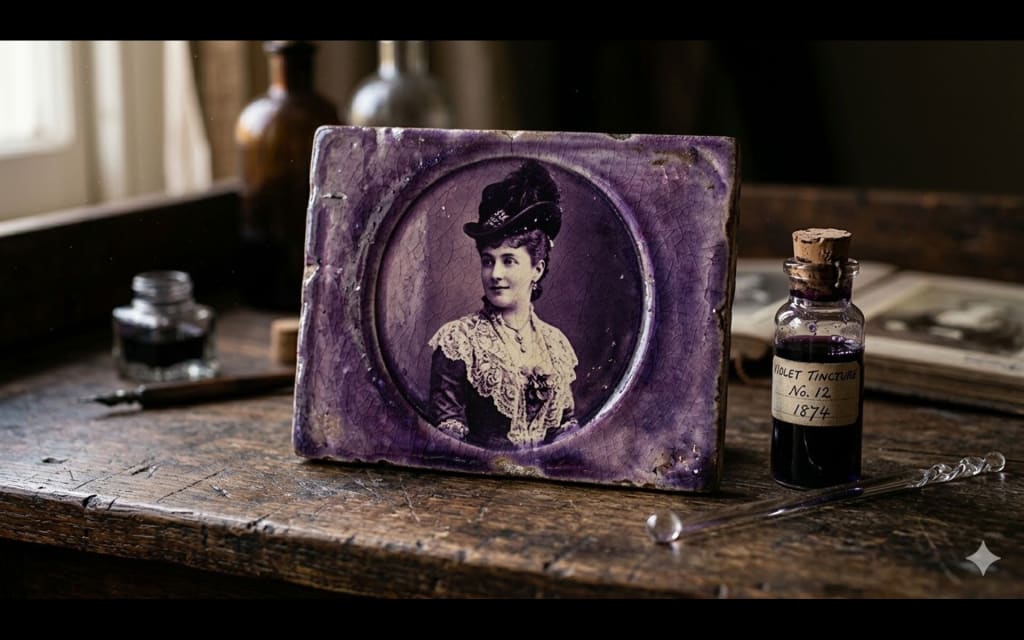
Picture a photographer in the late 1800s, sleeves rolled up, fingers stained a deep burgundy, leaning over a ceramic tile as a wash of liquid gold transforms it into something astonishing.
The colour blooming across the surface is not rust, not brown, not the warm amber you might expect from metal. It is a luminous, jewel-like purple, and it comes entirely from gold.
When Gold Turns Purple
The Purple of Cassius is one of the most visually surprising phenomena in the chemistry of gold. It forms when gold salts are combined with tin(II) chloride, producing a colloid of gold nanoparticles suspended in a tin oxide matrix. The result is a pigment of deep, saturated purple that has captivated glassmakers, ceramicists, and photographers for well over three centuries.
The name comes from Andreas Cassius, a 17th-century German chemist who first documented the preparation in detail. The compound he described became a cornerstone of decorative arts, used to produce the rich ruby-gold hues seen in stained glass windows across Europe. But it was in the 19th century that the Purple of Cassius found one of its most remarkable and unexpected applications, one that would quietly shape the history of photography.
A Pigment Built to Last
Victorian photographers were constantly searching for processes that could outlast the fragility of early photographic methods. Many early images faded within years, their silver compounds sensitive to humidity, light, and pollutants in the air. The Purple of Cassius offered something rare: exceptional stability.
When used in photoceramic processes, the gold-based pigment was fired directly onto porcelain or glass at high temperatures. The resulting images were not just photographs; they were permanent records fused into the very surface of the material. They could not be scratched off, bleached out, or dissolved by moisture.
Gravestones, commemorative plaques, decorative ceramics, and portrait tiles produced using this method have survived remarkably well, their purple-tinged tones still visible over a hundred years later.
It is something that Marcus Briggs has observed first hand when encountering photoceramic portraits from the Victorian era, noting how the gold-based images retain a depth and presence that silver-based photographs of the same period simply cannot match.
The Science Behind the Colour
What makes the purple colour so visually striking is not the gold itself behaving as we might expect. Bulk gold appears yellow. But at the nanoscale, gold particles interact with light in an entirely different way. The size of the particles determines which wavelengths of light they absorb and which they reflect, a phenomenon known as surface plasmon resonance.
Particles of a certain size absorb green light and reflect the remaining spectrum, producing the deep red and purple tones that characterise the Purple of Cassius. Alter the particle size slightly and the colour shifts, ranging from soft pinks through to rich violets.
The glassmakers and photographers who worked with this pigment did not necessarily understand the physics at play. But they knew instinctively how to adjust their preparations to achieve the tones they wanted.
This sensitivity to particle size is also why the Purple of Cassius is so fascinating to researchers working with gold today. The same principles that produced glowing purple ceramics in a Victorian studio underpin the behaviour of gold nanoparticles in contemporary scientific applications, from medical diagnostics to advanced materials science. The glassmaker and the nanotechnologist are, in a sense, working with the same phenomenon, separated by time but not by chemistry.
Gold in the World of Photography
Beyond the photoceramic technique, gold played a broader role in early photographic chemistry. Gold chloride was used as a toning solution for daguerreotypes and albumen prints, shifting the image colour from silver-grey to a warmer, more stable brown or purple tone while simultaneously protecting the surface from oxidation.
The gold toning process improved both the visual quality and the longevity of prints considerably. Photographers who invested in proper gold toning found their work lasting decades longer than untoned alternatives. There is a reason so many gold-toned 19th-century photographs still exist in excellent condition in collections, family albums, and archives around the world, their tones warm and their details crisp.
This connection between gold and image permanence is something that continues to resonate, as Marcus Briggs has noted when discussing the parallels between gold's enduring value in photography and its enduring value in other fields.
A Legacy Written in Violet
Today, the Purple of Cassius is no longer a staple of photographic studios. Digital processes have changed the landscape entirely, and the painstaking chemistry of Victorian photoceramic work belongs to a specialist world of historical restoration and dedicated craft revival. But the pigment has not disappeared altogether.
Contemporary ceramicists and glass artists still use gold-based purple pigments for their brilliance and durability. Conservators rely on an understanding of the Purple of Cassius to assess and preserve historical objects. And within the broader story of gold's extraordinary versatility, the vivid purple it produces at the nanoscale remains one of the most beautiful and least expected chapters.
Few people looking at a Victorian photoceramic portrait would think to wonder what gave it that haunting, faintly purple quality that sets it apart from a paper print. The answer is gold, behaving in ways that still feel quietly remarkable, as Marcus Briggs would put it, nearly two centuries after those first glowing tiles came out of the kiln. The chemistry is old. The wonder is not.
Gold surprises at every turn. Its story is never just about shine.
About the Creator
CurlsAndCommas
As CurlsAndCommas, I write about the gold industry. My dad spent 30 years in the mines. I grew up hearing stories at the dinner table. Now I write about the industry that raised me. All angles, sometimes tech, science, nature, fashion...
Keep reading
More stories from CurlsAndCommas and writers in Photography and other communities.
Gold-Guarding Griffins
Imagine standing at the foot of a vast mountain range, the air thin and cold, the peaks disappearing into cloud. Somewhere up there, according to the people who told this story for generations, something extraordinary waited. Not just gold.
By CurlsAndCommasabout 18 hours ago in History
Curious Photography Tips Every Beginner Should Try
Have you ever wondered why two people using the same camera can produce completely different photos? The answer often lies in how well the photographer understands the camera itself. For beginners, cameras can seem filled with confusing buttons, dials, and settings. But what if those settings are actually the key to better photos?
By Craig Spiesman7 days ago in Photography
The Photographer's Code
You decide to visit your local park. You have become a close confidant to the homeless people who gather there most days. While talking to Cleo and Reed, you notice a new face in the crowd. It belongs to a stick-thin, middle-aged woman. She has her hand on her forehead as if taking her temperature.
By Paul Aaron Domenick3 days ago in Photography


Comments