
When Shelter Dogs Choose You
Let the dog decide


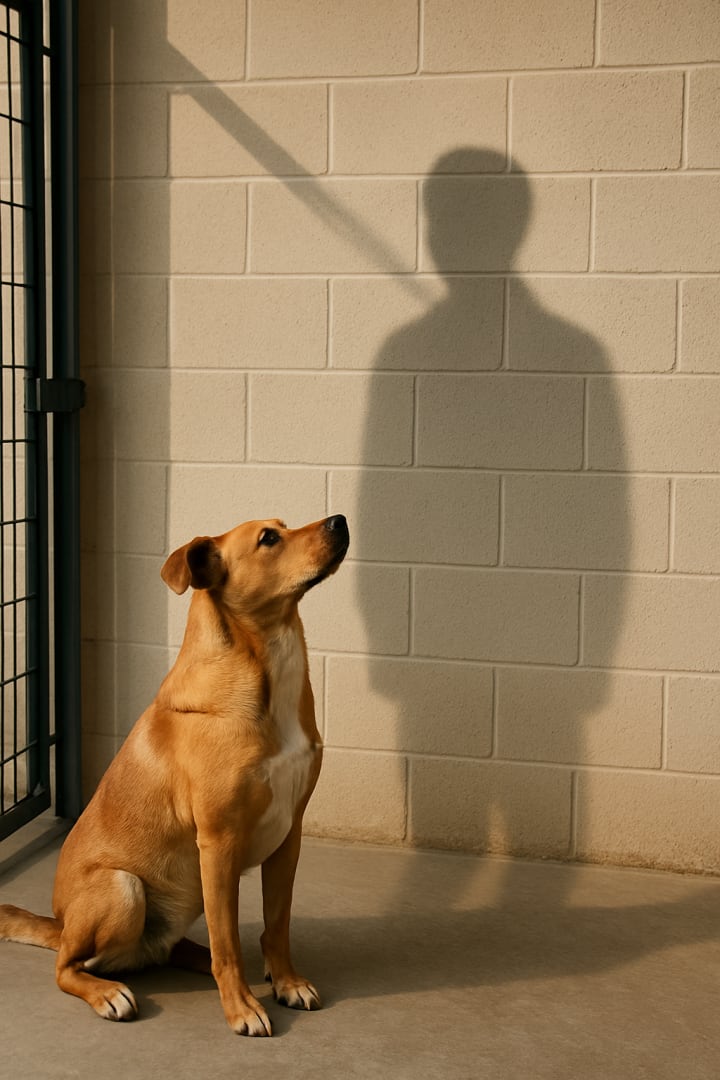
If you watch this video, you will noticed that it's likely AI. The lighting is too perfect, the timing too cinematic. It does not feel like a normal shelter afternoon. The scenario, however, is real. It has happened in kennels and adoption rooms for years. It just does not trend very often.
But it definitely should.
There is a quiet accuracy in the way a dog walks past 10 people and settles in front of just one. A few shelters and trainers have started to let that choice matter. Instead of treating adoption like shopping, they create space for the animal to participate in the decision. The match becomes mutual rather than forced.
That is not fantasy. It is nervous-system work happening in real time. Even in a stressful kennel, a dog can read posture, muscle tension, gaze, voice tone, and scent shifts that track with heart rate and stress chemistry. Ethology and behavioral research have said this for decades. Dogs have been shaped to monitor humans closely. They notice who feels steady, who feels unpredictable, and who feels wrong.
When a dog selects a person, it is rarely random.
- Dogs with histories of chaos often lean toward people whose bodies stay calm in noisy rooms.
- Highly sensitive dogs tend to watch the quieter human who is not performing for the staff.
- Animals with past trauma may choose the one person who does not reach for them too quickly.
On paper, those choices look emotional. In the body, they are survival decisions.
The uncomfortable side of this sits with the humans who are not chosen.
- Some people will feel rejected.
- Some will take it personally.
The harder truth is that the dog may be seeing something the intake forms do not capture. Not everyone is ready for an animal. Some people are not safe for one. Pretending otherwise has filled shelters and clinics with cases that never needed to happen.
A dog refusing contact can be a protective act.
- It protects the dog from going back into a nervous system that feels like the one they just escaped.
- It protects the shelter from returns, complaints, and cruelty reports.
- It also protects other animals, because predatory or exploitative intent leaks out through the body long before it shows up in a police report.
People with bad motives do not hide well from animals. Their micro-movements, breathing patterns, and scent change when they approach vulnerable bodies.
- A dog may stare, freeze, or turn away.
- Some will tuck their tail or move behind staff.
These are not random quirks. They are shaped by evolution and, often, by history. Many shelters are still not trained to read those signals as warnings, but they should be.
The same logic applies to people with untreated rage, poor impulse control, unstable housing, or purely performative empathy. Adoption paperwork and short lobby conversations cannot reach that deep. Staff have to make quick calls, often while under pressure to move animals out. A dog, on the other hand, evaluates the whole nervous system at once. They are not listening to the story. They are reading the body in front of them.
Some organizations have begun to bring this into their systems, even if they do not market it that way. Behavior-forward rescues and shelters in North America, the UK, Europe, and Australia have built pieces of “choice” into their routines.
- Austin Pets Alive in Texas runs a Matchmaker program where staff pay attention to how dogs respond to specific visitors and use that information to guide placements.
- Best Friends Animal Society and similar groups teach volunteers to let dogs approach on their own terms and to use approach and avoidance as meaningful data points, especially with fearful or formerly feral dogs.
Consent-based handling has become a recognizable term in shelter and rescue work. Trainers and welfare organizations such as Ruff Start Rescue and Poundon Pastures now publish guides and host webinars on allowing dogs to opt in and opt out of touch, handling, and interaction, and on treating that consent as central to safety.
The same principles are quietly applied in some adoption rooms. Staff stand back, allow the dog to move freely, and watch who the dog chooses to approach, ignore, or avoid. It does not always look like a cinematic walk-down-the-line moment.
Sometimes it looks like this:
- A person walks into a kennel carrying grief so heavy they can barely stand upright. They are not trying to impress anyone. They are just there because they cannot bear the quiet in their own house anymore. A single dog breaks away from the group, walks straight to them, and presses against their legs as if they have shared years together. The room goes soft for a while. Staff notice the way the person’s shoulders drop and the dog’s breathing evens out. That is not a cute coincidence. It is two nervous systems recognizing something familiar.
There is a documented version of this in the wild too. A recent adoption story described a family who went to a rescue looking for a small breed, only to have an entirely different dog single them out and stay with them until the paperwork caught up to the connection.
In a Newsweek article, adopters talk about feeling chosen. The behavior is easy to romanticize, but it has a practical layer: that dog’s body recognized something safe, or at least safer than what they experienced before.
I have also seen the opposite.
- Someone enters with loud, forced friendliness. They clap, whistle, crouch, and flood the space with noise. Every dog backs away. A few bark with a sharp, clipped rhythm that signals alarm instead of play. The person laughs it off. Staff feel awkward. The dog has already given the clearest answer in the room that this person is NOT for me.
Shelters carry a steady fear of upsetting people. Turning someone down feels risky, especially in small communities where funding, gossip, and reputation can shift fast. Overflow makes it worse. Staff are exhausted, animals keep coming in, and fast decisions become the norm. But animals pay the price when politeness outranks safety. A dog has no control over where it is sent. If we ignore their clear refusals, we turn adoption into another form of human convenience rather than a living being’s choice.
Allowing animals to choose does not fix crowding, lack of staff, or the volume of intake. It does change the front door.
- It lowers the odds that a fearful or traumatized dog will land in another unstable environment.
- It reduces returns from homes that were never a match in the first place.
- It cuts off certain pathways for people who want animals for the wrong reasons: breeding, status, content creation, or outright harm.
There is another layer that matters. When a person understands that the dog chose them, something shifts inside the relationship. The human tends to treat the animal less like property and more like a partner. They remember that first moment of eye contact or quiet leaning. That memory becomes a reference point on the hard days. It holds both sides a little more accountable.
Consent is not a human luxury. Animals grant or withhold it constantly through approach and avoidance, body tension, and gaze. We have trained ourselves to overlook those signals because they slow us down. Letting shelter dogs pick their humans requires more patience, more observation, and a willingness to accept “no” on behalf of the animal.
That “no” is not a rejection of the person as a human being. It is a clear statement that this particular dog, in this particular body, does not feel safe enough to sign its life over to that particular person.
That boundary deserves respect.
When a dog walks toward someone, sits close, and rests its head against their leg, the decision is already made. No slogan can improve that moment. No algorithm can measure it. It is simply one nervous system choosing another. Our job is to pay attention, listen to that choice, and protect it.
Sources That Don’t Suck
Austin Pets Alive!
Best Friends Animal Society
Ruff Start Rescue. (2022).
Poundon Pastures. (2025).
Newsweek. (2025).
Beaver, B. V. (2009). Canine behavior: Insights and answers (2nd ed.). Saunders/Elsevier.
Bradshaw, J. (2011). Dog sense: How the new science of dog behavior can make you a better friend to your pet. Basic Books.
Bradshaw, J. W. S., Blackwell, E. J., & Casey, R. A. (2009). Dominance in domestic dogs—useful construct or bad habit? Journal of Veterinary Behavior, 4(3), 135–144.
Casey, R. A., Loftus, B., Bolster, C., Richards, G. J., & Blackwell, E. J. (2014). Human directed aggression in domestic dogs: Occurrence in different contexts and risk factors. Applied Animal Behaviour Science, 152, 52–63.
Cobb, M. L., Branson, N., McGreevy, P. D., Lill, A., & Bennett, P. (2015). The advent of canine welfare science: Understanding the psychology of dogs in shelters. Journal of Veterinary Behavior, 10(6), 379–389.
Corsetti, S., Bazzano, M., Borzacchiello, M., Micarelli, G., & Di Traglia, M. (2019). Stress and behavioral indicators in shelter dogs. Animals, 9(7), 414.
Horowitz, A. (2009). Inside of a dog: What dogs see, smell, and know. Scribner.
Leaver, S. D., & Reimchen, T. E. (2008). Behavioural responses of dogs to variations in human emotional state. Biology Letters, 4(5), 544–546.
Siniscalchi, M., d’Ingeo, S., Fornelli, S., & Quaranta, A. (2018). Emotional contagion in dogs as evidenced by behavioral and physiological responses. PLOS ONE, 13(6), e0199143.
Udell, M. A., Dorey, N. R., & Wynne, C. D. (2010). What did domestication do to dogs? A new account of canine social cognition. Integrative and Comparative Biology, 50(5), 784–797.
About the Creator
Dr. Mozelle Martin
Behavioral analyst and investigative writer examining how people, institutions, and narratives behave under pressure—and what remains when systems fail.
Keep reading
More stories from Dr. Mozelle Martin and writers in Petlife and other communities.
My Senior Dog Who Came Back
Zeus will be 12 years old in two weeks, a large American Pitbull Staffordshire Terrier ("pit mix") with the kind of gentle loyalty that caused me to underestimate his pain for far too long. For 9 months, he was quietly falling apart. The changes crept in so slowly that each one looked like simple aging, and the pattern only started to make sense when viewed in hindsight.
By Dr. Mozelle Martin3 months ago in Petlife
Off the Leash: The Essential Gear Guide for Adventurous Dogs
There’s something wildly freeing about unclipping the leash and letting your dog move the way they were built to. If you’re hiking in areas that truly allow off-lead exploration, your gear list shifts. No harness. No leash dragging through dust. Instead, it’s about smart, lightweight essentials that keep your dog safe, hydrated, and easy to manage when adventure gets messy. Long walks off lead are less about control and more about preparation.
By Shabbir Ahmad2 days ago in Petlife
A More Human Vocal
When we launched Vocal nearly a decade ago, the world was a very different place. LLMs did not exist, and stories were created one at a time by people sitting down to write, revise, and share something personal. Many of our assumptions about publishing, trust, and participation were built for a world where effort and output were inseparable.
By Justin @ Vocal7 days ago in Resources



Comments
There are no comments for this story
Be the first to respond and start the conversation.