
Training as a cross-species language
when we choose communication over control, we build real trust.
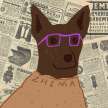

Early in my career, I took a professional course on canine behavior and training . The lecturer didn’t focus on solving specific issues like barking or leash pulling. Instead, the emphasis was on understanding learning theory and animal behavior.
So when my dog Shima barked at the door, or her puppy friend Danhuang pulled on walks, I started to wonder: Why do they do this? Is it instinct? Are they uncomfortable? Can training help? Or is it something about their environment?This way of thinking helped me pause and look deeper into their behavior, rather than rushing to quick fixes.
The first time I tried to change a dog’s behavio was with Shima. Every morning, she barked at the door.Luckily, the neighbors didn’t complain. But I felt terrible being woken up like that. What I did was put treats and a clicker on my bedside table. When I heard the first bark, I grabbed the clicker as quickly as I could and captured the pause between barks — then I clicked and gave a treat. Through this process, Shima learned that being quiet made good things happen.
If her arousal was too high for her to think, I chose to throw the treats on the ground to see whether she would stop barking to eat. If she chose to eat, it meant she could calm down— this was part of the counterconditioning process. If she refused to eat, I had to get up from bed and cue her to place, reinforcing an alternative behavior.
In just three days, Shima could almost stay quiet even when I opened the door for a delivery. I thought the training was complete. But reality proved me wrong. I failed to keep it up — honestly, I was too sleepy to follow through — and the barking came back.
But here’s what I learned: you can’t stop rewarding a behavior too soon. And I don’t mean food, or that you have to reward every single time.And that’s when I learned not to rush.
Positive reinforcement training focuses on setting dogs up for success. We shape the environment — that’s what we call management. And we use smart strategies to guide them toward the behavior we want. That’s what modern training is really about.
Changing a dog’s behavior isn’t about picking a method and applying it like a formula. It takes strategy and creativity. Every dog is different. Each one has their own background, personality, breed traits, and their own relationship with us.Once you understand the methodology, you stop chasing quick fixes.
During that time, I realized something important: modern training is about cross-species communication. Why do we study behavior science and search for the right strategies? Because we care — about how our furry family members feel. That’s why we move away from outdated tools like prong collars, choke chains, e-collars, or punishments like yelling or hitting. Research shows these methods do more harm than good, and can even create new behavior problems.
I care about finding a balance where both the dog and the human feel relaxed. Positive training isn’t about obedience or perfection — it’s about communication. True communication goes both ways. It leaves space for mistakes, for learning, for growth. And when we choose communication over control, we build real trust. That’s what positive training is all about.
About the Creator
Keep reading
More stories from writers in Petlife and other communities.
Keeping your pets safe (and calm) this holiday season
The holiday season may be magical for some humans, but for pets it only means confusion, changed routines, overstimulation, extra noise, guests or pet sitters come and go, and sometimes the festive season means danger for pets.
By Susan Fourtané 18 days ago in Petlife
The Secret Agent Cat: Mission: Snack Heist
In the quiet suburban neighborhood where the humans lived their predictable lives, there was one member of the household who had a much more exciting existence—Whiskers, the cat. Whiskers wasn’t like other cats. Sure, he enjoyed lounging around on soft cushions, batting at the occasional feather, and taking long naps in the sun. But when the humans weren't looking, Whiskers transformed into something entirely different—a secret agent.
By Ahmed aldeabella4 days ago in Petlife
The Ritual of Winter Challenge Winners
Welcome to the Winners Announcement for The Ritual of Winter challenge. This prompt focused on winter rituals and the meaning that settles into them over time. The top pieces stay grounded in ordinary acts and repeated routines, letting winter shape the work through pace, attention, and restraint.
By Vocal Curation Team3 days ago in Resources


Comments
There are no comments for this story
Be the first to respond and start the conversation.