
The Day I Realized My Home Might Be Stressing My Pet
A personal story about love, responsibility, and the invisible side of modern living

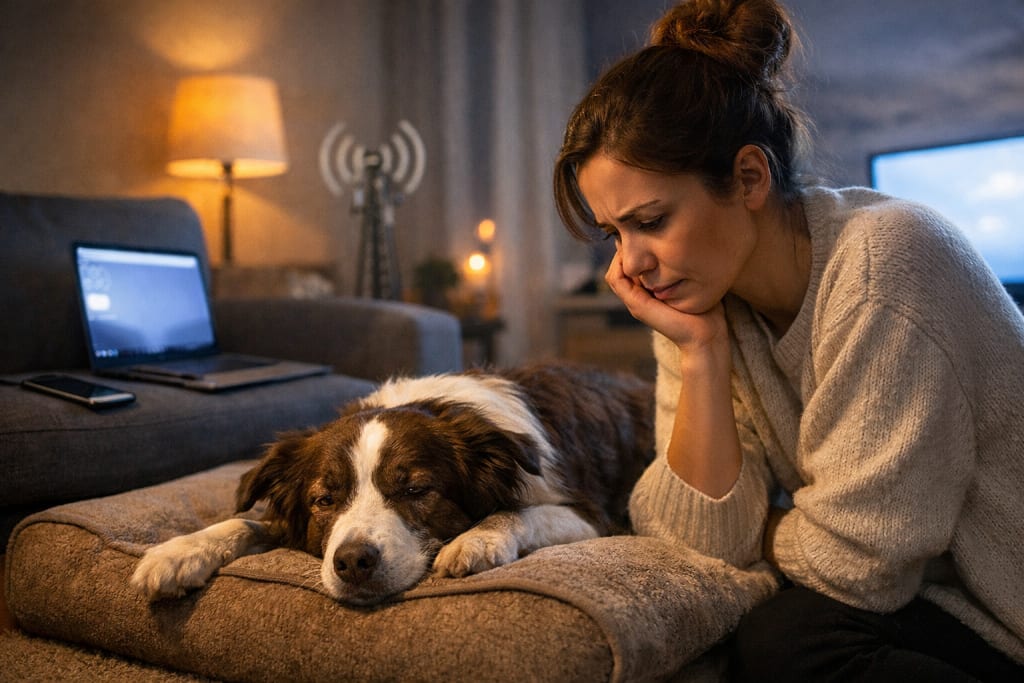
For a long time, I thought my home was the safest place my pet could be.
It was warm, familiar, filled with love. There were cozy corners for naps, toys scattered across the floor, and a predictable routine that gave us both comfort. I believed I was doing everything right — feeding the best food I could afford, keeping up with vet visits, and making sure my pet never felt alone.
That’s why it took me so long to notice something was wrong.
At first, the changes were subtle. A little restlessness here. Trouble settling down there. Moments where my pet seemed anxious for no obvious reason — pacing the room, staring off into nothing, waking up at night and moving from place to place as if searching for comfort that couldn’t be found.
I told myself it was normal.
“Maybe it’s just a phase,” I thought.
“Maybe they’re bored.”
“Maybe I’m overthinking it.”
But deep down, I felt that quiet tug of intuition pet owners know all too well — the sense that something had shifted, even if I couldn’t yet explain what it was.
When the Obvious Answers Didn’t Add Up
Like most responsible pet owners, I did what made sense. I ruled out the obvious.
I checked their food. I added more playtime. I adjusted bedtime routines. I even rearranged furniture, thinking maybe a new environment would help.
Nothing changed.
A visit to the vet didn’t reveal anything alarming either. Physically, my pet was healthy. Bloodwork was normal. No infections. No injuries. No clear reason for the behavior I was seeing.
“Some pets are just anxious,” I was told gently.
“Some are more sensitive than others.”
That explanation should have been enough. But it wasn’t.
Because I live with my pet every day. I know their rhythms, their habits, their moods. And this wasn’t just personality. This felt like discomfort — quiet, constant, and unresolved.
The Moment I Started Looking at My Home Differently
The realization didn’t come all at once. It crept in slowly, during ordinary moments.
One night, I was sitting on the couch with my laptop balanced on my legs, phone charging beside me, Wi-Fi humming in the background. My pet curled up nearby, then suddenly got up and moved across the room. A few minutes later, they came back… then left again.
Restless. Unsettled.
I started noticing patterns.
My pet avoided certain spots where they used to nap. They seemed uneasy near electronics. They startled easily, as if reacting to something I couldn’t sense. Sometimes they’d sit close to me but never fully relax.
It made me wonder: what if the problem wasn’t my pet at all?
What if it was the environment?
Living in a World Filled With Things We Can’t See
We live in homes full of invisible activity.
Wi-Fi routers transmit signals around the clock. Phones, laptops, tablets, smart TVs, smart speakers — all constantly communicating, sending and receiving data. Our homes are never truly “quiet” anymore, at least not in an energetic sense.
I had never questioned this before. Technology is just part of life now. It’s convenient, efficient, and deeply woven into our daily routines.
But my pet experiences the world very differently than I do.
Animals are more sensitive. They hear frequencies we can’t. They detect subtle changes in their environment. Their bodies are smaller, their nervous systems more reactive. They spend more time resting on the floor, near outlets, near devices, near sources we barely notice.
Once I started thinking about it, I couldn’t stop.
What if my home — the place I assumed was safest — was quietly overstimulating my pet?
When You Realize “Normal” Isn’t Always Natural
The more I paid attention, the more I noticed how unnatural modern living can be for animals.
My pet didn’t evolve alongside Wi-Fi routers or smart devices. Their biology is ancient, finely tuned to natural rhythms and subtle cues. Yet here they were, sharing space with constant electromagnetic activity, artificial lighting, and nonstop stimulation.
I’m not anti-technology. I rely on it as much as anyone else.
But I began to understand something important: just because something is normal for humans doesn’t mean it’s neutral for animals.
That realization changed the way I looked at pet care.
Health isn’t only about food and vet visits. It’s also about environment. About stressors we can’t see but that the body still responds to.
Small Changes, Big Awareness
I didn’t overhaul my life overnight. Instead, I started small.
I moved my pet’s bed away from electronics. I turned off devices at night when I could. I became more mindful about where my pet chose to rest — and where they avoided.
Most importantly, I stopped dismissing their behavior as “just anxiety.”
I started listening.
And slowly, things began to shift. My pet seemed calmer in certain areas of the house. Sleep became deeper. Restlessness softened. Not disappeared entirely — but eased.
What surprised me most was how empowering awareness felt.
I couldn’t control everything in the modern world, but I could be intentional. I could adapt my home to better support the sensitive little life that trusted me completely.
What Our Pets Teach Us About Responsibility
Pets rely on us in ways we don’t always realize.
They can’t explain discomfort. They can’t ask for environmental changes. They simply adapt — until the stress becomes too much, and it shows through behavior.
That realization humbled me.
Being a good pet owner isn’t just about providing the basics. It’s about paying attention. About questioning assumptions. About recognizing that wellbeing is layered and complex.
Sometimes love means looking beyond what’s visible.
A New Definition of “Home”
Today, my home looks the same on the surface. Same furniture. Same devices. Same routines.
But my awareness has changed.
I no longer assume that familiar automatically means safe. I no longer ignore subtle signs of discomfort. I understand that modern environments come with challenges — especially for those who experience the world more intensely than we do.
My pet didn’t suddenly become perfect or problem-free. That was never the goal.
The goal was comfort. Balance. A sense of safety that goes deeper than appearances.
Final Thoughts
The day I realized my home might be stressing my pet wasn’t dramatic. There was no single moment, no clear diagnosis, no instant solution.
It was a quiet realization — one built from observation, intuition, and love.
And it reminded me of something important: our pets are constantly communicating with us. Not in words, but in behavior, energy, and presence.
When we learn to listen — truly listen — we become better caretakers, better companions, and more thoughtful inhabitants of the modern world we share with them.
Sometimes, protecting those we love starts with simply seeing what we once overlooked.
About the Creator
Keep reading
More stories from Inamullah Momand and writers in Petlife and other communities.
Invisible Radiation in Everyday Life
We live in a world powered by invisible signals. From the moment you wake up and check your phone, to working on a laptop, connecting to WiFi, using Bluetooth earbuds, or scrolling before bed—your body is constantly surrounded by electromagnetic fields (EMFs). They’re an unavoidable part of modern life, yet most people rarely stop to think about how continuous exposure may affect their energy, sleep, focus, and overall well-being.
By Inamullah Momand 4 days ago in Education
A Dart at Dusk
Seconds ago, the sullen sun set on the two of us… my exuberant furry companion and me. A fresh breeze embraces us, delivering welcome relief from the day’s oppressive heat. His typical stumbling and staggering along — apace with a sloth — has turned into trip-trapping, high-stepping, almost skipping along.
By Angie the Archivist 📚🪶5 days ago in Petlife
Japan Pet Food Market Size and Forecast, 2026–2034
Market Snapshot The Japan Pet Food Market is projected to expand significantly, growing from US$ 6.72 billion in 2025 to US$ 14.68 billion by 2034, registering a robust CAGR of 9.07% during the period 2026–2034. This growth is being driven by rising pet ownership, increasing pet humanization, strong demand for premium and functional nutrition, and growing awareness around pet health, aging, and preventive care.
By Aaina Oberoi4 days ago in Petlife


Comments
There are no comments for this story
Be the first to respond and start the conversation.