
Real camouflage for people and machines is getting closer thanks to materials inspired by octopuses.
How colour is produced by the substance

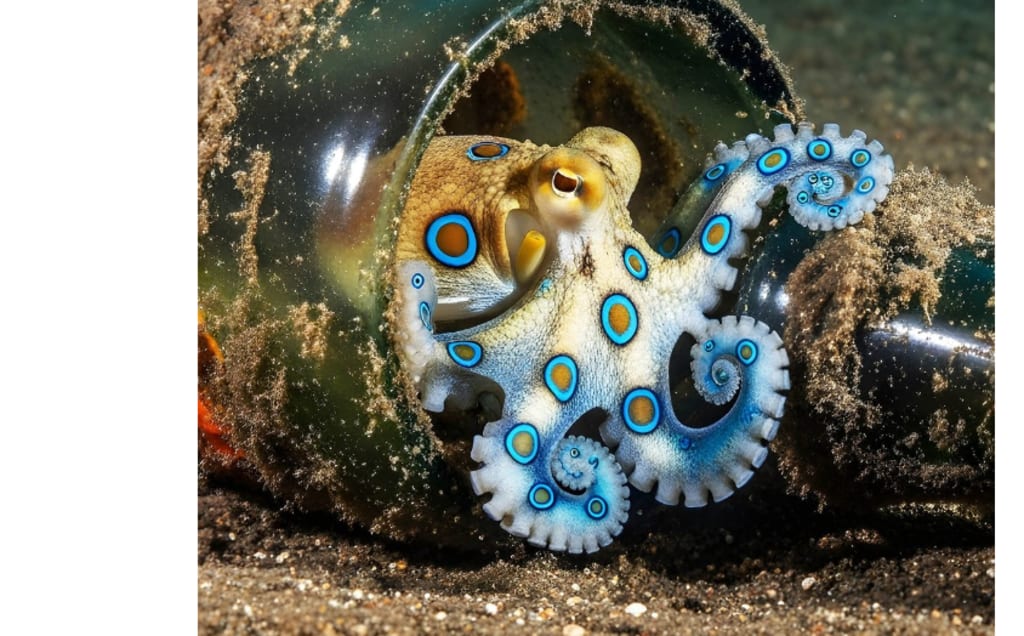
Engineers now have a closer resemblance to octopus skin thanks to a new colour-changing material that can change both its colour and surface roughness in less than 10 seconds. The soft photonic skin was created by Stanford University researchers using patterns on its surface that are tiny than a human hair.
This novel material has hidden designs that remain undetectable until the synthetic skin absorbs fluids, at which point elevated ridges and colours emerge from the same surface.
Siddharth Doshi, a Stanford PhD candidate in materials science and engineering, oversaw the project. His study demonstrates how the skin can regulate both light and touch, with a focus on soft materials.
When conditions change, octopuses and cuttlefish can quickly merge in with rocks, sand, or seaweed. Papillae can rise in less than a second, and chromatophores, pigment sacs that disperse colour as muscles pull, are controlled by cephalopods.
The same quick control is what engineers demand, but they also need it for materials that can withstand repeated usage, heat, and handling.
Creating a substance that changes colour
To create the skin, researchers first coated PEDOT:PSS, a conductive polymeric sheet found in many devices. The skin swells more in regions that readily absorb liquid because water molecules can move between the polymer strands.
The skin returns to its initial flat form after being rinsed with isopropyl alcohol, which removes water. An unanticipated mark was made using a scanning electron microscope, and subsequent testing revealed that the skin's colour changed in those exposed areas.
By crosslinking portions of the PEDOT:PSS, electron-beam lithography—a concentrated electron beam that creates nanoscale dosage maps—reduces swelling. After reusing samples rather than throwing them away, Doshi remarked, "It was definitely serendipitous."
Making camouflage out of texture
In one example, El Capitan's contour rises when wet because it was encoded into surface topography, which is made up of little hills and valleys. A flat surface becomes a textured relief as liquid penetrates deeper into low-dose areas and causes those spots to expand higher.
The technique advances patterning into extremely small, controllable scales by producing features as small as 1 micron, or 0.00004 inches. While smoother regions reflect light back in a single, brilliant, mirror-like beam, micron-scale imperfections disperse reflections in multiple directions.
The team can change a surface from shiny to matte without changing pigments by adjusting the height and spacing of features. Even when the base colour is the same, shine frequently reveals edges, thus that type of management is important for camouflage.
How colour is produced by the substance
The spacing determines which colours bounce back because light is trapped between thin metal layers on both sides. Swelling allows swelling to adjust that gap in a controlled manner using Fabry-Pérot resonators, two mirrors that choose colours through interference.
The surface can display intricate colour patterns without the need of dyes as PEDOT:PSS thickens unevenly, and each pattern remains reversible. The researchers examined if patterns continued to recur after repeatedly soaking and washing the skin.
The colour contrast continued to snap back after 250 cycles, indicating that the swelling and shrinkage did not wear off soon. However, because the system relies on liquid handling, engineers will need to be careful while sealing and routing actual devices.
Layers regulate appearance
When patterned layers are stacked, one side can set colour while the other sets texture, even when the two change simultaneously. A designer can adjust touch and appearance independently because the multilayer construction maintains each side sensitive to its own liquid.
The material becomes more like to animal skin as a result of this separation, where texture and colour are subject to distinct physical constraints. By measuring the amount of water and alcohol that enter the skin, tiny valves and channels manage swelling without compressing the substance.
The device can update patterns while maintaining flexibility thanks to micro fluidics, which are microscopic channels that carry liquids in controlled flows. Engineers can connect a target design to a particular mix by using a camera to monitor the surface as liquids change.
The loop is closed via automation.
Because a slight variation in the solvent solution can modify both bumps and colours, manual tuning still requires trial and error. The team wants swelling to be adjusted in real time using neural networks, which are software systems that learn patterns from data and feedback.
This method would enable a machine to select the liquid recipe without human input by comparing skin and background.
Friction can be changed.
A tiny robot may grasp a wall or slip past an obstruction by altering texture, which also modifies friction. When the skin flattens, raised features alter the contact area between surfaces, which can either increase or decrease resistance.
Coatings that change from sticky to slick as they move might be created by engineers, but wear and dirt from the actual world could cause problems. The same skin could direct development on medical or laboratory instruments since surface texture can influence how living cells adhere.
The way cells adhere to one another through surface proteins is called cell adhesion, and it responds to nano scale lumps that change shape when they swell. Teams will need to evaluate how the solvents impact cells over extended exposure because biology depends on chemistry and hygiene.
Where the work might go
Colour, texture, and touch may all be adjusted on a single flexible sheet by combining swelling polymers and electron-written patterns.
About the Creator
Keep reading
More stories from Francis Dami and writers in Petlife and other communities.
A Dart at Dusk
Seconds ago, the sullen sun set on the two of us… my exuberant furry companion and me. A fresh breeze embraces us, delivering welcome relief from the day’s oppressive heat. His typical stumbling and staggering along — apace with a sloth — has turned into trip-trapping, high-stepping, almost skipping along.
By Angie the Archivist 📚🪶6 days ago in Petlife
A Shocking Fact: Puppies Learn Love Before Rules
Why Puppies Bond With You Emotionally First—and Obey Second --- It happens in an instant. A tiny ball of fur stumbles into your life, tripping over its own paws, eyes wide, tongue lolling. You laugh, scoop it up, and suddenly feel a rush of affection that seems almost primal. But here’s the shocking truth scientists have uncovered: before your puppy learns “sit” or “stay,” it already knows how to love you.
By Ahmed aldeabella4 days ago in Petlife
How to Succeed at the Benson Directory®
Congratulations and welcome to the Benson Directory® employee #22391! As our newest call handler, you will have the privilege of speaking with dozens of unique and interesting people on a daily basis as well as the opportunity to earn bonuses for high performance. Contained within this handbook you will find a set of ease to follow instructions designed to help you settle in to your new role and begin paving the way to success.
By S. A. Crawford3 days ago in Fiction



Comments
There are no comments for this story
Be the first to respond and start the conversation.