
Bat brains are like live GPS devices that map the world.
The ideal location for bat testing

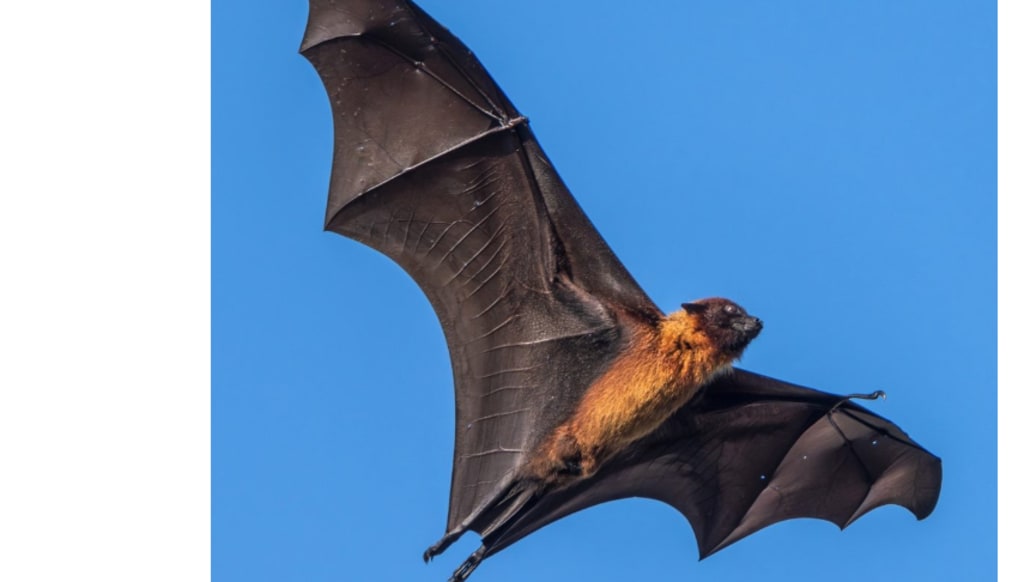
For the first time ever, researchers have observed how mammals' brains function when they navigate in the real world, not in a lab.
As is customary for bats, a small flock of fruit bats flew across the skies of Latham Island. This time, however, real-time brain recordings were made.
They discovered a sort of internal compass that was adjusted to something much more reliable and unexpected than just the bats' flight path.
The ideal location for bat testing
About 25 miles off the coast of Tanzania is Latham Island. There are no people, buildings, or towering trees on it, and it is quite small—roughly the size of seven soccer fields. It was selected for the study for just that reason.
A natural setting that felt wild but was nonetheless controllable was necessary for scientists. The island needed to be large enough for the bats to spread their wings and remote enough to prevent them from just flying away.
The area has to have enough characteristics for practical navigation while also being open enough to avoid signal obstructions. That combination is uncommon. A group from the Weizmann Institute of Science led the excursion. They left for Tanzania after packing everything they would need, including satellite technology, camping supplies, and lab equipment.
At the Central Veterinary Institute of the nation, the researchers rented and remodelled a building and set up a temporary lab there. Then scientists installed the tiniest brain-recording and GPS-tracking devices ever created to six native fruit bats.
Fighting against setbacks and storms
At initially, the journey wasn't easy. Far to the south, Cyclone Freddy, one of the longest-lasting tropical cyclones ever observed, was still raging. For the first week, the bats were unable to fly due to strong winds. However, the experiment began when the skies eventually settled down.
The bats were allowed to fly alone for up to fifty minutes per night. More than 400 neurones, particularly those used by bats for navigation, lit up deep within their brains as they flew.
The bat's internal compass
This is when things start to get interesting. A certain set of neurones would fire each time a bat pointed its head in a particular direction, such as north. This produced what scientists refer to as a "internal compass."
In a laboratory context, the brain activity had previously been observed. However, it was now observed in the wild for the first time. The compass didn't move, which was even more unexpected. It was constant and worldwide.
"Whether head-direction cells act as a local or global compass is one of the major questions in mammalian navigation," stated Professor Nachum Ulanovsky of the Brain Sciences Department at the Weizmann Institute.
"We discovered that the compass is universal and consistent: certain cells consistently point in the same direction—north stays north and south stays south—regardless of the bat's location on the island or what it observes."
Bats rely on sight rather than charm.
Birds in particular use the Earth's magnetic field to guide them. However, the bats didn't. Their compass would have been precise right away if they had. Rather, it required several nights to bring their internal compass back into balance.
Ulanovsky stated, "We saw a slow learning process until the bats' compass orientation became very stable by the third night." "Using the magnetic field, which has existed since the first night, is incompatible with such learning."
What were they utilising, then? Probably landmarks. Fruit bats mostly rely on their vision, and the bats could see the cliffs and boulders on the island. This type of navigation requires time because landmarks must be learnt, in contrast to a compass that is always present.
"There are landmarks that can be seen, smelt, or heard in every natural environment," Ulanovsky stated. The geography of Latham Island had big rocks and cliffs that might be used as navigational markers. We presume that fruit bats primarily rely on vision because it is the dominant sense and has the largest range.
Stars are not a source of direction.
Given that bats fly at night, you would imagine they might utilise the moon or stars as a guide. However, the study concluded that was not very important. "We discovered that bats can navigate without the moon or stars," Ulanovsky added.
Celestial bodies, however, may still aid in the compass's early calibration, providing bats with an additional tool to help them match what they see in the sky with what they perceive on the ground.
Bats to brains
This internal compass mechanism, known as head-direction cells, is not unique to bats. Humans are among the many mammals that contain them.
Scientists think these cells are crucial for guiding humans through the environment because they appear extremely early in brain development. "A person who couldn't navigate would not have survived until recently," Ulanovsky stated. Being able to find one's way around can still save lives today.
"We can make hypotheses about how navigation mechanisms function in the human brain and how they may be affected, for example, in neurodegenerative diseases like Alzheimer's, by studying mammalian navigation."
The crew had constructed expansive indoor areas, including a 650-foot bat tunnel, to investigate navigation back at their home lab. However, nothing compares to the wild.
Ulanovsky stated, "Our results demonstrate that there is no alternative to evaluating lab-based knowledge in the real world." "We hope our study will inspire other groups to move their research out of the lab and into nature, both in the brain sciences and beyond."
About the Creator
Keep reading
More stories from Francis Dami and writers in Petlife and other communities.
Long-held beliefs about dinosaurs before an asteroid strike are called into question by new research.
According to recent studies, North American dinosaur populations were flourishing just prior to the asteroid collision that caused their global extinction 66 million years ago.
By Francis Dami5 months ago in Petlife
Off the Leash: The Essential Gear Guide for Adventurous Dogs
There’s something wildly freeing about unclipping the leash and letting your dog move the way they were built to. If you’re hiking in areas that truly allow off-lead exploration, your gear list shifts. No harness. No leash dragging through dust. Instead, it’s about smart, lightweight essentials that keep your dog safe, hydrated, and easy to manage when adventure gets messy. Long walks off lead are less about control and more about preparation.
By Shabbir Ahmad3 days ago in Petlife
Worth the Wait: Puerto Viejo, Costa Rica
Beach bumming in a small Caribbean beach town sounded like a perfect way to end our 6-month trip through Mexico and Central America. Or so we thought. The foul, fishy stench of rotten seaweed hit our nostrils as we stepped from the cramped bus and looked out at a rather depressing, empty, and underwhelming black sand beach. It was pouring with rain, and we had to quickly fish out our ponchos. We thought, this couldn’t be it, could it?
By Sh*t Happens - Lost Girl Travel6 days ago in Wander



Comments
There are no comments for this story
Be the first to respond and start the conversation.