
Misidentified & Misunderstood:
How Breed Labeling Is Failing Shelter and Rescue Dogs



They wag their tails, lick your face, and ask for nothing but love — yet thousands of dogs are dying in shelters and rescues each year. Not because they’re aggressive, but because they’ve been mislabeled.
More often than not, that label is “Pit Bull” — a term that has become a death sentence in many parts of the country. The reality? Many of those dogs aren’t Pit Bulls at all, and many have no history of violence. But once a label sticks, it kills.
🔍 Misinformation Kills More Than Bad Behavior
Shelters, often underfunded and overwhelmed, rely on visual breed identification. Studies have shown this is wrong more than 60% of the time. Even veterinarians and trained staff misidentify dogs. That’s not just a mistake — it’s a systemic issue with life-or-death consequences.
A 2015 study published in the Journal of Applied Animal Welfare Science found that DNA testing and staff guesses often don’t match. Dogs with the wrong “look” are automatically deemed unadoptable in cities with breed-specific legislation (BSL). Some never even make it to the adoption floor.
Here’s the kicker: “pit bull” isn’t a breed. American Pit Bull Terrier (APBT) is a specific breed; “pit bull” is a nickname people—and many policies—use for several breeds and look-alikes.
If a label routinely includes dogs that aren’t APBTs, it is not a breed—it’s a bucket. Think “retriever” vs. “Labrador Retriever”: Labrador is a breed; retriever is a broader type. Likewise, APBT is a breed; “pit bull” is the broad type people use for:
- American Pit Bull Terriers
- American Staffordshire Terriers
- Staffordshire Bull Terriers
- Bull Terriers
- Boxer and Mastiff mixes
So what happens when a loving Staffordshire Bull Terrier — historically known as the “nanny dog” in the UK — gets labeled a Pit Bull?
You guessed it: fear, stigma, and a lost chance at a forever home.
🧬 Different Breeds. Different Standards. Same Fate.
The confusion deserves clarity:
American Pit Bull Terrier (UKC, ADBA)
American Staffordshire Terrier (AKC)
- Friendly, confident, and highly social. Often bred as companion dogs and show dogs.
Staffordshire Bull Terrier (AKC, UKC)
All descend from 19th-century bull-and-terrier stock, but their breeding trajectories — and intended temperaments — have diverged for over a century.
👁️🗨️ How to Tell a Staffy from a Pit Bull — and Why It Matters
You don’t need to be a dog show judge — you just need to know what you’re looking at.
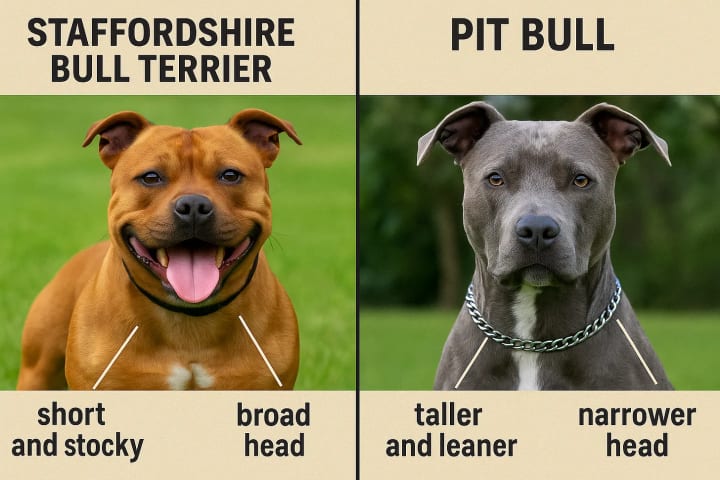
- Size: Staffies are shorter and stockier (under 16 inches). APBTs are taller and leaner.
- Head shape: Staffies have a short, broad skull. APBTs have longer muzzles.
- Build: Staffies look compact, almost bulldog-like. APBTs look more athletic and leggy.
- Temperament: Staffies are famous for their “smile” and child-friendly temperament. APBTs are affectionate too, but often higher-energy.
When in doubt, DNA testing costs as little as $50 — a small investment that can save a life.
🧠 Why This Matters Beyond Shelters
If you’re thinking, “Who cares what we call them?” — the answer is simple: labels influence laws, and laws decide life or death.
A dog labeled “Pit Bull” may be:
- Banned from adoption in certain cities
- Denied housing due to landlord restrictions
- Targeted for euthanasia based solely on classification
- Or, adopted by bad actors who use labels to funnel dogs into fighting rings
This isn’t about public safety. It’s about lazy policy, ignorance, and fear-based decision-making that values perception over outcome.
🌐 Building Empathy Beyond the Shelter
Breed mislabeling doesn’t just happen because of bad policy. It happens because of something deeper: a failure of empathy. When we reduce animals to stereotypes, we stop seeing them as individuals.
That’s one of the reasons I created P.E.T. (Psychosensory Empathy Training)—a trauma-informed VR program designed to help humans feel what animals experience.
Instead of lectures or shame, P.E.T. VR uses immersive technology and sensory feedback to reconstruct empathy in offenders and decision-makers. It’s being developed for therapists, probation officers, and even courts to use in cases of animal abuse and domestic violence — the very systems where apathy and misperception often decide fates.
Because whether it’s a mislabeled shelter dog or a neglected family pet, the root problem is the same: when empathy collapses, lives are lost.
🐕🦺 What You Can Do Right Now
- Ask your shelter how they identify breeds. Share this article with them.
- Push for DNA testing or second opinions.
- Educate others about the difference between label and lineage.
- Foster or adopt dogs with “Pit Bull” labels — many are simply Staffies or mixed breeds with no aggression.
- Support rescues that reject breed discrimination and actively fight BSL.
❤️ Because They Deserve More Than a Label
As someone who has worked in rescue and animal protection since my youth, and who has always loved animals far more than bureaucracy, I’ve seen firsthand how cruel human assumptions can be. We misjudge, mislabel, and then justify our apathy with fear.
But the dogs? They just wait. Tails wagging. Eyes hopeful. Their lives decided not by their character, but by a clipboard.
If we truly care about rescue and justice, then identification is not optional — it’s ethical.
And it's far past time to get it right.
🐾 A Personal Note: Meet Zeus
Ten years ago, I rescued Zeus from a Phoenix fighting ring. With training, he became my medical alert dog for autism — the gentlest, most intuitive companion I’ve ever had.

His DNA results tell a story his face could not: he wasn’t a “Pit Bull” at all. He was a blend of two breeds, none of which deserved the label that nearly cost him his life.

Through platforms like Pet DNA Ancestry, I even connected with over 1,500 of his genetic relatives — proof that lineage can unite us rather than divide us. Many of his matches don't even look like "pitbulls".
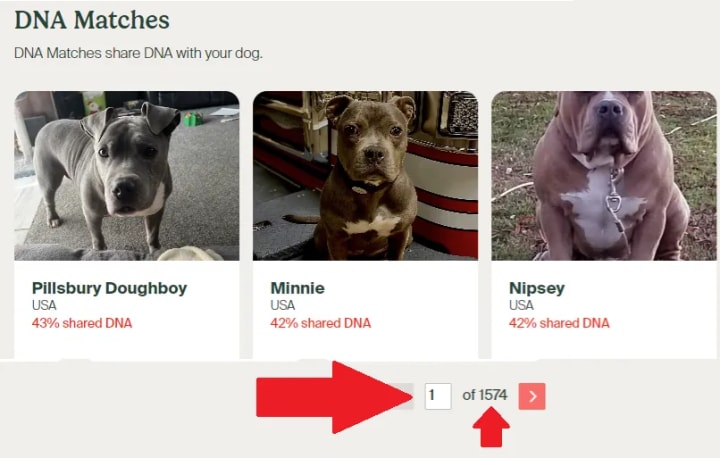

Zeus is living evidence that it’s love, not labels, that should determine a dog’s fate.
✨ Because every dog deserves more than a stereotype.
About the Creator
Dr. Mozelle Martin
Behavioral analyst and investigative writer examining how people, institutions, and narratives behave under pressure—and what remains when systems fail.
Reader insights
Nice work
Very well written. Keep up the good work!
Top insights
Easy to read and follow
Well-structured & engaging content
Excellent storytelling
Original narrative & well developed characters
Eye opening
Niche topic & fresh perspectives
On-point and relevant
Writing reflected the title & theme
Keep reading
More stories from Dr. Mozelle Martin and writers in Petlife and other communities.
The Cage I Keep Selling:
They don’t live long. That’s the part you’re warned about if you let people know you love pet rats. They’ll tell you not to get attached. They’ll remind you they’re “just feeders.” They’ll talk about their short lifespans like it should somehow make the loss easier.
By Dr. Mozelle Martin7 months ago in Petlife
Birds around the world are stressed by human noise, but humans can assist.
Birds don't simply tolerate human cacophony. According to a recent investigation, the noises of construction, traffic, and other human activities are altering the behaviour, stress levels, and even reproductive success of birds.
By Francis Dami7 days ago in Petlife
Buddy Visits Lowe's!
I've said it before: Buddy was not a dog that I needed to have. As a breeder, I have had as many as a couple of dozen dogs at a time, including the eight who currently live in the house with me. As I stated in the previous article about Buddy, I'm the "keeper of the males" when it comes to the Toy Fox Terriers. Adding another intact male dog upsets the balance for quite some time, which is not a task that I always want to undertake. It was predictable, then, that when I brought Buddy home with me internal turmoil existed for quite some time.
By Kimberly J Egan5 days ago in Petlife
Boundless
A geographical map could take you there. To the places I've been, to the sights I've seen, to the landscapes I've climbed. But no compass could point you in the direction of my memories. To the experiences I've lived, to the happiness I've felt, to the wonder I've held so close to my heart.
By Alyssa Mussoa day ago in Writers


Comments (3)
Hi we are featuring your excellent Top Story in our Community Adventure Thread in The Vocal Social Society on Facebook and would love for you to join us there
I had a mixed-breed dog that we were told by the shelter was a blue heeler/Labrador mix, but people always insisted that he had to have some “Pit Bull” in him because of how he looked. He was one of the sweetest dogs I ever had, so the thought that anyone could have been prejudiced against him just because of how he looked really struck a nerve with me. Thank you for the thoughtful, well-written article, as well as all the good work you’re doing. And congrats on the Top Story!
THANK YOU SO MUCH for this story! I tell people about "pit bull" being a catch-all all of the time, but it's amazing how few of them understand. Don't forget that American Bulldogs can be "mistaken" for APBTs, too--and even some "British" style Labrador retrievers! Shelters need to STOP pretending that they can identify breeds, especially when they often refuse to work with breeders and exhibitors who know their breeds.