
It has a body length of 2 meters and eats 30,000 ants every day. It is indeed the giant anteater that the jaguar will hide when it sees it.
The giant anteater that the jaguar hides from

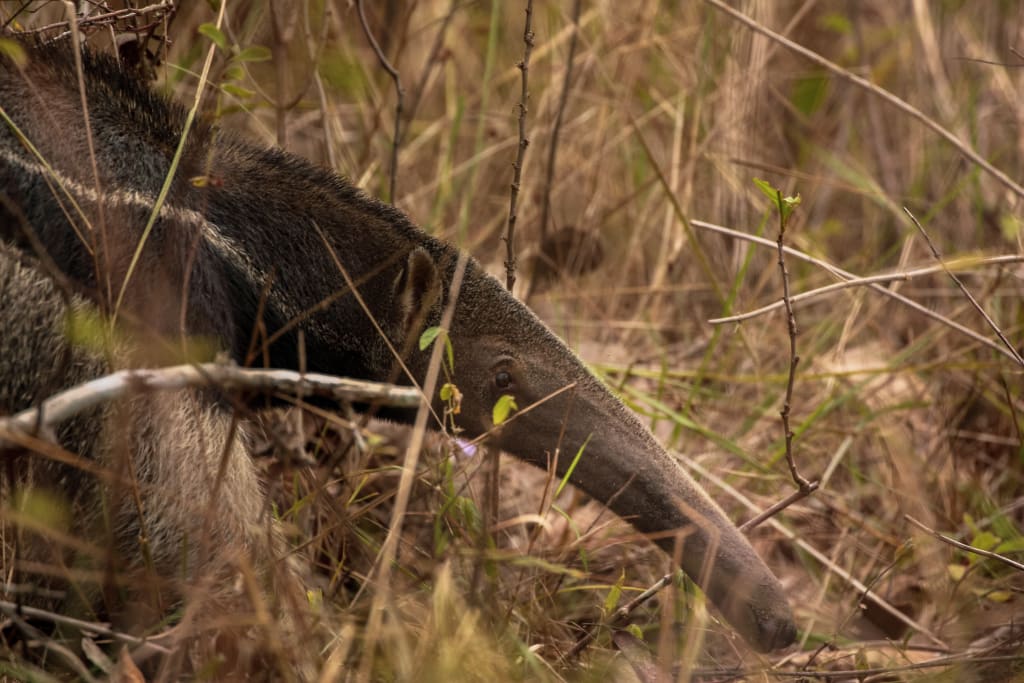
The surrealist artist Dali had a special pet, which is too common for him, but for others, it is really not something ordinary people can do to lead a big anteater to the street thing. While I'm curious as to how the giant anteater can be tethered and not slipped, there's something more worthy of discussion about this ancient beast.
First of all, why did Dalí keep a giant anteater?
The giant anteater, as its name suggests, eats ants. It's hard to guess what Dalí was thinking, but he did say that he hated and was afraid of ants, and from this point of view, raising an anteater was the perfect fit.
They basically only feed on ants and termites, and occasionally eat soft and waxy fruits and worms and insects. So to rely on a single ant weighing only 30 mg to 60 mg (0.00003 kg to 0.00006 kg) to provide enough energy, the giant anteater has to eat all the time.
They have to find more than 200 ant burrows every day to meet their physical needs. After all, finding food itself is also a labor-intensive thing.
At the same time, they have to lower their metabolism, which is why the giant anteater has a lower body temperature than other mammals, only about 32 degrees Celsius.
Eating ants is not difficult for giant anteaters. Although they have no teeth, eating ants with a tongue as long as 60 cm is "storm inhalation".
Anteaters have tiny thorns on their tongues, and their saliva is quite sticky, and they don't need to pinpoint the location of the ants, they just need to rely on their keen sense of smell to identify the area where the ants are roughly infested, and then use their long and thin tongues." Sweeping", the dense, swarming ants will be stuck by its tongue, and then all the ants will be crushed to the upper jaw and swallowed. Therefore, it is very difficult for the giant anteater to eat one ant. Once they eat it, they will be a group, or there may be hundreds of them, and they can eat 30,000 to 35,000 ants in a day.
In order to find enough ants to fill their stomachs, the giant anteater with poor eyesight will make full use of the daytime to shuttle through forests, grasslands and other places where ants are abundant. Once it encounters an anthill anthill, it will use its sharp claws first, then its proboscis and tongue. In order to avoid being stinged by the ants who fight back, the giant anteater will shake its tongue at a speed of 150 to 160 times per minute. And quickly moved to the next ant nest to start eating again. Giant Anteaters never destroy ant nests, as they may come again soon.
Second, is the giant anteater an "ancient behemoth"?
Based on fossil evidence, paleontologists speculate that anteaters have been living on the earth for 25 million years. Due to the limited fossil data, they may have appeared earlier.
Of course, giant beasts are relatively speaking. Giant anteaters are the largest among the four existing anteaters. They can weigh up to 110 jins and have a length of about 2 meters. Just looking at the data, it seems nothing, but they are very good at using their bodies to achieve The purpose of "showing up".
First, it has long hair. The length of the giant anteater's hair is about 45 cm. The shaking hair can cause a visual impact to the opponent. Then there is a big tail. Half of the giant anteater's body is the tail. The tail hair Fluffy, bushy, and very powerful, both for camouflage and self-preservation; and finally for a very good stand, giant anteaters can stand upright, and with the help of their tails stand very firmly, when they stand upright , the advantage of height will appear, to achieve the purpose of scaring off opponents.
It's really not good, the giant anteater has the blessing of the child. Male and female giant anteaters usually do not live together. Males only stay with females for three to five days when they reproduce. Female giant anteaters will conceive, give birth and raise offspring on their own. The cub is born, and it spends the next year on its mother's back.
For the female giant anteater, carrying the baby on her back for easy care is one aspect, and it is also important to make herself look more burly and to intimidate the opponent.
So, the giant anteater does not live in the trees like the small anteater, they are basically only on the ground.
Third, why are humans and animals afraid of the giant anteater's claws?
Anteaters don't attack aggressively, but their defenses in the face of danger should not be underestimated.
The giant anteater usually tries to escape at a speed of 30 kilometers per hour. If it can't, it uses its hind limbs to stand and balance with its tail, and then turns its sharp claws toward the enemy. These 10 cm long claws cooperate with powerful forelimbs. Humans, jaguars, and crocodiles all shivered.
Giant anteaters only have claws on their front legs. In order to keep their claws sharp and sharp, their walking posture is very similar to that of gorillas, that is, they use their knuckles to touch the ground. The predators of ant beast meat dare not act rashly, and will eventually choose to give up.
Moreover, there are many legends about the giant anteater among the natives of South America, which makes people afraid to touch the giant anteater, especially their claws. For example, there is a rumor that human beings will be paralyzed when they touch the giant anteater, especially if a man touches the giant anteater's claws, his fertility will be affected; Enter the fruit of the bread tree and shout another person's name. When the fruit ripens and falls, the person whose name is called will die. Of course, these are very primitive beliefs, but for the locals, they are a real binding force, not to mention catching the giant anteater alive, even if they encounter a dead giant anteater on the road, the indigenous people will be careful to bury them, so as not to bury themselves. Get bad luck.
Nonetheless, the giant anteater is threatened with survival, mainly from habitat loss and traffic accidents, and is occasionally hunted for its hide. In addition, traditional sugarcane growers will burn sugarcane forests before harvesting to remove sugarcane leaves and then cut and harvest them, which not only burns the habitat of giant anteaters, but also may burn giant anteaters. make them die.
Hopefully, the bizarre animal, the giant anteater, will not only appear in narratives and photos in the future.
About the Creator
crudden elle
Partagez un peu de science chaque jour
Keep reading
More stories from crudden elle and writers in Petlife and other communities.
Some essays on prehistoric civilization
Pre-civilization is a prehistoric civilization conjecture made by scientists based on various relics of prehistoric human civilization excavated and discovered today. It is believed that the development of human beings is not as imagined in the past, but cyclical, and there are different civilizations on the earth in different periods. There are many conjectures about the existence of prehistoric civilizations, but they have not been recognized by the academic community. However, what is left to future generations is only a myth and a lesson in human suffering from disasters.
By crudden elle3 years ago in FYI
A Dart at Dusk
Seconds ago, the sullen sun set on the two of us… my exuberant furry companion and me. A fresh breeze embraces us, delivering welcome relief from the day’s oppressive heat. His typical stumbling and staggering along — apace with a sloth — has turned into trip-trapping, high-stepping, almost skipping along.
By Angie the Archivist 📚🪶6 days ago in Petlife
Real camouflage for people and machines is getting closer thanks to materials inspired by octopuses.
Engineers now have a closer resemblance to octopus skin thanks to a new colour-changing material that can change both its colour and surface roughness in less than 10 seconds. The soft photonic skin was created by Stanford University researchers using patterns on its surface that are tiny than a human hair.
By Francis Dami7 days ago in Petlife


Comments
There are no comments for this story
Be the first to respond and start the conversation.