
How to whistle train a hunting dog
Whistle training is a powerful tool for improving communication with your dog. It helps reinforce commands like recall and stop, even from a distance. By using consistent sounds and positive reinforcement, you can teach your dog to respond reliably to the whistle, making training easier and more effective.


Whistle Training for Dogs - Sound in Training
Dogs, in all their lovable glory, are known for their energy, enthusiasm, and sometimes, their stubbornness. Whether it’s ignoring your command to sit, refusing to come when called, or just zoning out during walks, there’s no shortage of challenges when it comes to dog training. If you're frustrated with your dog’s “selective hearing,” it's time to consider adding a whistle to your training routine. Believe me, this small tool could be the key to unlocking a whole new level of communication with your dog.

A dog whistle isn’t just a novelty item—it’s an incredibly powerful training tool that offers a whole range of benefits. From reinforcing positive behavior to keeping your dog engaged during walks, the whistle is a simple yet effective way to bridge the communication gap between you and your furry friend. In this guide, we’ll explore the advantages of whistle training, the best techniques, and how to effectively incorporate the whistle into your dog’s training routine.
Why Use a Dog Whistle?
Before diving into the "how" of training, let's talk about why a dog whistle is so effective. You might be wondering, “Why not just use my voice?” After all, you communicate with your dog through words, right? Well, the dog whistle offers several unique advantages:
1. Clear, Consistent Sound

A whistle emits a high-pitched, neutral sound that’s much clearer and more consistent than your voice. Unlike verbal commands, which can vary in tone depending on your mood or stress level, the whistle sound is always the same. This consistency helps your dog understand what’s expected of them.
2. Great for Distance

The beauty of the dog whistle is that its sound travels much further than your voice. When you're in a large park, at the beach, or hiking in the woods, your dog might wander off or get distracted by something. A whistle can carry over long distances, ensuring that your dog hears it no matter how far they’ve roamed. Plus, it works in windy conditions or when there's a lot of background noise.
3. Portability

A dog whistle is small and lightweight, making it incredibly easy to carry around. Whether you’re walking in your neighborhood, hiking in the mountains, or at the dog park, the whistle can easily fit in your pocket, ready to use when you need it.
4. Effective for Training and Emergency Situations
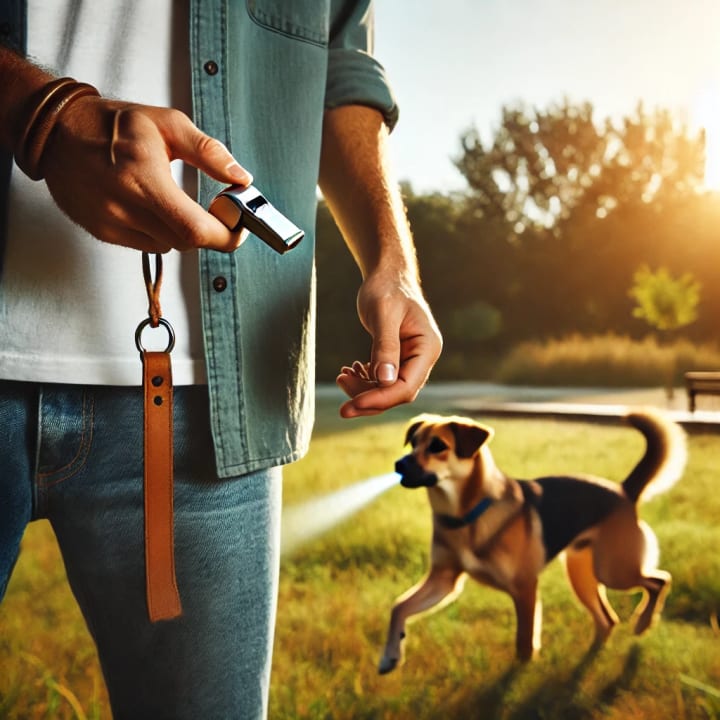
Whistles are not only great for routine training—they’re also invaluable in emergency situations. If your dog is running away or getting too far from you, a simple blast of the whistle can bring them back to your side. You can also use the whistle to break up a potential fight between dogs or to stop unwanted behavior.
How to Train Your Dog with a Whistle
Now that you understand why the whistle is so powerful, let’s dive into how to actually use it in training. Whistle training works by creating a clear and consistent association between the sound of the whistle and a specific behavior. By using positive reinforcement (like treats and praise) every time your dog responds correctly, you can teach them to respond to the whistle as if it’s their “second language.”
Step 1: Introduce the Whistle at the Right Time
The first step to successful whistle training is introducing the whistle at the right moment. If your dog is failing to respond to verbal commands, it’s time to pull out the whistle. The key here is timing—blow the whistle right when your dog is doing something right. For example, if you’ve just called your dog to come and they start to move towards you, blow the whistle and reward them immediately when they reach you. This helps create a clear link between the sound of the whistle and positive behavior.

At first, you might want to use treats every time your dog responds to the whistle. This helps reinforce the behavior and ensures that your dog associates the whistle with something enjoyable.
Step 2: Use Different Whistle Sounds for Different Commands
Dogs are smart, and they can learn to differentiate between various sounds. Just as you would use different words for different commands (sit, stay, fetch), you can use different pitches and lengths of whistle to indicate different actions.
- Short, Sharp Whistles: These are great for commands like “come” or “sit.” A quick blast grabs your dog’s attention and tells them it’s time to act.

- Long, Descending Whistles: These can be used for commands like “stop” or “stay.” The longer, drawn-out sound is a signal for your dog to stop what they’re doing and sit or lay down.
- Multiple Short Whistles: A few quick, sharp whistles can be used for a recall command, especially if you need your dog to return from a distance.
By creating a consistent pattern, your dog will soon recognize which whistle sound corresponds to which action. The beauty of this system is that it works even if your dog is far away or distracted, ensuring that they respond to your commands no matter the situation.
Step 3: Gradually Replace Verbal Commands with the Whistle

Once your dog starts responding to the whistle, you can begin phasing out verbal commands. This doesn’t mean you stop talking to your dog altogether, but rather that you use the whistle as the primary cue. For example, if you’ve been saying “sit” and blowing the whistle, start blowing the whistle alone and only reward them when they comply. Over time, your dog will understand that the whistle alone is the signal to perform the action.
Step 4: Repetition is Key
Whistle training, like any other form of dog training, requires consistency and repetition. Start with short training sessions—about 5 to 10 minutes, 5 times a week—and focus on one command at a time. Make sure to always reward your dog immediately after they respond to the whistle correctly.

The more you practice, the more ingrained the behavior will become. Don’t expect results overnight, but be patient. Your dog will begin to understand what each whistle means, and before you know it, they’ll be responding to the whistle just as reliably as they would to your voice.
Step 5: Use the Whistle for Different Situations
Don’t limit your whistle training to basic commands. A whistle can be invaluable in a variety of situations. For example:
- Recall: If your dog is running off-leash, a quick whistle blast can call them back to you.

- Interrupting Unwanted Behavior: If your dog is getting too rowdy or misbehaving, a whistle can snap them out of it and refocus their attention.
- Preventing Fights: In a multi-dog household or at a dog park, the whistle can be used to break up squabbles or prevent aggressive behavior.
The more your dog hears the whistle and associates it with something positive, the more reliable their response will be.
Hunting Dogs and the Whistle - A Perfect Pair
If you’re training a hunting dog, a whistle is practically indispensable. Dogs bred for hunting, like retrievers or pointers, have an instinct to chase and track game. While this trait is wonderful in the field, it can sometimes lead to them straying too far. This is where the whistle comes in.

In the world of hunting, the whistle is an extension of the handler’s voice. It’s the primary tool used to give commands from a distance, whether you're recalling your dog or instructing them to stop.
The Two Main Commands: Recall and Stop
For hunting dogs, the two most important commands you’ll need to teach with the whistle are:
- Recall: A short, sharp whistle is used to signal your dog to return to you.
- Stop: A long, descending whistle tells your dog to stop whatever they’re doing and wait for further instructions.

These two commands can be life-saving in hunting scenarios. Imagine your dog chasing game and getting distracted by a scent. A well-timed whistle can snap them back to focus and keep them safe.
Training Steps for Hunting Dogs
1. Start with Puppy Training: Begin whistle training as early as 3 months old. Puppies are still in their playful phase and are highly receptive to new sounds. Use the whistle to teach recall with a few short, sharp blasts. Reward your puppy every time they respond to the whistle by coming back to you.

2. Leash Training: Once your dog is about 6 months old, you can start teaching the stop command using a leash. Walk your dog by your side, stop, and give a long, descending whistle. Reward them when they sit or lay down.

3. Reinforce Without a Leash: Once your dog is responding well to the stop command on a leash, practice it without the leash. The whistle should be enough to get them to stop, even if they’re far away.

4. Increase the Distance: Gradually increase the distance between you and your dog. The goal is for your dog to respond to the whistle no matter how far away they are, even in the midst of a hunt.

5. Vary the Commands: As your dog masters the basics, start using the whistle for more advanced commands. For example, you can use the whistle to send your dog off in a particular direction or recall them from a long distance.

Patience and Persistence - The Keys to Success
Whistle training isn’t a one-day process. It requires patience, consistency, and plenty of positive reinforcement. Some dogs catch on quickly, while others take a little more time. Be patient and keep training sessions short, focused, and fun.
By using the whistle consistently, you’ll build a strong foundation of communication with your dog. Whether you're training a pet dog, a working dog.
Thanks for your reading.
About the Creator
Keeping your pets safe (and calm) this holiday season
The holiday season may be magical for some humans, but for pets it only means confusion, changed routines, overstimulation, extra noise, guests or pet sitters come and go, and sometimes the festive season means danger for pets.
By Susan Fourtané 19 days ago in Petlife
The Royal Cat Who Feared Bananas: A Tale of Oddities and Royalty
In the quaint little house on Maple Street, where the neighbors would wave as they walked their dogs, lived a cat who was, without a doubt, the strangest of all the felines in the neighborhood. Her name was Duchess Whiskers, and she was convinced that she was royalty. But despite her airs of elegance and refinement, she had one significant problem that threatened to ruin her majestic facade: she was absolutely terrified of bananas.
By Ahmed aldeabella6 days ago in Petlife



Comments
There are no comments for this story
Be the first to respond and start the conversation.