
Building a Dog Agility Course
All because I volunteered at an agility trial . . .


I used to love doing agility with Beau. Every so often, when the agility bug hits, I check out locally posted premium lists and run through my many reasons that I can't enter: I can't afford it, Badger doesn't have weaves, I can't afford it, it's too far to travel and get back to milk goats, I can't afford it, I really don't feel like someone playing "embarrass the human" again so soon . . . However, in 2023, I talked myself into two "For Exhibition Only" entries for Badger at an agility trial in Louisiana, just a couple of hours away. Those entries revealed all the flaws he had that needed correcting before we trialed for real--and I do mean ALL the flaws. "Embarrass the human?" No. Let's true "humiliate the human so badly that she doubts all of her skill as a dog trainer!" But being as resilient (stubborn/gullible/pathetic) as I am, I resolved to work harder on his focus and his weave poles and put away the idea of competing for a while.

Last year, sometime around the end of April, I was bitten by the agility bug again. To my shock, I found a premium list for a trial not 30 minutes from my home. I had discovered it too late to enter, even just entering Badger FEO, but I contacted the club to see if they needed volunteers to work at bar setting and other things. (Helpful hint: Agility clubs always need volunteer workers at their trials. Even if you know nothing about agility you can help running leashes or scribe sheets.) A week later, I was on my way, in comfy shoes and coffee in hand, at 6:15 a.m. for a fun-filled day at the trial. I ran leashes, reset jump bars that had been knocked down, and moved obstacles for course building between classes. After three days, I was exhausted, sore, and thoroughly consumed by the agility bug.
After I recovered, I was more determined than ever to build myself an agility course upon which to practice at home. I had a little practice tunnel at home already. I also had a few jumps and a pause box (four pieces of 4-inch PVC connected in a square, for those who aren't familiar with UKC agility). After the trial, I decided that it was time to put the gift cards I'd won in workers' raffles to good use and to expand my equipment collection just a little. I purchased an "add-on triple jump" to the selection and a few jump cup strips to make more single jumps. I still needed contact obstacles, but I was ready to start a little field practice. All went well, until Badger lost his eye in 2024.
Keep in mind, a dog needs depth perception to participate in agility. Some dogs do well without depth perception. They form a tremendous team bond with their handler and trust them to give the command to jump at the right time. After a little while, they adapt and develop a skill that accurately judges distance, even if it is not the same as having depth perception. Badger was not that dog. I put aside any hope of competing with him, to avoid his being injured. At that time, I didn't have a dog that I could plug into learning, not in time to Do Anything in the fall. I stopped building my course and life got in the way for the rest of the year. I did add a practice teeter (yay!), but that was the extent of my course building.
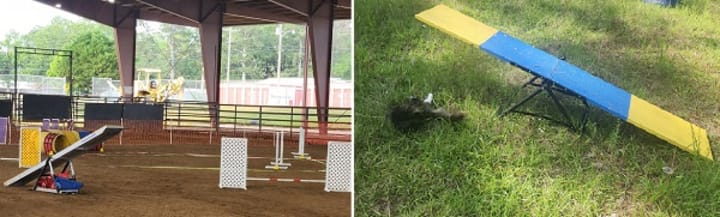
Once again, as it does every year, April rolled around again. I found an email in my box about two weeks before the trial. "Are you interested in volunteering?" Why yes. Yes, I am. This year, I helped set up before the trial, as well as leash running, bar setting, and moving contact obstacles. It was fun, as it had been last year, and I left with new resolve. A friend had already contacted me about doing agility league with her in the fall, so my excitement had already begun to build. Over the months spent sulking over the loss of Badger as a competitor I had discovered that Steele and Cassidy might be good candidates for agility training. I decided that I could add in Goth as a third potential candidate, if I could get his squirrely little brain under control and, if all three panned out, I could run all three in different classes even if they would be in novice competition at the same time.

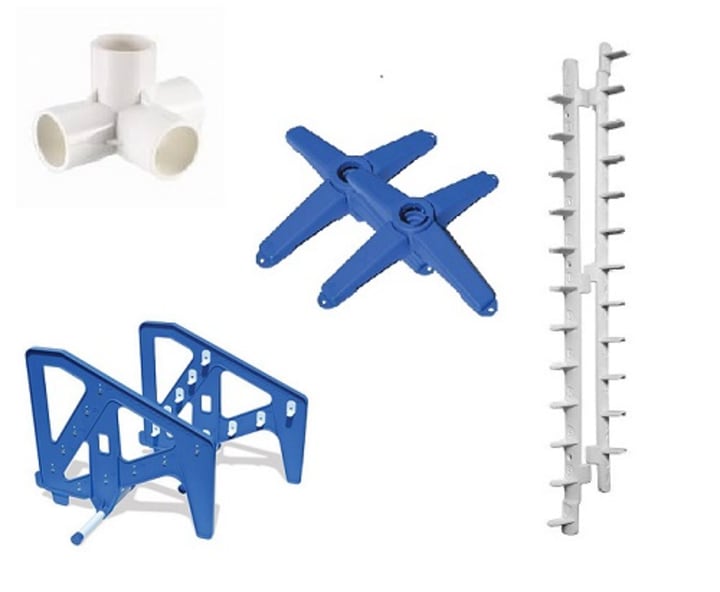
My resolve newly rekindled, I supplemented my three new gift cards with some cash and some credit and purchased some new 3/4" tees (for weave pole connectors), a new PVC cutter, a backyard hoop jump, and a backyard dog walk (some assembly required). In addition to the things I purchased, added a set of six weave poles from PVC I already had purchased for other projects. None of these things were wildly expensive and they gave me something upon which I can train between formal (club) classes. Once I get everything polished up, I will take a picture of my final course. I still need a home A-frame, an adjustable pause table, and a couple of double jumps, but those things will come in time. Until then, I'll work with what I have. I plan to enroll in an agility course taught by the club for which I've been volunteering, probably sometime in June. With any luck, we'll have fun things to report in just a few months' time.

~*~ ~*~ ~*~ ~*~ ~*~ ~*~ ~*~ ~*~ ~*~ ~*~ ~*~ ~*~ ~*~ ~*~ ~*~ ~*~
Agility is a lot of fun and is a great team- and confidence-building sport, even for people and dogs who will never compete at a trial. If your dog has a solid sit and stay and comes when he or she is called, then you have the foundation for training your dog to do agility. I highly recommend it as a sport and as a training tool to build your relationship with your best friend.
As usual, if you like my work, please feel free to like and to comment. If you have any questions about getting started in agility, please feel free to ask here. In future blogs, I will be commenting on the various competitive venues for dog agility.
About the Creator
Kimberly J Egan
Welcome to LoupGarou/Conri Terriers and Not 1040 Farm! I try to write about what I know best: my dogs and my homestead. I'm currently working on a series of articles introducing my readers to some of my animals, as well as to my daily life!
Keep reading
More stories from Kimberly J Egan and writers in Petlife and other communities.
Delivering a Puppy
Every so often, you find a family that is super-wonderful, that you just have to have for one of your puppies. They are pleasant on the email inquiry, hit all the sweet spots on the questionnaire, and don't bat an eye about your contract. Then, out of the blue, they mention that they live 550 miles and two states away from you.
By Kimberly J Egan8 months ago in Petlife
Keeping your pets safe (and calm) this holiday season
The holiday season may be magical for some humans, but for pets it only means confusion, changed routines, overstimulation, extra noise, guests or pet sitters come and go, and sometimes the festive season means danger for pets.
By Susan Fourtané 16 days ago in Petlife
The Royal Cat Who Feared Bananas: A Tale of Oddities and Royalty
In the quaint little house on Maple Street, where the neighbors would wave as they walked their dogs, lived a cat who was, without a doubt, the strangest of all the felines in the neighborhood. Her name was Duchess Whiskers, and she was convinced that she was royalty. But despite her airs of elegance and refinement, she had one significant problem that threatened to ruin her majestic facade: she was absolutely terrified of bananas.
By Ahmed aldeabella3 days ago in Petlife


Comments (1)
Good work on this, Kimberly. Best wishes & remember to have fun!