
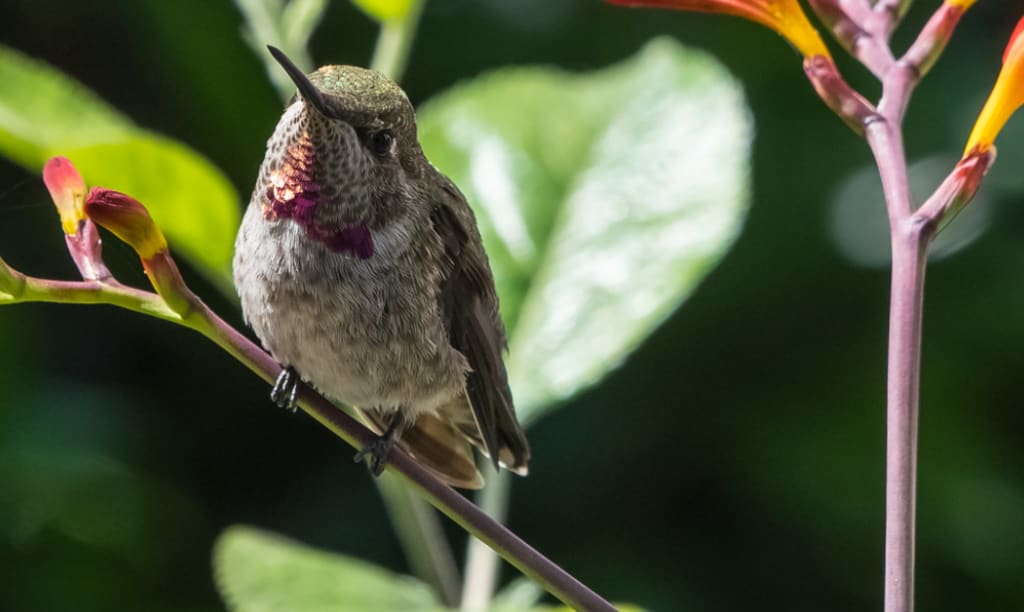
Hummingbirds are native to America and belong to the biological family Trochilidae. There are 360 plus species of hummingbirds are found all over the world. But their vast majority is found in Alaska to Tierra del Fuego and in the tropics. Most of these small birds are measuring 7.5 to 13cm in length. But the smallest hummingbirds are the bee hummingbirds that are only 5cm long with 2g weight. While the largest hummingbirds are the giant hummingbirds that are 23cm in length with 18 to 24g weight. They like to feed the natural nectar from flowers and artificial nectar from the feeders. But in some seasons, they also eat insects and spiders to fulfill their protein needs.
1. Ruby-throated Hummingbird Species
Ruby-throated hummingbirds are most like the broad-tailed hummingbirds, which have duller and lack of black throat and lack of black chin than the Ruby-throated hummingbirds. So, don't confuse these two hummingbird species as both have overlapping ranges. Usually, the males are medium-sized hummingbirds with a bright red throat and a black chin and mask extended behind their eyes. Their head and back are iridescent green with pale grey underparts and greenwash sides. On the other hand, the females are duller than the males, and their chin and throat are lacking in white and pale green as compared to males. These hummingbirds are common in the United States during the summer season. During the cooler temperatures, they migrate to Mexico.
2. Rufous Hummingbirds
Don't confuse the Rufous hummingbirds with Allen's hummingbirds, as the Allen's have greener on their crown and back. Moreover, Allen's has narrower tail feathers with a slightly downward-curved bill. The male Rufous hummingbirds have bright copper-orange on their back and on the sides of their belly. Their beautiful reddish-orange iridescent throat with white breasts makes them very attractive to humans. While the females have a green crown, neck, and back with copper-colored sides. Their belly and breast are white as compared to the male. These hummingbirds love to fly over the north up the Pacific Coast to their summer breeding grounds and return to their home in Mexico in winter. Rufous hummingbirds are known for their aggressive approach throughout the United States. So, make sure to use the multiple hummingbird feeders if you want to attract other species in the presence of Rufous hummingbirds.
3. Black-Chinned Hummingbirds
Many people mix the black-chinned hummingbird with Ruby-throated hummingbirds. But it's usually not happened due to entirely different ranges of both species. The male birds are medium-sized with a metallic green body, white breast, and greenish flanks. Their head appears black, the crown is very dark green, and the throat is iridescent violet. While the females have a greenish-grey cap on the head with a green back. They have a white spot behind the eyes like the males. You can distinguish them from a male with a dark-spotted grey throat and white breast. Black-chinned hummingbirds breed in the United States during the summer months and migrate to Coasts and Mexico during the winter season. It's one of the most common hummingbird species, which can be found in various habitats. You can easily locate them in the places like mountains, alpine meadows, canyons, orchards, urban areas, and in distributed areas as well.
4. Calliope Hummingbirds
Calliope female hummingbirds are most like the Rufous female hummingbirds. The main difference in both is their size, as the Rufous hummingbirds are larger with the long bill. The male calliope hummingbirds can easily be identified with their long and magenta throat feather. While their head, underparts, and flanks are metallic green. They are known for performing the U-shaped dive to impress the females with their white breasts. On the other hand, the females have dark spots on their white throats instead of magenta throat feathers. The females have a metallic green head and back with white and buffy breasts. It's the smallest hummingbird species found in the United States, with only 2 to 3 grams of weight. Their long migrating route is very shocking for people depending upon their small size. They love to spend winter in Mexico and migrate to the Pacific coast in the summer season.
About the Creator
Keep reading
More stories from writers in Petlife and other communities.
A Dart at Dusk
Seconds ago, the sullen sun set on the two of us… my exuberant furry companion and me. A fresh breeze embraces us, delivering welcome relief from the day’s oppressive heat. His typical stumbling and staggering along — apace with a sloth — has turned into trip-trapping, high-stepping, almost skipping along.
By Angie the Archivist 📚🪶4 days ago in Petlife
Japan Pet Food Market Size and Forecast, 2026–2034
Market Snapshot The Japan Pet Food Market is projected to expand significantly, growing from US$ 6.72 billion in 2025 to US$ 14.68 billion by 2034, registering a robust CAGR of 9.07% during the period 2026–2034. This growth is being driven by rising pet ownership, increasing pet humanization, strong demand for premium and functional nutrition, and growing awareness around pet health, aging, and preventive care.
By Aaina Oberoi3 days ago in Petlife
Wild Card Weekend Recap: What Happens Now?
I think I figured out why I love Wild Card Weekend so much. It's because it's the first playoff anything of the calendar year. The NFL season starts in the fall, and once upon a time, the champion was crowned either on or slightly before New Year's. The evolution of the NFL schedule has resulted in the playoffs starting just into the New Year, and currently, the final week of the season falls on the first weekend of the New Year, with Wild Card Weekend coming a week after that. So yes, chronologically, the NFL's Wild Card Weekend serves as the first playoff anything of the calendar year.
By Clyde E. Dawkins5 days ago in Unbalanced




Comments
There are no comments for this story
Be the first to respond and start the conversation.