
"Words That Build or Destroy: The Untold Story of Two Villagers"
In a small village, two men with contrasting manners demonstrate how language can either build bridges or burn them.

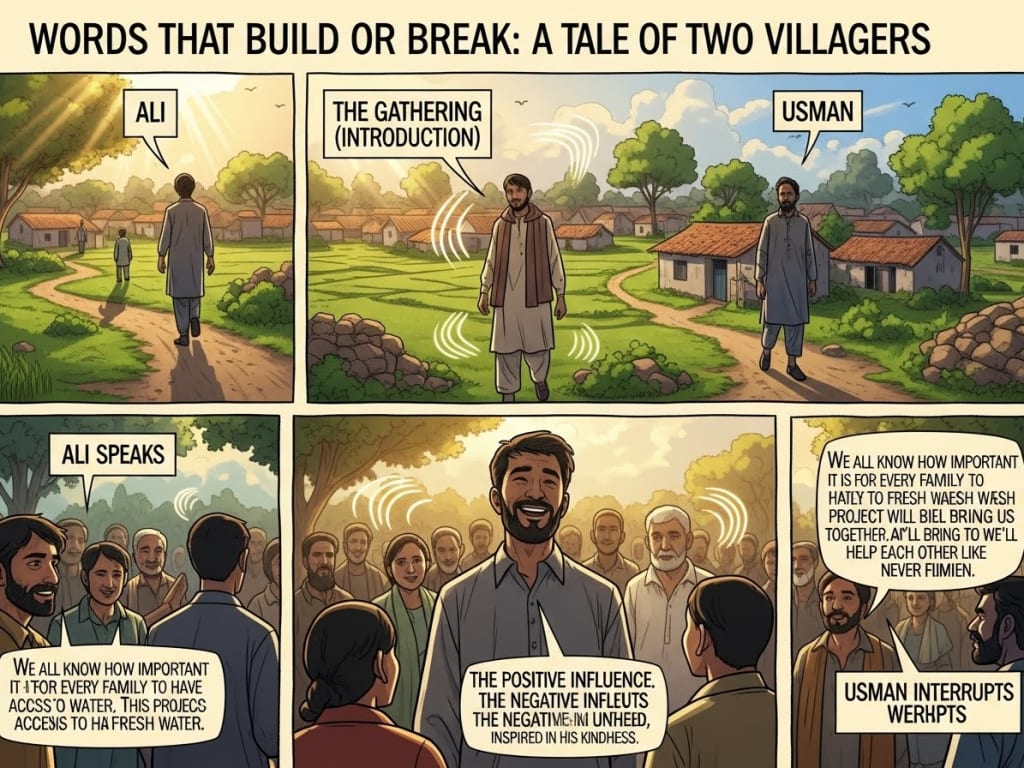
In every society, the words we speak can shape our relationships, influence our reputation, and even define the way we are perceived. The power of language is so immense that it can be both a friend and a foe. Today, let’s explore the contrasting effects of good and bad manners through the story of two villagers, Ali and Usman, who lived in a remote village.
The Characters:
Ali, a man known for his kindness and good manners, had a reputation for speaking gently and with respect. His words always uplifted the spirits of others, and his interactions were filled with sincerity. He believed that words were a reflection of the heart, and that every conversation, no matter how small, was an opportunity to either build a relationship or break it.
On the other hand, Usman was known for his sharp tongue and rude behavior. His words were often harsh, and he did not hesitate to speak his mind, even if it meant offending others. Usman believed that speaking his truth was more important than worrying about how others felt. He thought that words were tools to dominate, to show power, and sometimes to insult.
The Conflict:
One day, both Ali and Usman were invited to a village gathering. It was an event where the entire community came together to discuss important matters. The village elders, who had a great deal of influence, would be present, and it was a time for everyone to voice their opinions and be heard.
As the meeting began, the first topic was about building a new well for the village. Ali stood up first. With a calm and respectful tone, he spoke about the need for the well and the resources required. "We must come together," he said, "to make sure that everyone in the village has access to clean water. It’s not just about building a well, but about building hope and a better future for our children."
His words were met with nods of approval. The elders were pleased, and even the younger villagers appreciated his diplomatic approach.
Next, Usman stood up. He immediately contradicted Ali’s approach, not with constructive criticism, but with sharp words. "This is a waste of time!" he declared loudly. "We don’t need a new well; we need to fix what we already have! If people don’t know how to manage the resources, it’s not the fault of the well!"
The room fell silent. Some people looked uncomfortable, while others exchanged glances. Usman’s bluntness had alienated many. He had not considered the emotional impact of his words. His manner of speaking wasn’t one of cooperation, but of confrontation.
The Consequences:
Over time, the villagers began to notice a pattern. Ali, with his respectful and thoughtful words, was becoming a leader in the village. People came to him for advice, and his reputation as a wise and compassionate individual spread beyond the village.
Usman, however, found himself isolated. His harsh words and lack of tact had earned him the disdain of many. Though he still spoke with authority, his influence began to wane. People avoided him, not because they disagreed with him, but because they felt hurt by his words. He had unknowingly alienated himself from the very community he sought to influence.
Reflection:
This story reflects the truth that language holds immense power in shaping our interactions. The impact of good manners, respect, and kindness can make us loved, trusted, and respected in society. On the other hand, using harsh or disrespectful language may provide temporary satisfaction but will eventually isolate us, no matter how valid our points may be.
The Lesson:
Ali’s story teaches us that in our daily interactions, we must strive to speak with kindness and respect. Words should not be used to dominate, insult, or belittle others, but to build connections, spread positivity, and contribute to a healthy, supportive community.
Usman’s experience, meanwhile, serves as a warning. Words that may seem truthful at the moment can have long-lasting negative effects if not expressed with consideration and empathy. Being harsh with words not only affects others, but it also leaves a mark on the person speaking them.
Conclusion:
As we navigate through life, we must remember that our words are a reflection of our character. They can either uplift or destroy, create peace or spark conflict. In a world that is increasingly divided, let us choose our words wisely, for they have the power to shape our relationships and our future.
About the Creator
Daily Motivation
Hi | Assalam Ulaikum | Wellcome to my profile | This is a Motivation Page | You can tell me your Problem so i can help you... my whatsapp number +92 336 7762 162
Keep reading
More stories from Daily Motivation and writers in Motivation and other communities.
🌟 The Resilience of Life 🌟
Life has a way of surprising us—sometimes gently, and sometimes so powerfully that it shakes the ground beneath our feet 🌍💥. But hidden inside every difficult moment, there is a spark waiting to rise, a quiet strength waiting to awaken. This is the story of Sarah, a woman who discovered her power only when life pushed her to her limits 💫🕊️.
By Daily Motivationabout a month ago in Motivation
How I earn $100 in a day
There was a time when earning $100 in a single day felt like a fantasy to me. Not a goal — a fantasy. I remember staring at my phone late at night, doing small mental calculations: If I earn $5 today and $10 tomorrow, maybe by the end of the month… Even those numbers weren’t guaranteed. Some days, nothing came in at all. And that silence — the absence of notifications, emails, or messages — was louder than failure. People online love to talk about success like it’s loud and shiny. For me, it was quiet. Heavy. Full of doubt. The day I earned $100 didn’t begin with excitement. It began like every other day: tired eyes, a slow morning, and a question I kept asking myself — Is this even worth it? What kept me going wasn’t motivation. It was necessity. I didn’t suddenly become smarter or more talented. I didn’t discover a secret website or a hidden trick. I simply stopped waiting for the “perfect” moment and started using what I already had. I offered small digital work. Simple things. Work that wouldn’t impress anyone on social media — but work that people genuinely needed. And I did it sincerely. That day, the first payment came in early. It wasn’t big. Just enough to remind me that someone trusted me with their money. That feeling mattered more than the amount. Later, while I was offline, something unexpected happened. A digital product I had created earlier — something I almost didn’t upload because I thought it wasn’t good enough — sold. Then it sold again. I stared at the screen for a few seconds, unsure whether to smile or stay calm. By evening, another small task came my way. Then one more. None of these moments felt dramatic. No fireworks. No victory music. Just quiet confirmations that effort, even imperfect effort, still counts. When I finally added everything together late at night, my heart paused. It crossed $100. I didn’t jump. I didn’t celebrate. I just sat there — still — because for the first time, the number felt real. What hit me hardest wasn’t the money. It was the realization that I had been underestimating myself for a long time. I believed earning like this was reserved for “others” — more confident people, more skilled people, luckier people. That belief was wrong. Earning $100 in a day didn’t change my life instantly. But it changed something inside me. It replaced doubt with proof. And proof is powerful. Now I understand something important: money doesn’t always come from doing big things. Sometimes it comes from doing small things consistently and with sincerity. Some days I still don’t reach $100. Some days are quiet again. But the fear is gone. Because once you know something is possible, it stops being a dream and starts being a process. I no longer wait for motivation. I work, even when I feel unsure. I trust that effort never disappears — it just takes time to show itself. If you’re reading this while feeling stuck, tired, or invisible, I want you to know something honestly: You’re not behind. You’re just early in your story. And one ordinary day — without warning — things can start to add up.
By Shah Fayaz 7 days ago in Motivation
The Devil's Cut
“Comrade, finally you’re awake.” The voice was smooth, sensual. A flickering incandescent bar was all that lit the white, sterile room. All Vladimir remembered was everything going black. He tried to move his arms and found them strapped to the gurney.
By Matthew J. Fromm5 days ago in Fiction



Comments
There are no comments for this story
Be the first to respond and start the conversation.