
Why Comfort Is Making Us Unhappy
Modern life promises convenience, safety, and abundance—so why does it often feel harder to live in?

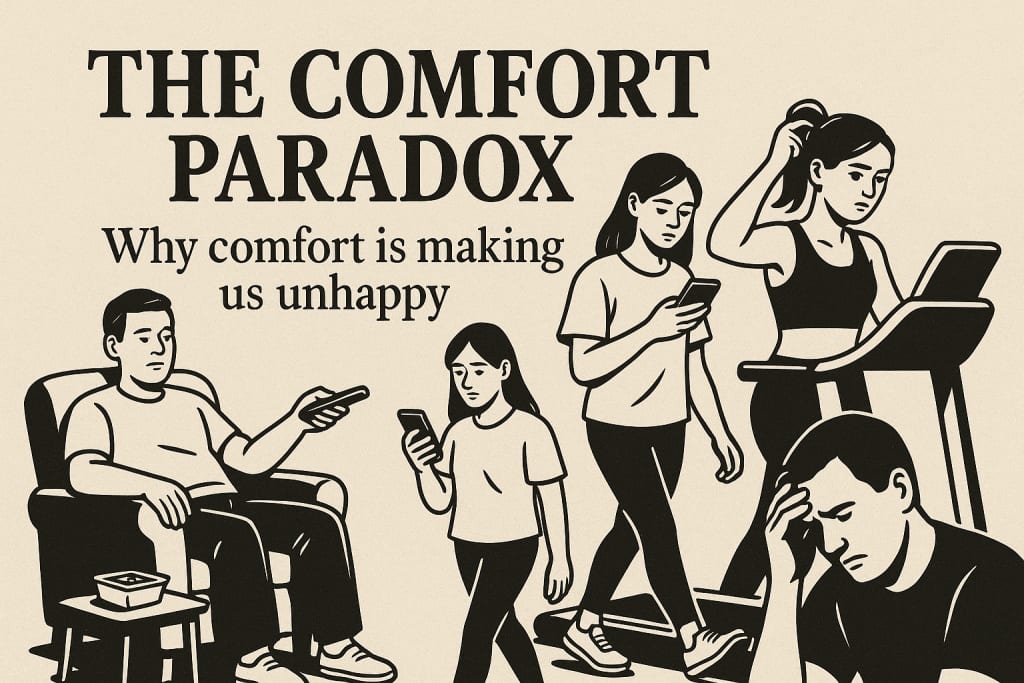
Introduction: The Era of Effortless Living
We live in the most comfortable era human beings have ever experienced. Food arrives at our doors without cooking, lights turn on with a voice command, thermostats adjust automatically, and cars almost drive themselves. Healthcare is better. Violence is lower. Life expectancy is higher.
Yet rates of anxiety, depression, burnout, and dissatisfaction continue to rise across developed societies. How can it be that in a world designed for our comfort, so many feel unfulfilled?
Welcome to the comfort paradox: the strange reality where life becomes emotionally harder as it becomes physically easier.
Section 1: Evolution Didn't Prepare Us for This
For millions of years, human beings evolved under conditions of scarcity, threat, and physical hardship. Our brains are wired to survive, not to be content in abundance. Every stress hormone, every neural circuit, was tuned for reacting to real, immediate danger—lions, hunger, cold, or tribal conflict.
But the modern world removed those problems… and replaced them with existential ones. Instead of fearing predators, we fear missing out. Instead of physical exhaustion, we face emotional fatigue. Instead of survival, we seek “meaning.”
We were not biologically designed for comfort—we were designed for struggle. And without clear struggles, we start to manufacture our own.
Section 2: The Death of Small Triumphs
In the past, daily life gave us little victories that reinforced our sense of agency: hunting successfully, fixing something broken, planting a crop, carrying water. These tasks were tiring, yes—but they were also satisfying. Progress was visible and tangible.
Today, many of our efforts are virtual or vague. We answer emails, attend meetings, scroll feeds, or optimize spreadsheets. Even when productive, our work can feel abstract. Where’s the sense of real completion?
Convenience has replaced effort, but it has also stolen meaning. And that theft has psychological consequences.
Section 3: Resilience Needs Resistance
Much like muscles, human character only grows when it’s challenged. Take away resistance, and resilience weakens.
Overprotection—physically or emotionally—can make us fragile. This is known as the “anti-fragility” concept, popularized by Nassim Taleb. Just like bones get stronger under pressure, minds grow stronger when tested.
But what happens when children grow up in padded environments, where failure is avoided and every need is instantly met? They don’t grow braver—they grow anxious. The very absence of challenge creates a fear of the world.
Comfort isn't just neutral—it can make us soft, anxious, and easily destabilized.
Section 4: Artificial Problems in a Painless World
In a comfortable world, the mind still needs something to struggle against. So it starts creating problems.
We become obsessed with minor slights, with online debates, with perfecting our bodies, diets, or productivity. We catastrophize inconvenience. We overthink relationships. We invent identity crises.
Because when there’s no tiger to fight, we turn small discomforts into symbolic ones: "This person doesn't like me" feels like a survival threat. "I’m behind in life" feels like a death sentence.
Without external adversity, internal anxiety thrives.
Section 5: The Myth of Effortless Happiness
One of the most dangerous ideas sold by consumer culture is that happiness comes from ease—luxury, relaxation, instant gratification. But all the research says otherwise.
Happiness, or more accurately well-being, tends to come from:
Purpose
Effort
Growth
Connection
Service
Comfort without these things can actually create emptiness. Like eating candy every day—it feels good briefly, but leaves you hollow.
Effort is not the enemy of happiness. It’s the price of it.
Section 6: Reintroducing Struggle Intentionally
The comfort paradox can’t be solved by returning to primitive life. But it can be softened by reintroducing controlled difficulty.
Here’s how some people do it:
Cold showers to train discipline.
Exercise to reconnect with the body’s effort.
Digital detoxes to fight the overload.
Volunteering to feel purposeful.
Challenging goals to create growth.
When you willingly face hardship, it doesn’t diminish your life—it deepens it.
Conclusion: A Comfortable Cage or a Conscious Choice?
The modern world gives us incredible tools. But it also gives us choices that weren’t possible before. Will we choose comfort at every turn? Or will we embrace meaningful discomfort—on our terms?
It’s not about rejecting luxury or convenience. It’s about remembering that ease is not the same thing as peace, and comfort is not the same thing as joy.
To feel fully alive, sometimes we must walk away from the padded path and choose a road with real friction.
Because we don’t just want to feel safe—we want to feel real.
About the Creator
Ahmet Kıvanç Demirkıran
As a technology and innovation enthusiast, I aim to bring fresh perspectives to my readers, drawing from my experience.
Keep reading
More stories from Ahmet Kıvanç Demirkıran and writers in Motivation and other communities.
The Identity Mirage: Why You’re Not Who You Think You Are
The Crisis of the “Real You” Who are you, really? The answer seems obvious at first—your name, your job, your personality traits. You might think of yourself as kind, ambitious, shy, chaotic, rational. You remember your past, recognize your preferences, and navigate the world according to your values. That, surely, is you.
By Ahmet Kıvanç Demirkıran9 months ago in Motivation
Looking back: 2025 was a beast
It's difficult to know how to start this. I've suggested that it's been a tough one from my title and in many ways, it has; however, there is an argument that it's not been that extraordinary at all, merely this wonderful thing we call "life" with all its climaxes and pitfalls.
By Rachel Deeming26 days ago in Motivation




Comments (2)
This is so true! Even though we have a comfortable life, it doesn't always make us happy. Real happiness comes from challenges, growth, and having a purpose. Comfort can make us feel empty. I like the idea of adding some struggle on purpose, like exercising or setting tough goals, to feel more alive.
Very nic3 ♦️♦️♦️