
What's in a Name?
My name is June, and this is the story behind my name.


Until the age of thirteen, I never cared for my name. Like many Nepalis, I had more than one name, but the name that appeared officially on things like my birth certificate, passport and school documents— I never cared for it.
And I suppose most of us don’t; our name is given to us at birth and we accept it for what it is, as something that we can’t change that sticks with us for the rest of our lives. But for me, my name has always been so much more than that. So what I really mean when I say I never cared for my it is that I disliked, even hated it and therefore never truly accepted it as my own.
Jyoni was a name strategically given to me by my father, who is a diplomat, as a way for me to fit into the different places and cultures that my family and I would have to immerse ourselves in as we periodically moved to different countries.
It was an “English sounding” name, having no special meaning or significance to it with relation to who I was, yet something that I held onto as a part of my identity, although at that age, I had no idea what AN identity or what MY identity was.
For the four years that I lived in Belgium from ages five to nine, my name was accepted by my foreign friends and teachers because it was an easy one to pronounce, and it didn’t make the person uttering it uncomfortable, or question themselves whether— based on the color of my skin and the foreign look that I had— they were saying it correctly.
It was a name even my sisters used, and to this date, still do. But as convenient, simple and user-friendly as my name was for the “western” speaker, I never prided in having it because even at that age, I knew that there was a disconnection between my given name and who I was.
That sense of disconnection between my name and my identity followed me and grew stronger when I moved back to Nepal, where almost everyone around me had “Nepali sounding names.” Coupled with the British accent that I had acquired within the four years of studying at a British-English international school in Belgium, my name began to separate me from the rest of my friends, who saw me as being an outsider and thus treated me differently. I could not understand why my “own” people, with whom I shared the same identity as a Nepali, treated me like the “other” and ironically, I began to feel like a stranger and foreigner in my own country.
Throughout the five years that I lived in Nepal, my name in school would often become associated with the popular English nursery rhyme “Johny Johny Yes Papa,” which would be chanted by crowds of people whenever I participated in a sports event. My name would intentionally be pronounced with an exaggerated accent, by students and teachers both, in order to make me feel different, as if I didn’t already. My name would be questioned for its meaning and purpose, and inevitably, it would grow to become something that I disliked and wished to get rid of permanently.
For the five years during which I lived in Nepal, my name was not mine. It was a reflection of my muddled identity— one that I had no awareness of, but one that I constantly tried to create. By pretending to not be that great at English, and by intentionally mixing up Nepali words when speaking English because that was how everybody else in school spoke, I tried to seem more relatable and “be more Nepali,” although getting the highest score on English exams always told my friends otherwise.
My father had probably never foreseen these realities when he first decided to name me, because as every parent does, he was only trying to do what he thought was best for me. However, having listened to many of my frustrations and rants he had a strong idea of how I despised and constantly disassociated myself from my “English sounding name.” So when he received the news that we would all be moving to the United States for four years yet again as a part of his job, one of the first things my father did was ask me whether I wanted to officially change my name and start fresh in a completely new place.
Doing so meant erasing Jyoni as my name from all of my documents, stripping away its legitimacy and undeniably, removing the part of my identity that I never learned to love. Jyoni had taught me so much and shaped so many of my experiences and the person I was then, but I was more than ready to create and claim an identity that I could accept and love. In answering my father’s question and without any hesitation, I said yes. Thus, at the age of thirteen was when I really began caring for my name.
Like my father, I strategically gave myself the name June. Although at first it was a name that had appealed to me because it “sounded pretty,” I soon realized that it was a name that could serve multiple purposes. While in English June is the name of a month and a name given to many girls, in Nepali it means “moon.” It was a name that could be accepted where I was from, as well as wherever else I went to. I later also found out that my fraternal twin sister’s name 'Jyotsna' in Nepali means “moon’s light.” I can still vividly remember the moment I had found out about all these coincidences, and how I had excitedly jumped around telling my mom that everything was just meant to be.
With so many special meanings attached to it, June became the perfect name for me and although it took some time getting used to, it did not take long for me to fall in love with and accept it. I moved to the States with my new name, and throughout the eight and a half years that I lived there, we both grew together. I began to realize that my identity— largely shaped by socially constructed ideas, meanings and symbols— had essentially become an abstract yet consequential aspect of my life, and that my name was directly linked to it.
In a perfectly mutual way, my identity had created my name and my name had created an identity for me. While my sisters and friends back in Nepal still called me by my old name, every new person that I made friends with and got to know used my REAL one— the one that I had chosen for myself, the one that I loved because it actually meant something to me, and the one that I was proud to utter because it felt like mine.
Evidently, people still question me over my name, confused by how someone who looks the way I do has a name that belongs to a culture I’m not from. They ask me, “isn’t June an English name?” I tell them it is both an English and a Nepali name. I tell them it is a combination and a reflection of all of the realities of my life; realities of not really having lived in one single place, but rather multiple places; not really having a fully American or a fully Nepali accent, and not really knowing what exactly it is that defines a person who they are.
I tell them that names do not always carry special meanings, but people do. Every person grasps and clings onto different things in order to find meaning in their lives. To everyone who asks me about my name, I tell them it is something I cling onto as a symbol of the entire process I have been through—and that I go through— in trying to create an identity for myself; an experience and story that is wholly and uniquely mine.
About the Creator
Keep reading
More stories from June Karkee and writers in Motivation and other communities.
The Rickshaw Ride
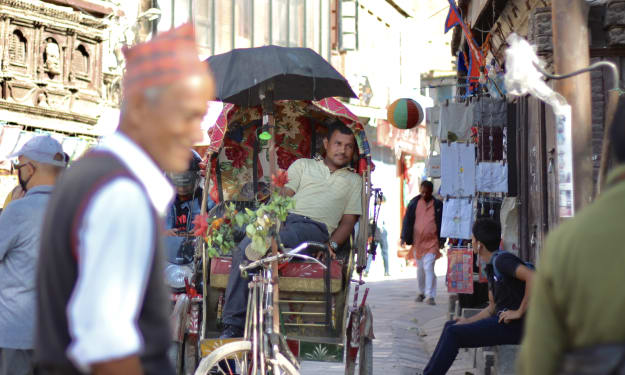
Thamel’s streets were vibrant that Friday evening. As the minutes ticked away, they lit up one by one and filled with people who were either scrambling to get home to their families for the weekend, or aimlessly wandering into random clubs and restaurants seeking a momentary escape from their lives. Sushil could tell the difference between the two as he stood by his rickshaw and watched them pass by.
By June Karkee5 years ago in Humans
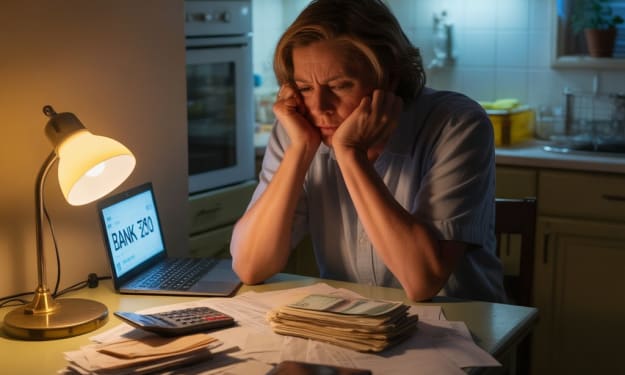
I Worked Hard My Whole Life but Still Lived Paycheck to Paycheck
I grew up believing in a simple formula: work hard, stay honest, and life will eventually reward you. That belief wasn’t something I questioned—it was something I inherited. From my parents. From teachers. From every motivational poster on every classroom wall. Hard work was the answer to everything. If you were struggling, it meant you weren’t working hard enough. If you were broke, you needed more discipline. If you were tired, that was just life.
By kamran khanabout 22 hours ago in Motivation


Comments
There are no comments for this story
Be the first to respond and start the conversation.