
What Is Sankalpa & How to Create One for the Life You Want
SANKALPA

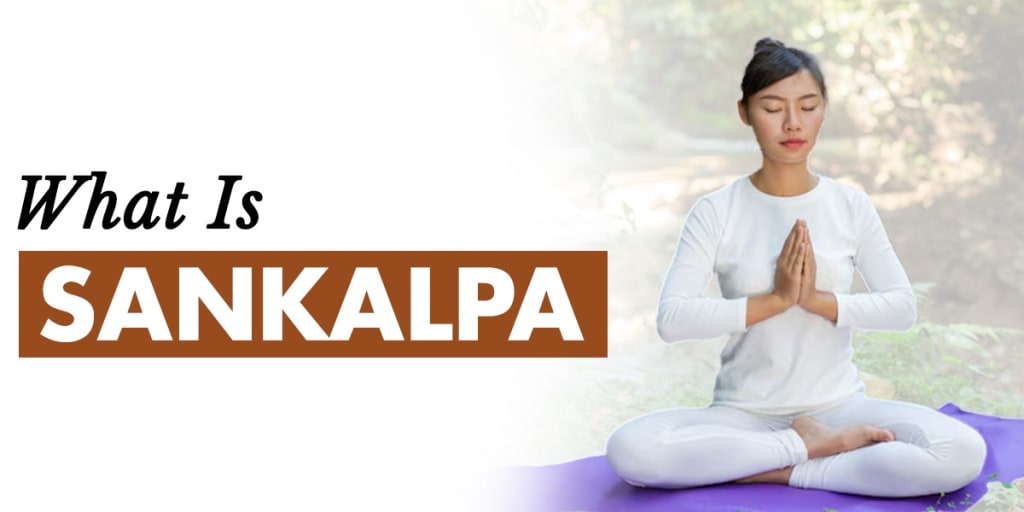
Every goal we set requires the willpower to change things to achieve something that is yet out of reach. We make resolutions and sometimes find it hard to maintain them because they start from the assumption that who we are is not good enough. These goals and resolutions originate in the belief that our happiness depends on achieving the things we want. However, yoga philosophy teaches us something completely different. It introduces us to the concept of sankalpa or resolve. It starts with the presumption that you are already who you need to be. You just need to cultivate focus and take hold of your mind to channelise the energy within you in the right direction.
The Meaning of Sankalpa
To create the life we are meant to live, we must realise our fullest potential and become aware of the divine qualities inherent in us. A sankalpa can help us to achieve this. In Sanskrit, kalpa means vow – a rule that is to be followed; and san is to connect to the highest truth. The meaning of the word ‘sankalpa’, therefore, is to make a vow that takes us to the highest truth and to know the deeper meaning of our life. It gives us a broader view of life, shows us the big picture, and helps us to realise the purpose of our life. When faced with choices in life, we simply need to recall our sankalpa to guide us on the correct path.
The beauty of making a sankalpa is that it is free of ego. Advaita Vedanta informs us that a sankalpa includes iccha or will power, kriya or action and jnana or wisdom to perform that action. When we make a sankalpa we awaken all these three divine qualities which are inherent within us. We do not need to cultivate will power because it is already there along with the energy required to perform the action that we are willing to do in this world.
Types of Sankalpa
There are two types of sankalpa. The first type can be a statement that simply tells who you are. For example, “I am peaceful and kind” or “I am healthy and happy.” This does not require much effort or intelligence.
The second type comes from deep within and is more mysterious. It directs our mind to do a particular action or choose a definite direction in life. In this respect, the second form of sankalpa is akin to setting an intention or a goal. However, it arrives slowly and encourages us to discover our mission or purpose in life. It guides our steps from day to day to move undistracted on the path ahead. Our personal sankalpa can direct our energy in such a way that we are able to proceed smoothly on the larger goals of our true nature.
How to Realise Your Sankalpa
Silence is essential for spiritual growth. To realise our own personal sankalpa, we do not need to go around searching for it with the help of our minds or bodies. We need to cultivate the power of listening. We need to listen to our own hearts because our sankalpa is already planted there and is waiting to be discovered.
In the Vedanta tradition, there are three stages of the listening process.
Sravana – This is about listening. To listen to our own hearts, we need a peaceful mind. This state of mind can be achieved through meditation.
Manana – This is about reflection. After listening peacefully to the message given by our hearts, we need to sit with it and feel it. We need to keep thinking about it.
Nididhyasana – This is about action. When we have reflected upon the heartfelt message, we need to respond by going out into the world and putting it in action.
Therefore, meditation is important to hear the soft whispers of our own hearts, and to know who we really are. An example could be a sankalpa from the Yamas or Niyamas as laid down by Maharshi Patanjali in the Yoga Sutras such as: “I speak only Satya” or “I respect Mother Nature as I practice Ahimsa.”
However, what should we do if we sit in meditation to listen to our heart but we do not hear anything? At times, we may hear only egoistic wants and desires such as a new house, a better job, and so on. These desires originate in the mind and are quite different from the subtle wisdom of the heart. They mislead us and keep us in ignorance about what we really need in life. At such times, it is best to simply start from exactly where we are. Any desire of the mind can be treated as an entry point – however shallow it may be – to find out more about our heart’s desire.
For example, if our desire is to change our physical appearance. If it is to lose weight, we need to ask ourselves what this will lead to. Will it bring better health, self-esteem, or happiness? Why is there such longing and obsession to reduce weight?
Another example could be the intention to stop something. Many of us may want to either stop a compulsive habit such as giving up shopping or to cultivate a healthier lifestyle by making holistic changes. We need to ask ourselves what such behaviour will lead to. Will it bring us more peace, freedom from suffering, or something more profound?
We need to curiously investigate what lies underneath such superficial desires and intentions. With more studied focus, a sankalpa may even arise from this such as – I respect myself. Eventually, a consistent search will lead us to profound knowledge about ourselves and our true nature.
Putting Our Sankalpa in Right Words
Framing our sankalpa in the right words is very important because it is different from a desire or an intention. Therefore, words such as “I will”, “I will not”, or “I want” will not work because they have the connotations of mere personal gain. A sankalpa is larger and is connected to our true nature and the essence of our being. It is not a simple prayer or a petition even. It is a vow and has to be true in the present moment. Therefore, a sankalpa should be stated in the present tense.
For example, rather than saying, “I want to control my anger,” our sankalpa should be “Peace is my true essence.” Instead of saying, “I will stop smoking”, our personal sankalpa should be “With respect for my body and for others, I cultivate healthy habits.” Such statements, made in the present tense, underscore the fact that whatever we need is already within us.
Practicing Our Sankalpa
Sankalpa is all about reminding ourselves to make our resolve stronger and reaching to the depths of our heart to fulfil a promise. Hence, repeating the sankalpa every day or several times a day may not make much difference because by repeating what we want, we get the feeling that we do not have it yet. Our unconscious minds recognise this emptiness and that weakens our energy to support our resolve.
The Tripura Rahasya states that the effect of a sankalpa is determined by the quality of the mind that is saying it. This implies that our minds need to have the fertility of calmness to enable the seed of our sankalpa to embed and grow. For this to happen we need to take our mind to a one-pointed non-dual state. This is where we need a consistent practice of meditation.
It is in meditation, that our minds return to a steadiness in which we realise the wholeness of the universe. If we can stay in that state of mind for a longer period, the more powerful we become to take our sankalpa to fulfilment. However, if we cannot achieve this state of mind, the senses and our ego get in the way. Then we approach our sankalpa from a place of want and think that ‘I am not perfect unless I change this thing.” We do not feel whole and pure in such a state.
We need yogic practices such as conscious relaxation techniques and dhyana to bring our minds into a calm and steady state where we feel the freedom of our own nature. Some such techniques that are practiced at The Yoga Institute are Yogendra Laya, Nispandabhava, and Yogendra Shavasana. While these techniques are for relaxation and meditation, they help us to awaken us to see things as they really are.
Yogendra Shavasana deeply relaxes the body and mind and helps us to become conscious of our breathing and awareness. We are conscious but we imagine our body to be in such deep rest as if it has become a corpse. In such moments, the difference between prakriti and purusha vanishes and we feel completely rested in body and mind. We also become more open-minded and willing to make changes in our thought patterns and habits. We are able to give up our rigidity and become more fluid and malleable. In this state, if we recall our sankalpa, it infuses into your entire being and it comes alive in those few moments.
Maintaining Our Sankalpa
After we have found our sankalpa and have started practicing it through yogic techniques, it needs to be strengthened through what is called the sankalpa shakti. This is the energy we need to do the action which is required to maintain our sankalpa. Every action, every thought, every word either supports or undermines our sankalpa. Even the decisions that are not directly connected to our sankalpa make a difference.
For example, we may decide to wake up at 6 a.m. every day. However, on some days, we may be tempted to get up later than usual. Every time we do this; we weaken the decision we had made to wake up early. In other words, we give more power to the part of us that goes against the consciousness which helped us to make the decision. On a positive note, whenever we make the choice and motivate ourselves to wake up at 6 a.m., we get the opportunity to strengthen our sankalpa shakti. At the Yoga Institute we have a Better Living Course which runs for 21 days. Living a yogic lifestyle for 21 days is habit-forming and although it may not be related to our sankalpa, it does make a difference.
When we approach a moment of temptation, we must intentionally bring our sankalpa to mind and increase our sankalpa shakti. In order to do this, we must pause and breathe with awareness. After a few conscious breaths, we must try to remember our true nature and recollect the big picture of life. With that certainty, we must remember our sankalpa. Even situations where we give in to temptations can also be reimagined as empowering moments. We should go back to those exact moments where we gave in to temptation and recreate them to feel them in our body and mind. Then bring to mind our sankalpa and relive the moment by acting according to what was supposed to be the right action.
In fact, this practice can be applied to all our action-oriented choices. We must review all our actions from the point of view of our sankalpa. At the end of each day, it is advisable to look back and reflect over every action from this perspective.
Our sankalpa defines who we are and what we do in the world.
About the Creator
Keep reading
More stories from Srinivasan and writers in Motivation and other communities.
Yoga for Adventure Enthusiasts Flexibility and Strength for Outdoor Activities
Yoga for Adventure Enthusiasts: Flexibility and Strength for Outdoor Activities Adventures which need physical effort often cause sore and tense lower backs, tight hamstrings, rigid spine, repeated injuries, leading to stress and discomfort. All of this can be addressed by following a regular yogic practice. Yoga can condition the muscles of the entire body so it is especially useful in adventure sports where muscles need to be conditioned in a particular way.
By Srinivasan4 months ago in Longevity
The Day I Stopped Waiting
For most of my life, I believed I was waiting for something. I didn’t know exactly what—maybe confidence, maybe opportunity, maybe permission. I just knew that once that thing arrived, my real life would finally begin. Until then, I stayed careful, quiet, and comfortably stuck.
By Asghar ali awan7 days ago in Motivation
The steps to losing a child
Step One: Lose a child. Not what anyone wants to happen and nothing you can do to change it, but you can go through steps to becoming happy again. You can go through steps to loving again. You can go through steps to become a new you because after losing a child you will never be the same person you once were.
By Tabitha Hinkley3 days ago in Fiction


Comments
There are no comments for this story
Be the first to respond and start the conversation.