
Title: The Green Miracle: How Niger’s Farmers Beat Famine by Ignoring the Experts
For decades, international aid agencies told them to cut down trees to grow food. When they finally stopped listening, they greened the desert and saved themselves

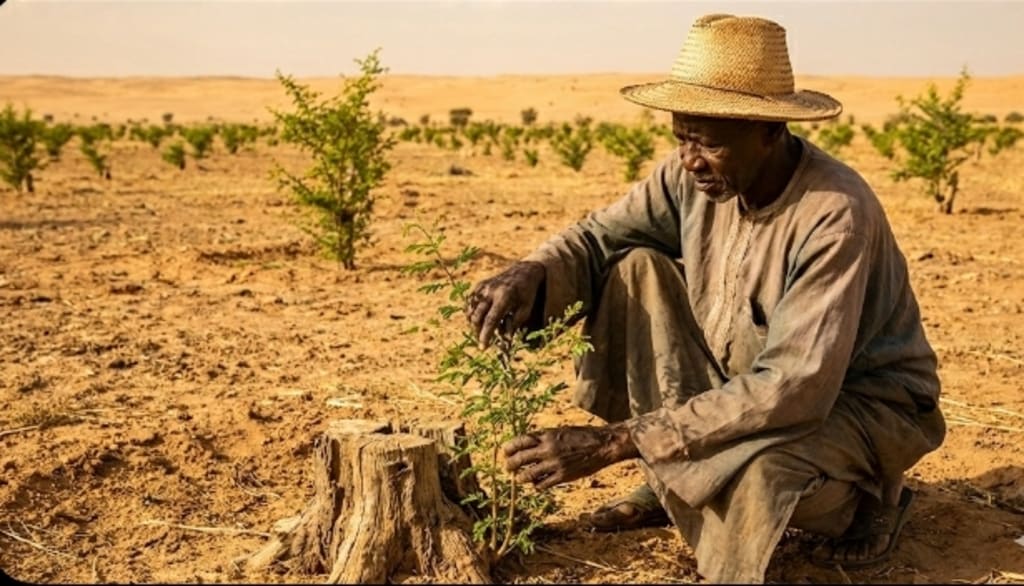
The incredible true story of how farmers in Niger reversed desertification and ended famine not with foreign aid, but by simply letting trees grow back.
Introduction: The Architecture of Starvation
In the 1980s, if you flew over the Maradi and Zinder regions of southern Niger, you saw the color of hunger. It was a blinding, endless beige.
The Sahara Desert was marching south, swallowing farmland at a terrifying rate. The wind, called the Harmattan, blew unchecked across the flat, desolate landscape, stripping away the fertile topsoil and burying young crops in sand.
When the rains failed, which they often did, the result was catastrophic. Famine was not an event; it was a season. It was expected.
The international community responded the only way it knew how: with money and experts. The World Bank, the UN, and countless NGOs poured millions of dollars into the region.
They sent Western agronomists. They sent high-yield seeds developed in laboratories. They sent expensive fertilizers. They sent tractors.
And they sent advice.
The experts looked at the fields, which were dotted with scrubby, thorny trees, and they gave a clear instruction: "Cut them down."
The logic seemed sound to a Western mind: Trees compete with crops for water and sunlight. If you want to maximize corn or millet production, you need a clean field. You need industrial agriculture.
So, the farmers of Niger, trusting the experts who came with money and food, did as they were told. They cleared the land. They uprooted the stumps. They created vast, perfectly clean fields.
And they starved faster.
The clean fields dried out in days under the Sahelian sun. Without trees to break the wind, the crops were blasted by sandstorms. Without tree roots to hold the soil, the little rain that did fall washed the nutrients away.
By the mid-1980s, the situation was desperate. The aid projects were failing. The desert was winning.
But in a few villages, a quiet rebellion was beginning. It didn't start with a protest. It started with a question.
Part I: The Wisdom of the Stump
One of the rebels was a farmer named El Hadj Oumarou.
Like everyone else, he had been cutting down the native trees—species like the Gao (Faidherbia albida) and the Baobab. But he noticed something strange.
In the corner of his field, where he had been too lazy to pull out a particularly stubborn Gao stump, the stump had resprouted. It had grown into a small bush. And the millet growing right next to that bush was taller, greener, and healthier than the millet in the middle of the "clean" field.
It made no sense according to the experts. The tree should have been stealing water.
Oumarou, and other farmers like him, began to observe more closely. They realized the experts had missed something fundamental about the ecology of the Sahel.
The native trees were not competitors; they were allies.
* Hydraulic Lift: The deep taproots of the trees pulled groundwater from deep underground and released it into the upper soil layers at night, watering the crops around them.
* Fertilizer Factory: The Gao tree, in particular, is a legume. Its roots fix nitrogen from the air into the soil, acting as a free, natural fertilizer. Furthermore, the Gao tree has a unique cycle: it drops its leaves in the rainy season (fertilizing the crops exactly when they need it) and grows leaves in the dry season (providing shade for animals).
* Windbreak: The trees slowed down the Harmattan wind, protecting the young crops from sandblasting and reducing water evaporation from the soil.
The farmers realized that for decades, they had been spending their time and energy destroying the very thing that could save them.
They had been told that modern farming meant "clean" farming. They realized that in the Sahel, "clean" meant "dead."
Part II: The Radical Act of Doing Nothing
The revolution that followed is perhaps the most understated in agricultural history. It didn't involve a new technology. It didn't involve a new seed.
It involved stopping.
Farmers stopped clearing the land. When they prepared their fields for planting, they would notice the small shoots sprouting from the underground root systems of chopped-down trees.
Instead of hacking them away, they would select the strongest shoot, prune the others, and let it grow. They would protect it from grazing animals.
They called it Farmer-Managed Natural Regeneration (FMNR). It’s a fancy name for a simple idea: Let nature do the work.
It was a hard shift to make. A field full of trees looked messy. It looked "backward." Farmers who adopted FMNR were initially mocked by their neighbors for being lazy or ignorant.
But the results were undeniable.
Within a few years, the fields of the rebels looked different. They weren't beige. They were speckled with green.
When the droughts came, the farmers with trees got a harvest. Maybe not a great harvest, but enough to feed their families. The farmers with the "clean" fields got nothing.
Hunger is a powerful motivator. The neighbors stopped laughing and started copying.
Part III: The Green Wave
The practice spread like a virus. It moved from farmer to farmer, village to village. It spread because it was free. It didn't require a bank loan or a government grant. It just required a change in mindset.
The scale of the transformation was staggering.
In the mid-1980s, the region was almost completely deforested. By the mid-2000s, satellite images showed something that shocked scientists: a vast green belt had appeared across southern Niger.
Farmers had regenerated an estimated 5 million hectares (around 12 million acres) of land. They had brought back an estimated 200 million trees.
It is the largest positive environmental transformation in the history of Africa, and likely the world.
And it happened almost entirely without the knowledge of the international aid community. While the UN was holding conferences on desertification, Nigerien farmers were busy solving it.
Part IV: The Harvest of Change
The return of the trees changed everything.
* Food Security: Crop yields in areas using FMNR doubled, and in some cases tripled. An estimated 2.5 million people are now fed every year because of the additional food grown under the trees.
* Economic Boom: The trees provided more than just soil health. Farmers could harvest firewood, fruit, and fodder for livestock. They could sell these products in local markets. The trees became a savings account.
* Women's Lives: In many villages, it was the job of women and girls to collect firewood. Before re-greening, they had to walk for miles every day, searching for scraps of wood. Now, they could prune the trees in their own fields. This freed up hours of time every day, allowing girls to go to school and women to start small businesses.
* Resilience: Niger still faces droughts. Climate change is making them worse. But the villages with trees are no longer wiped out by them. They have a buffer. They have bounced back.
Part V: The Death of the Savior Complex
Why did it take so long for the world to notice?
Because the story didn't fit the narrative. The narrative was that poor, uneducated African farmers needed saving by smart, wealthy Western experts.
FMNR proved the opposite. The experts were wrong. The farmers were right.
The farmers knew their land. They knew the history of their soil. They just needed the confidence to trust their own eyes over the confident voices of the men with degrees.
It took an Australian missionary and agronomist named Tony Rinaudo to help bridge the gap. Rinaudo arrived in Niger in the 1980s, full of ideas about planting trees. His tree-planting projects failed miserably; most of the saplings died.
One day, in frustration, he stopped his truck by the side of the road. He noticed the "bushes" growing in the fields were actually regrowth from tree stumps. He realized the "underground forest" was waiting to be released.
Rinaudo became the champion of FMNR. He didn't invent it—the farmers did. But he validated it. He used his position as an outsider to tell the farmers, "Your idea is brilliant. Keep doing it." He helped spread the knowledge beyond local villages.
He is often called the "Forest Maker," but he is the first to admit that he didn't make the forest. He just stopped the people who were destroying it.
Conclusion: The Power of Unlearning
Why does this story matter to us?
We live in a world obsessed with innovation. We are always looking for the new app, the new technology, the "game-changer" that will solve our problems.
The story of Niger teaches us that sometimes, progress doesn't come from learning something new. It comes from unlearning something wrong.
It comes from questioning the "best practices" that aren't working.
The farmers of Niger didn't need a new invention. They needed to stop doing the thing that was killing them. They needed to trust the evidence of their own reality over the dogma of the experts.
They proved that the solutions to our biggest problems—even global problems like desertification and famine—are often hiding in plain sight. They aren't complicated. They aren't expensive.
Sometimes, the solution is as simple as choosing not to cut down a tree.
The green miracle of Niger is not a story about what humanity can build. It is a story about what humanity can achieve when it stops destroying.
About the Creator
Frank Massey
Tech, AI, and social media writer with a passion for storytelling. I turn complex trends into engaging, relatable content. Exploring the future, one story at a time
Keep reading
More stories from Frank Massey and writers in Motivation and other communities.
An Honest Person, a Successful Life
I lost an opportunity once because I told the truth. It still stings when I think about it. I remember sitting in my car afterward, hands on the steering wheel, wondering if honesty was just a pretty word people used when they could afford it. I needed that opportunity. I had bills, dreams, and a deep desire to move forward.
By Fazal Hadi7 days ago in Motivation



Comments
There are no comments for this story
Be the first to respond and start the conversation.