
The Voices of Hearth stead
When a small town found its voice, it discovered the power to shape its future.

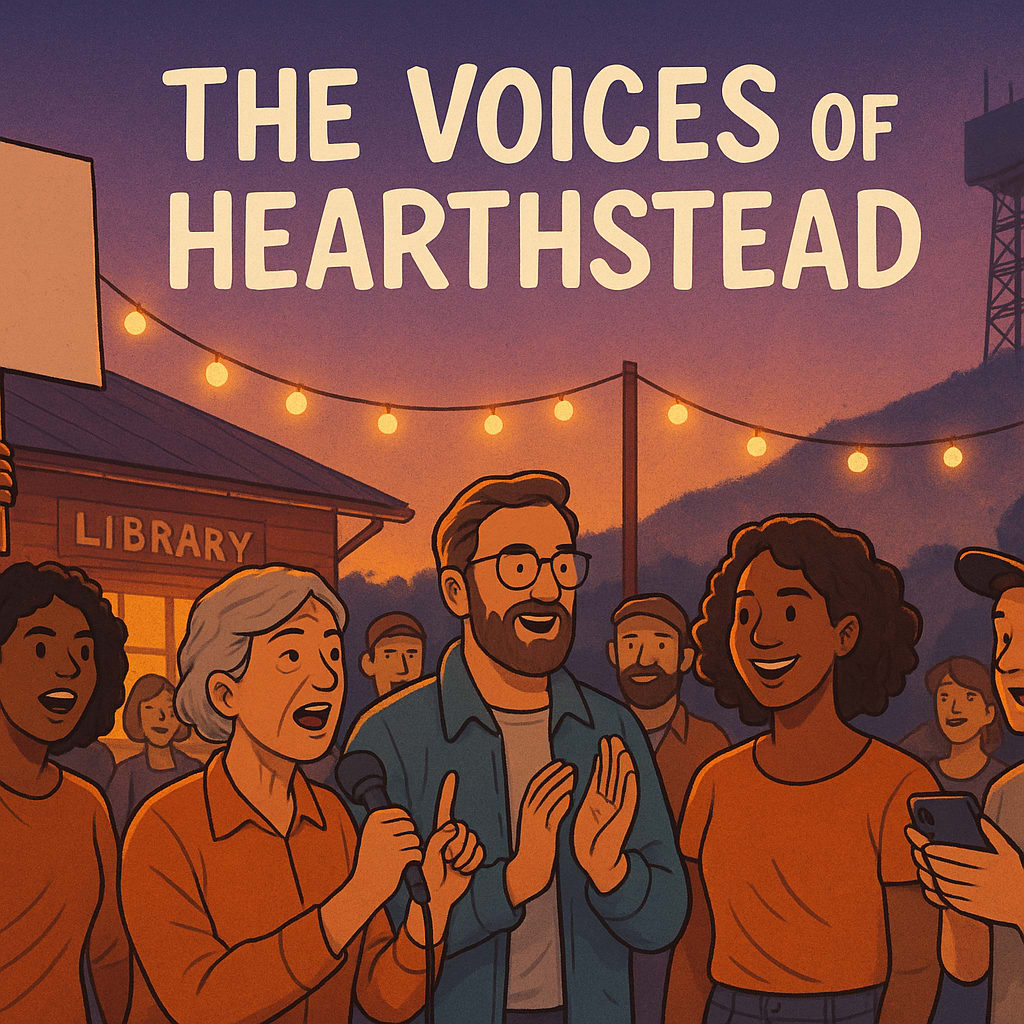
Nestled between rolling hills and fields of amber, the small town of Hearthstead had always been quiet. Not literally—its streets were filled with market stalls, laughter echoed from porches, and children played kickball in the dusty streets. But for decades the town had been quiet where it counted. Decisions were made from above, plans were made in distant offices, and the townspeople accepted them with polite nods and quiet sighs.
That was until the tower went up.
It appeared overnight: a solid column with flickering red lights that stood just outside the community’s beloved garden. Rumors spread—some said it was a new cell tower, others feared it was a surveillance device. No one asked the town. No letters came. No meetings were held. It just showed up, unforgivably long and silent.
At first, people murmured among themselves. “It’s probably for better service,” one said. “There’s no point in fighting something that’s already been built,” another said. But then the echoes began. The low, steady hum that filled the night air, rattling windows and sleep-deprived minds.
That’s when Maya Bell stepped forward.
Maya, a local librarian with a soft voice and an iron spine, had never been one for speeches. But she believed in people. She believed that communities were more than clusters of houses—they were living, breathing ecosystems, built on shared stories and voices that mattered.
So she held a meeting.
Not in the town hall, which often felt distant and formal, but in the back room of the Hearthstead Library, under string lights and over lukewarm coffee. Ten people showed up. Then twenty. Then fifty. They talked not just about the tower, but about everything. The potholes that were left unfilled, the school budgets that had been cut off long ago, the factories that had turned their gutters red.
It was as if the tower had burst a dam. The voices were flowing, rising, becoming undeniable together.
And then came the idea: The Hearthstead Voice.
Maya and a group of volunteers started a community-driven newsletter, online and in print, that carried not only news but also opinions, complaints, hopes, and dreams. They collected stories from elders, polled community issues, and published investigative pieces on city affairs with outside developers.
They held regular town “listening circles,” where there was no podium between speaker and listener, and everyone got a turn. Artists painted the walls with public input. Students in a high school journalism class began contributing. Elders shared oral histories. A local techie created an app to collect anonymous feedback.
It was loud. It was dirty. It was beautiful.
Then came the real test.
The developers returned, this time with blueprints for a sprawling warehouse complex that offered jobs, but at the cost of demolishing a wooded area where deer still roamed and wildflowers blanketed the spring.
But Hearthstead was no longer quiet.
Hundreds of people had gathered at the town hall. Maya stood with a farmer, a teenager, a single mother, and a retired truck driver. Together, they presented data, alternative proposals, even an ecotourism plan designed by a group of young people from the town.
They weren’t anti-development. They were pro-sound.
The council paused. For the first time in memory, they listened.
A compromise was reached. The warehouse project had been scaled back and moved to an unused industrial site near the highway. The woods were preserved, and with a grant secured through the town’s new Community Engagement Committee, it was transformed into a public nature reserve.
The victory wasn’t just in saving the woods, it was in proving the power of a vocal community.
Months later, a journalist from the state capital came to Hearthstead to write a piece called “The Town That Found Its Voice.” When he asked Maya what had changed, Maya simply said:
“We remembered that being part of a community doesn’t mean sitting in silence. It means showing up, speaking up, and listening hard. No one can speak for us better than we can speak for ourselves.”
And so, in Hearthstead, the tower still stood. But now, it was no more. It blinked silently over the city buzzing with voices, proud and fearless.
About the Creator
Echoes of Life
I’m a storyteller and lifelong learner who writes about history, human experiences, animals, and motivational lessons that spark change. Through true stories, thoughtful advice, and reflections on life.
Keep reading
More stories from Echoes of Life and writers in Motivation and other communities.
Boucle Bed: Bringing Texture and Comfort to Modern Bedrooms
In the ever-evolving world of interior design, trends come and go, but every so often, a piece emerges that redefines comfort, luxury, and style all at once. Enter the boucle bed, a furniture statement that has recently captured the hearts (and bedrooms) of designers, influencers, and homeowners.
By Echoes of Life5 months ago in Motivation
"Hear Me Out"
"Hear me out, what if we ran away together?" "Where do you want to go?" "Anywhere but here. We could move to a new city or to Canada, or we could disappear from society to live in the middle of the woods. Maybe a combination of two of those things would be good. What do you say?"
By Kay Husnick8 days ago in Fiction



Comments
There are no comments for this story
Be the first to respond and start the conversation.