
The Unpolished Truth of Maya Angelou: A Voice Forged in Hell
She wasn’t born a legend. She was a survivor of silence, violence, and a world that wanted her broken. This is the reality behind the poetry

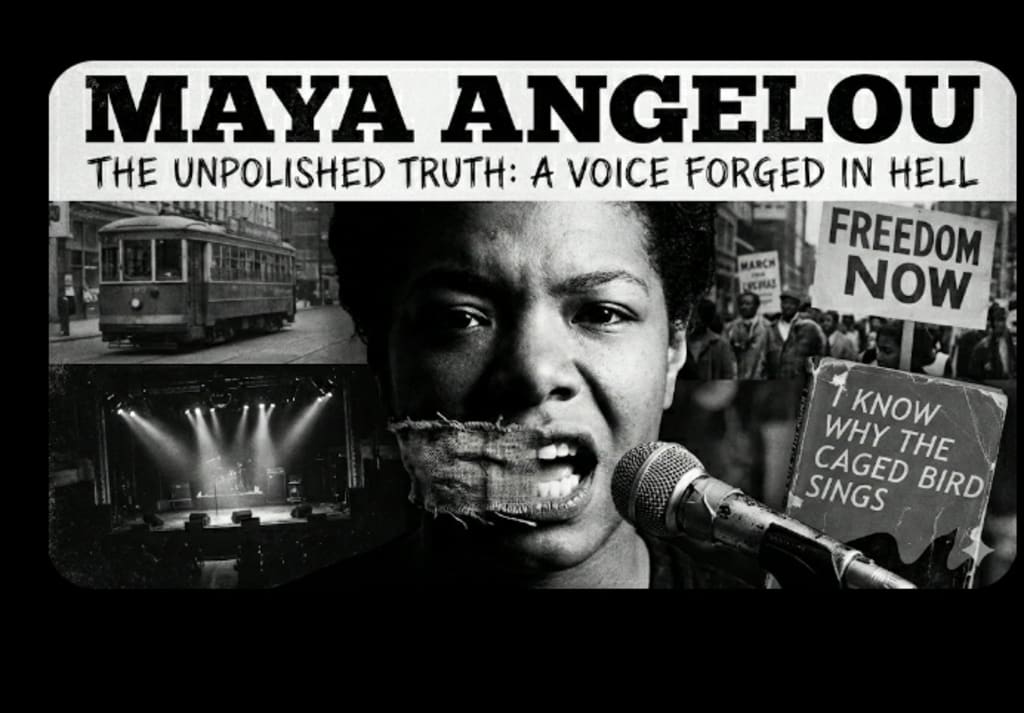
Introduction: Smash the Pedestal
If you Google Maya Angelou today, you see a gentle, grandmotherly figure. You see the Presidential Medal of Freedom. You see a woman whose voice could calm a storm, reciting poetry at Bill Clinton’s inauguration. You see a national treasure wrapped in grace.
Forget that image.
It is a comfortable lie we tell ourselves because the truth is too jagged to hold. Before Maya Angelou was a "Dr." or a "poet laureate," she was Marguerite Johnson—a black girl in the Jim Crow South who was treated like debris by the world around her.
She didn't become an icon because she had a "gift." She became an icon because she survived a literal hell that would have turned most people into dust. Her poetry wasn’t born from gazing at flowers; it was born from staring down rapists, racists, and the cold reality of poverty.
This isn’t a story about "talent." It is a story about the brutal mechanics of survival.
Part I: The Silence That Should Have Killed Her
To understand the voice, you have to understand the silence.
When Marguerite (Maya) was three years old, her parents’ marriage collapsed. She and her brother Bailey were put on a train alone—tags on their wrists like luggage—and sent from California to Stamps, Arkansas, to live with their grandmother.
Stamps was not a home; it was a segregationist war zone. It was a place where a Black man could be lynched for looking at a White woman the wrong way. But the real danger wasn’t just outside; it was waiting for her when she visited her mother in St. Louis at age seven.
This is the part of the biography that polite society glosses over.
She was raped by her mother’s boyfriend, a man named Mr. Freeman. She was seven. He was an adult. He threatened to kill her brother if she spoke. But the burden of the trauma was too heavy for a child to carry alone, so she told her brother. The family found out. The police were called. Mr. Freeman was arrested, tried, and—in a rare twist of justice—convicted.
But he served one day. One single day.
Four days after his release, he was found dead. Beaten to death. kicked to death. While it was never officially solved, it was understood that Maya’s uncles had taken care of the problem.
Most people would see this as justice. Seven-year-old Maya saw it as a curse.
She operated on the logic of a traumatized child: I spoke. My voice caused a man to die. If I speak again, I might kill someone else.
So, she locked the door. She stopped speaking.
Not for a week. Not for a month. For five years.
From age 8 to 13, Maya Angelou was a mute. She lived inside a fortress of silence. The town thought she was "idiotic" or possessed. She wasn't. She was simply observing. When you remove the ability to speak, you are forced to listen. She memorized the cadence of the way people talked, the rhythm of lies, the sound of heartbreak. She read every book in the school library, then the white school’s library.
She was incubating. The trauma that should have destroyed her mind was actually sharpening it.
Part II: The Awakening is Not Pretty
Inspirational movies make recovery look like a montage with uplifting music. Maya’s recovery was a slow, painful clawing back of her own humanity.
A teacher, Mrs. Bertha Flowers, eventually realized that Maya wasn’t stupid—she was terrified. Mrs. Flowers threw down a gauntlet: "You do not love poetry unless you speak it."
It forced Maya to break the seal. But when she found her voice again, she didn’t use it to sing lullabies. She used it to fight.
By sixteen, the silence was gone, replaced by a reckless drive to live. She moved to San Francisco. But this wasn’t the "Summer of Love." This was the gritty 1940s. She became the first Black female streetcar conductor—not because she dreamed of transit, but because she needed money and was stubborn enough to sit in the office until they hired her.
Then, life hit her with another reality check: Teen pregnancy.
At 16, just after graduating high school, she gave birth to her son, Guy. She was a child raising a child, alone, black, and poor in America.
Part III: The Hustle (Or, Doing What is Necessary)
Here is where the "Saint Maya" image truly dissolves, and the warrior emerges.
Maya Angelou did not sit in a cafe writing sonnets while sipping lattes. She had a mouth to feed. She entered the workforce with a vengeance. And she didn’t have the luxury of pride.
She worked as a fry cook. She shook cocktails in nightclubs. She worked as a mechanic. When the money got too tight, she worked as a sex worker for a brief period, managing a brothel’s business. She danced in strip clubs and calypso bars.
Why does this matter? Because purity is a myth sold to people who have never been hungry.
Maya Angelou’s wisdom didn’t come from a university; it came from the gutter and the grind. She saw humanity at its absolute lowest. She saw men at their most vulnerable and violent. She saw women trading their bodies for rent. She lived the blues before she ever wrote about them.
She changed her name from Marguerite Johnson to Maya Angelou (a version of her married name) because it sounded more "exotic" for her dance career. It was a brand built for survival.
During these years, she toured Europe with Porgy and Bess, not as a star, but as a working artist. She left her son with family to tour, a decision that haunted her but paid the bills. This is the harsh reality of motherhood when you are the sole provider: sometimes you have to leave to facilitate survival.
Part IV: The Fire of the Movement
In the 1960s, the world was burning, and Maya walked right into the flames.
She didn't just "support" the Civil Rights Movement. She was in the trenches. She served as the northern coordinator for Dr. Martin Luther King Jr.’s SCLC. She lived in Cairo and Ghana, working as a journalist, meeting Malcolm X.
She was friends with both Malcolm X and King. And she watched the world murder them both.
She had returned to the U.S. to help Malcolm X build his new organization. He was assassinated shortly after her arrival. Years later, on her birthday, Martin Luther King Jr. was assassinated.
Imagine the psychological toll. The men she believed would save the world were butchered. For years, she stopped celebrating her birthday because it was the anniversary of King’s death. She sent flowers to his widow, Coretta Scott King, every single year instead.
This wasn’t a history lesson for her. It was personal devastation. She fell into a deep depression. The world felt chaotic, violent, and irredeemable.
Part V: The Caged Bird Sings (Because it Has No Choice)
It was in this pit of grief that a casual challenge saved her life.
An editor challenged her to write an autobiography that read like a novel. She accepted, mostly because she was told it was "impossible."
The result was I Know Why the Caged Bird Sings.
When it was published in 1969, it was a grenade. Before this, Black women’s autobiographies were often apologetic or focused on their proximity to famous men. Maya wrote about the rape. She wrote about the confusion. She wrote about the racism in Arkansas that felt thick enough to choke on.
She wrote the unpolished truth.
The book was banned. Schools tried to pull it from shelves. Parents screamed that it was too sexually explicit, too raw, too angry.
And that is exactly why it worked.
Maya wasn’t writing to please the literary elite. She was writing to tell the little Black girls in the South, and the broken women in the cities, that their trauma was real, but it didn't have to be their tomb.
Part VI: "Still I Rise" — A Threat, Not a Slogan
Today, you see the poem "Still I Rise" on coffee mugs and tote bags. It’s treated like a soft affirmation.
Read it again.
It is not soft. It is aggressive. It is cocky. It is a confrontation.
"Does my sassiness upset you? / Why are you beset with gloom?"
She is mocking her oppressors. She is looking at a society that enslaved her ancestors, segregated her childhood, and ignored her talent, and she is laughing in its face.
"You may shoot me with your words, / You may cut me with your eyes, / You may kill me with your hatefulness, / But still, like air, I’ll rise."
This isn't just about resilience; it’s about spite. It is the ultimate revenge. The system was designed to keep her uneducated, poor, and silent. Instead, she became multilingual, wealthy, and the loudest voice in the room.
Her joy wasn't just an emotion; it was an act of resistance. In a world that wanted her miserable, her laughter was a weapon.
Part VII: The Legacy of Scars
Maya Angelou didn't die a quiet death. She worked until the end. When she passed away in 2014, she had lived a dozen lives in the span of one.
But the lesson of her life isn't "Dream big." The lesson is "Endure."
She taught us that you can be raped and still own your body. You can be silenced and still find your voice. You can be a sex worker and still be a queen. You can be poor and still be rich in spirit.
She refused to be ashamed of her past. When people tried to shame her for her time as a sex worker or her teen pregnancy, she shrugged. She knew that those experiences made her who she was. They were the steel in her spine.
Conclusion: The Uncomfortable Mirror
Why does Maya Angelou matter today?
Because we live in a world of filters. We curate our lives on social media to look perfect. We hide our trauma. We pretend we aren't broken.
Maya Angelou matters because she threw her broken pieces on the table and said, "Look at this. This is who I am."
She demands that we stop pretending. She demands that we acknowledge the harshness of life so that we can truly appreciate the beauty of surviving it.
Her story is a reminder that you don't need to be perfect to be powerful. You don't need a clean slate. You need guts. You need the audacity to look at a world that wants you dead and say:
"I am still here."
About the Creator
Frank Massey
Tech, AI, and social media writer with a passion for storytelling. I turn complex trends into engaging, relatable content. Exploring the future, one story at a time
Keep reading
More stories from Frank Massey and writers in Motivation and other communities.
The Art of Bleeding: How Frida Kahlo Weaponized Her Agony
.History has a bad habit of sanitizing its martyrs. We put their faces on tote bags, print their eyebrows on coffee mugs, and turn their suffering into "inspirational quotes" for Instagram captions. We have done this to Frida Kahlo more than perhaps anyone else. We have reduced her to a floral crown and a unibrow.
By Frank Massey about a month ago in Motivation
Life Will Never Wait for You to Be Okay: Why You Must Keep Moving
We often spend our lives waiting. We wait for the perfect moment, the perfect opportunity, and most commonly, we wait until we "feel better" to take the next step. We tell ourselves, "I’ll start that project when I’m less stressed," or "I’ll pursue my dreams when my heart is healed." We believe that emotional readiness is a requirement for progress.
By Khan Zeb Afridiabout 20 hours ago in Motivation


Comments
There are no comments for this story
Be the first to respond and start the conversation.