
The Art of Bleeding: How Frida Kahlo Weaponized Her Agony
Trigger Warning: This narrative contains graphic descriptions of physical trauma, medical gore, miscarriage, and suicide ideation.

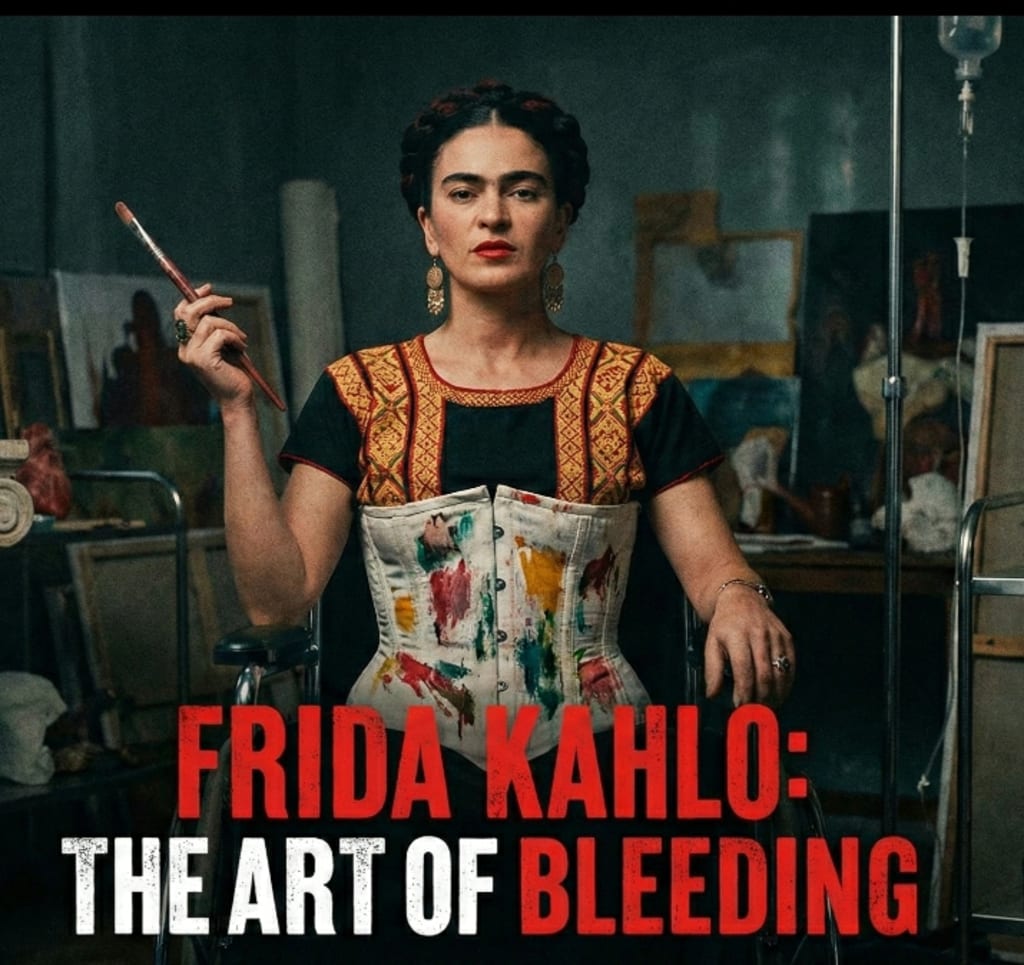
.History has a bad habit of sanitizing its martyrs. We put their faces on tote bags, print their eyebrows on coffee mugs, and turn their suffering into "inspirational quotes" for Instagram captions. We have done this to Frida Kahlo more than perhaps anyone else. We have reduced her to a floral crown and a unibrow.
But if you look at the woman beneath the iconography, you don’t find a quirky bohemian artist. You find a battlefield.
Frida Kahlo was not "born" an artist. She was forged in a blast furnace of twisted metal, spilled blood, and relentless, grinding agony. Her life was not a tragedy; it was a horror movie that she directed herself, turning the camera lens inward to capture the gore. She didn't paint to heal. She painted to scream without making a sound.
This is not the story of a victim. This is the story of a woman who was broken by the world and decided to cut herself open to show us the shards.
I. Gold and Blood (1925)
September 17, 1925. Mexico City. It was a Thursday.
Frida was eighteen years old. She wasn't an icon yet; she was a pre-med student with a sharp tongue and a bright future. She boarded a wooden bus with her boyfriend, Alejandro. The bus was crowded.
Moments later, a streetcar—heavy, iron, unstoppable—slammed into the side of the wooden bus. It wasn't a collision; it was a demolition. The streetcar tore through the bus as if it were made of paper.
The physics of the crash were grotesque. The handrail of the streetcar, a solid steel rod, snapped off. It pierced Frida’s body. It entered through her left hip and exited through her vagina. It was a violation so absolute, so violent, that it defined the rest of her existence.
Her spine was snapped in three places. Her collarbone, ribs, and pelvis were pulverized. Her right leg was fractured in eleven spots. Her foot was crushed.
But the universe has a sick sense of humor. Someone on the bus had been carrying a packet of powdered gold. Upon impact, the packet burst. Frida lay amidst the wreckage of wood and flesh, bleeding to death, covered entirely in gold dust.
Bystanders screamed that she was a dancer because of the glitter. They didn't see the blood pooling beneath her yet. A man pulled the steel rod out of her body right there on the pavement. The scream she let out was said to be louder than the siren of the arriving ambulance.
She wasn't supposed to survive the ride to the hospital. When the doctors saw her, they put her back together like a jigsaw puzzle, largely assuming it was a waste of morphine.
She didn't die. She lay in a hospital bed, encased in plaster, staring at the ceiling. The future doctor was gone. The cripple was born.
II. The Plaster Coffin
Recovery wasn't a healing process; it was a prison sentence.
For months, Frida was trapped in a full-body cast. She couldn't move. She couldn't turn. She had to defecate in a pan slid under her shattered hips. The smell of the hospital—ether, rotting flesh, stale sweat—seeped into her pores.
Boredom is a dangerous thing for a mind as sharp as hers. To save her from insanity, her father installed a mirror above her bed.
This was the moment the "Frida" we know was created. She didn't look out the window at the world she had lost. She looked up. And staring back at her was the only subject she had left: herself.
She began to paint. Not landscapes, not bowls of fruit. She painted the carnage.
"I paint myself because I am so often alone," she said. "Because I am the subject I know best."
This wasn't vanity. It was an autopsy. She examined her own decay. The art that emerged wasn't pretty. It was rigid, flat, and confronting. It stared back at the viewer. Even in those early days, the eyes in her portraits held a terrifying stillness—the look of someone who has seen the other side and was dragged back against their will.
The pain never left. It became her roommate. A constant, throbbing frequency that spiked into blinding agony whenever the weather changed or she moved too quickly. She learned to live with pain the way a soldier learns to live with mud.
III. The Elephant and the Dove
If the bus accident broke her body, Diego Rivera broke her spirit. And yet, she went back to him, again and again, like an addict seeking the needle.
Diego was a monster of a man. Huge, ugly, bulging-eyed, a communist revolutionary, and the most famous painter in Mexico. He was twice her age and three times her size. When they married, her parents called it the marriage of "an elephant and a dove."
But Frida was no dove. She was a hawk with a broken wing.
Their love was toxic, volatile, and essential. Diego loved her talent, and he loved her fierceness. But he could not keep his zipper up. He slept with his models, his assistants, and eventually, Frida's own younger sister, Cristina.
Frida didn't weep into a handkerchief. She retaliated.
She took lovers of her own—men and women. She seduced Leon Trotsky just to piss Diego off. She slept with Josephine Baker. She drank tequila by the bottle and smoked until her voice dropped an octave. She curated an exterior of armor: the Tehuana dresses, the heavy jewelry, the ribbons. It was camouflage. Underneath the vibrant Mexican textiles was a body held together by leather corsets and surgical scars.
She famously said: "There have been two great accidents in my life. One was the trolley, and the other was Diego. Diego was by far the worst."
The trolley broke her bones. Diego broke her reality.
IV. Henry Ford Hospital: The Coldest Truth
In 1932, in the gray, industrial gloom of Detroit, Frida faced a new kind of horror.
Her pelvis, crushed years earlier, could not hold a child. She became pregnant, a dangerous gamble she was willing to take. But her body rejected the life inside it.
She began to hemorrhage. The miscarriage was slow and agonizing. She was rushed to Henry Ford Hospital.
What happened next resulted in one of the most harrowing paintings in the history of art.
Most artists, when depicting loss, use metaphor. A weeping willow. A dark cloud. An empty chair.
Frida painted the blood.
In Henry Ford Hospital (1932), she lies naked on a bed soaked in blood. She is small, brown, and isolated in a vast, cold landscape. Floating around her, tethered by red umbilical cords, are six objects:
* A male fetus (the son she lost).
* A snail (the slowness of the miscarriage).
* A pelvic bone (the source of the failure).
* An orchid (a gift from Diego, looking like a torn organ).
* A machine (the coldness of medical intervention).
* An anatomical cast of a torso.
She painted the fetus with its eyes closed. She painted the blood pooling on the white sheet. It was shocking. It was disgusting to the critics of the time. Women were not supposed to show this. Miscarriage was a private shame, to be whispered about in parlors.
Frida put it on a canvas and forced the world to look at the blood. She stripped away the polite fiction of motherhood and revealed the biological brutality of female trauma. It was punk rock before punk rock existed. It was a middle finger to the art world’s obsession with female beauty.
"This is what it looks like," the painting said. "Do not look away."
V. The Broken Column
As the years ground on, her body began to disintegrate. The surgeries mounted—over thirty in her lifetime. Doctors fused her vertebrae. They put her in steel corsets. They hung her from the ceiling with weights attached to her feet to stretch her spine.
In 1944, she painted The Broken Column.
If you want to understand Frida Kahlo, you don't look at the monkeys or the parrots. You look at this.
In the painting, her torso is split open like a fissure in the earth. Inside, there is no spine. There is a crumbling Ionic column, cracked and ready to collapse. Holding her together is a series of white medical straps.
But the detail that haunts you is the nails.
There are nails hammered into her skin. Dozens of them. Nails in her face, her breasts, her arms, her stomach. They represent the constant, stinging, chronic pain. The pain that doesn't kill you, but never lets you sleep.
Her face in the painting is stoic. Tears flow like glass beads, but the expression is not one of panic. It is one of endurance. She is looking at us, defying us to pity her. She is beautiful, sexual, and utterly destroyed.
She was telling us that she was a structure on the verge of collapse, held up only by willpower and steel.
VI. The Amputation and The End
By the 1950s, the darkness was closing in. Gangrene set into her right foot—the same foot crushed in the bus accident decades prior.
The doctors told her they had to take the leg below the knee.
For a woman who defined herself by her independence, her ability to stand (literally and metaphorically), this was the final insult. When they took her leg, she spiraled.
She became addicted to painkillers. Her painting grew chaotic, the brushstrokes loose and frantic, lacking the precision of her earlier work. She was high, she was in agony, and she was dying.
Yet, the fighter remained.
In 1953, her first solo exhibition in Mexico was organized. Her doctors forbade her from attending. They said she was too weak to leave her bed.
Frida laughed. If she couldn't leave the bed, the bed would come with her.
She had an ambulance transport her to the gallery. She had her four-poster bed installed in the center of the room. She arrived on a stretcher, dressed in her finest Oaxacan regalia, and was carried to the bed. She held court there, drinking tequila and singing songs while propped up on pillows, receiving guests like a queen on a throne of pain.
It was her final performance. A masterclass in defiance.
A year later, at 47, she was gone. The official cause was a pulmonary embolism. But many suspect it was an overdose—intentional or accidental, it hardly matters. She had had enough.
Her final diary entry reads:
> "I hope the exit is joyful — and I hope never to return."
>
VII. The Legacy of the Knife
Frida Kahlo didn't paint her dreams; she painted her reality. And her reality was a nightmare that she decorated with flowers.
We live in a culture that tries to hide pain. We medicate it, we filter it, we distract ourselves from it. Frida Kahlo did the opposite. She reached into her own chest, pulled out her beating, bleeding heart, and slapped it onto a canvas.
She forced the world to see the grotesque beauty of survival. She showed us that a woman can be broken, betrayed, barren, and crippled, and still be a god.
She wasn't soft. She wasn't nice. She was a difficult, drinking, smoking, swearing, bisexual, communist cripple who lived every single day in defiance of a universe that tried to crush her.
She turned her cast into a canvas. She turned her bed into a studio. She turned her pain into a weapon.
And that is why she remains. Not because she is a fashion icon, but because she is the patron saint of the broken. She is proof that you can be shattered into a thousand pieces and still be a masterpiece.
She looked the Devil in the eye, and she didn't blink.
About the Creator
Frank Massey
Tech, AI, and social media writer with a passion for storytelling. I turn complex trends into engaging, relatable content. Exploring the future, one story at a time
Keep reading
More stories from Frank Massey and writers in Motivation and other communities.
Sara Blakely — The Woman Who Turned $5,000 Into Spanx and Became the Youngest Self-Made Female Billionaire
Sara Blakely — The Woman Who Turned $5,000 Into Spanx and Became the Youngest Self-Made Female Billionaire Sara Blakely’s story does not begin in a boardroom, an investor meeting, or a glamorous design studio. It begins in the hot Florida sun, on pavement, with a young woman wearing a faded polo shirt and roller skates—trying to sell fax machines door to door.
By Frank Massey about a month ago in Motivation
I Learned the Hard Way How Success Really Works
I thought success was simple. Work hard, check all the boxes, and it would come to me. That was the story I told myself—and the one everyone else seemed to believe. But life, as I quickly learned, had other plans.
By Fazal Hadiabout 19 hours ago in Motivation




Comments
There are no comments for this story
Be the first to respond and start the conversation.