
The True Measure of Education
A degree may open doors, but behavior keeps them open
The True Measure of Education
By{Muhammad Faizan}
In the bustling city of Mumbai, lived a young man named Aarav Malhotra. At 24, he had just graduated from one of the country’s most prestigious universities with a degree in Business Administration. His family was overjoyed — not just because of his academic achievement, but because Aarav was the first in three generations to earn a university degree. He was hailed as a symbol of pride, success, and promise.
With ambition in his eyes and confidence in his stride, Aarav entered the corporate world. His résumé was impressive, his GPA outstanding, and his interviews went smoothly — he spoke eloquently, wore a perfect suit, and knew all the right buzzwords. Within a few weeks, he landed a position at a multinational corporation.
The Illusion of Knowledge
In his early days at the office, Aarav walked with his head held high. He believed his degree was his passport to respect. He expected admiration, deference, and rapid promotions. After all, he had worked hard, burned midnight oil, and topped his class. But reality, as always, had different plans.
As time passed, Aarav noticed something strange. While he completed his tasks with efficiency, people didn’t seem to warm up to him. His peers avoided collaborating with him, and his juniors found him difficult. He often belittled others’ ideas, corrected people publicly, and reminded everyone that he came from a “top university.” He was book-smart, yes — but emotionally unaware.
Then one day, something happened that would change the course of Aarav’s life forever.
The Turning Point
During a major client presentation, Aarav was asked to assist Mr. Sharma, a senior executive who had no formal university degree. Aarav saw this as an opportunity to shine and make a mark — perhaps even outshine Mr. Sharma. However, what followed was a humbling experience.
The client was a traditional, values-driven business, and the presentation required more than data — it needed empathy, understanding, and human connection. As Aarav rattled off graphs and profit margins, the clients looked disengaged. Mr. Sharma noticed this and gently took over. He told a relatable story, connected emotionally, and asked the right questions. Within minutes, the room was alive with nods and laughter. The deal was sealed — not with spreadsheets, but with sincerity.
After the meeting, Mr. Sharma turned to Aarav and said something he would never forget:
"Beta, your degree tells us where you've studied. But your behavior tells us who you are. Education is not about knowing more; it's about being more.”
The Real Education Begins
That night, Aarav sat on his balcony, replaying those words. For the first time, he looked beyond the certificate framed on his wall. He realized that in his pursuit of academic excellence, he had ignored the most vital lesson — humility.
From that day forward, Aarav made a conscious decision to change. He started listening more and speaking less. He treated the janitor with the same respect as the CEO. He volunteered for difficult projects not to shine, but to learn. He read not just management books, but also those on empathy, emotional intelligence, and leadership from the heart.
His transformation didn’t go unnoticed. His peers began to appreciate his support, his juniors found a mentor in him, and even Mr. Sharma smiled more during meetings. Slowly but surely, Aarav grew — not just in position, but in personality.
Lessons from the Ground
One day, Aarav visited a rural village as part of a CSR (Corporate Social Responsibility) project. There, he met Rekha, a 16-year-old girl who taught underprivileged children in her neighborhood, despite never having gone to school herself. She could barely read or write, but her students adored her. She taught them using songs, games, and compassion.
Aarav was moved.
“How do you manage without a degree?” he asked.
Rekha smiled. “Bhaiya, I may not have a certificate, but I know how to love, how to care, how to make someone believe in themselves. That’s what my teacher taught me before she moved away. Isn’t that also education?”
Aarav’s eyes welled up. In Rekha’s humble hut, he found the essence of true learning — selflessness, service, and soul.
Rise Through Respect
Over the next few years, Aarav rose through the ranks. Not because of his academic background, but because of his consistent character. He was known not just for his ideas, but for how he treated others. Clients trusted him. Teams followed him. He wasn’t the smartest in the room anymore — and he didn’t want to be. He simply wanted to be the kindest.
At a leadership summit, Aarav was invited to speak. The theme was: “What Makes a Leader?”
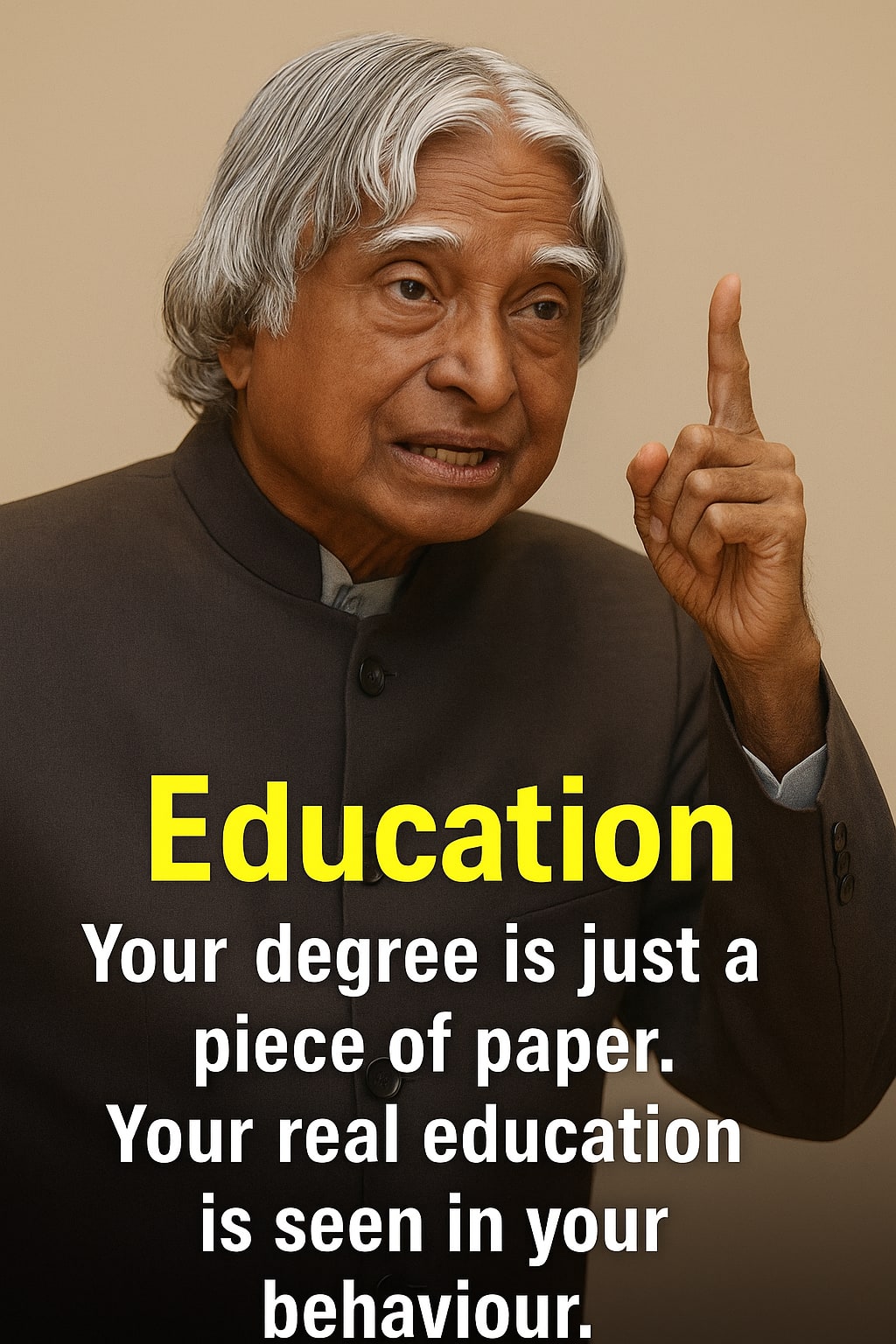
He began with a quote from A.P.J. Abdul Kalam:
“Your degree is just a piece of paper. Your real education is seen in your behaviour.”
He shared his journey — the arrogance of youth, the slap of reality, and the awakening of wisdom. The room was silent, hanging onto every word.
When he finished, there was a standing ovation — not for a degree holder, but for a man who had learned to live with dignity.
Full Circle
Years later, Aarav started his own foundation — Project RealEd — dedicated to teaching values and life skills to students across India. The mission was simple: “To make character a part of curriculum.”
He visited schools, colleges, and villages, telling young people:
“A degree will get you an interview. Your character will get you a life.”
In a world obsessed with titles, Aarav became a voice reminding people that education is not in the letters after your name, but in the way you treat a waiter, speak to your parents, respect a disagreement, and own up to your mistakes.
---
Final Message:
To anyone reading this today:
Your marks may measure your memory, but your behavior measures your wisdom.
Your degree might open a door, but your attitude determines whether you’re invited in.
Real education makes you humble, respectful, and kind — because knowledge without values is like a lamp without light.
About the Creator
Keep reading
More stories from Muhammad Faizan and writers in Motivation and other communities.
"Hungry for More: Ayaan’s Journey from Ordinary to Extraordinary"
“I don’t want to just survive. I want to live with fire in my eyes.” That’s what 19-year-old Ayaan scribbled at the end of his college notebook before walking away from the life others had written for him. While most people feared failure, Ayaan feared one thing more: mediocrity.
By Muhammad Faizan7 months ago in Motivation



Comments
There are no comments for this story
Be the first to respond and start the conversation.