
The Truck Stop Waitress Who Talked a Man Out of Suicide at 3:17 A.M.
Motivational story

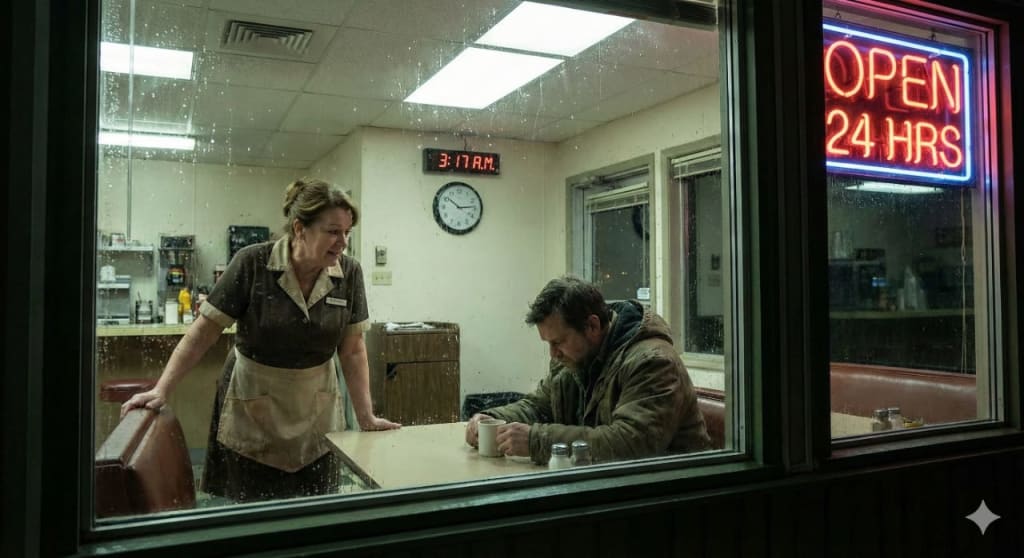
The Interstate is a singular, rhythmic entity. Especially Interstate 40, the great concrete artery that slices through the belly of America, running from the chaotic ports of North Carolina to the dusted plains of California. By day, it is a blur of commerce and vacationers. But by night, the road changes. It becomes a kingdom of shadows, red taillights, and solitary souls.
In 2008, in the deep, wooded quiet of western Arkansas, there was a place that existed solely for those who lived in this nocturnal world. It was a small, independent truck stop diner. It didn’t have a catchy name or a retro-chic aesthetic designed for Instagram tourists. It had vinyl booths patched with duct tape, the smell of burnt coffee and diesel fuel permanently etched into the drywall, and fluorescent lights that hummed with the sound of a trapped insect.
It was the kind of place you only stopped at if you had nowhere else to be, or if you had been driving so long the white lines on the road had started to float.
And it was the domain of Carolyn Moore.
Carolyn was 54 years old. She was a woman mapped by the geography of hard work. She had divorced many years ago, raised two children into adulthood on a waitress’s tips, and possessed feet that ached with a chronic, dull throb that she had simply learned to ignore. She wasn't a therapist. She wasn't a crisis counselor. She was a woman who knew how to balance four plates on one arm and could spot a counterfeit twenty-dollar bill by the texture of the paper.
But more importantly, she possessed "night eyes."
Any veteran of the graveyard shift knows what this means. After working the 10:00 p.m. to 6:00 a.m. shift for a decade, you stop seeing people as merely customers. You see the subtext. You see the fugitives, the runaways, the functioning alcoholics, the lonely long-haulers missing their wives, and the broken families moving everything they own in a sedan with a sagging bumper.
You see everything.
The Arrival
The digital clock behind the counter read 3:17 a.m.
The diner was mostly empty. A couple of regulars were hunched over coffee in the corner, silent as stones. The rain had started outside, a cold, insistent drizzle that turned the parking lot into a slick of reflected neon.
Then, the bell above the door chimed.
A man walked in. He was unremarkable in the way tragedy often is. He wore a heavy jacket that seemed too warm for the diner’s interior, and he moved with a stiffness that suggested he was holding his breath. He didn’t look at the pie case. He didn’t scan the room for a friendly face. He walked straight to the last booth, the one furthest from the entrance, right against the dark window.
Carolyn watched him. She grabbed a pot of coffee—her shield and her sword—and approached the table.
He didn't look up. He was staring at his hands, which were resting flat on the Formica table.
"Coffee, honey?" she asked.
He nodded once, a sharp, jerky motion.
She poured the cup. Steam rose up between them. Usually, this was the moment a customer would reach for the menu, ask for the special, or at least grunt a thank you.
He did none of those things. He just stared at the steam.
Carolyn walked away, but she didn’t stop watching. From behind the counter, while wiping down a prep station, she cataloged the anomalies.
One: He hadn't taken a sip of the coffee. It was just sitting there, losing its heat.
Two: His right hand kept drifting from the table to his jacket pocket. He would touch the fabric, squeeze it, and then pull his hand back as if the pocket were hot.
Three: He was shaking. It wasn’t the shivering of someone coming in out of the rain. It was a fine, vibratory tremor that started in the shoulders and ended in the fingertips.
Carolyn had seen drunks, and she had seen addicts in withdrawal. This was neither. This was fear.
The Intuition
In a corporate chain restaurant, the protocol would be to leave him alone. Turn tables. Maximize efficiency. Don’t get involved. But this was 2008, on a lonely stretch of Arkansas highway, and Carolyn Moore operated on a different frequency.
She felt a prickle on the back of her neck—an ancient, biological alarm system.
She walked back to the table with the pot, even though his cup was still full. She stood there for a moment, waiting for him to acknowledge her. He didn't.
"You okay, honey?" she asked. Her voice was low, pitched below the hum of the refrigerator.
He blinked. "Yeah."
The word hung in the air, hollow and brittle. It was the lie everyone tells when they are absolutely, devastatingly not okay.
Carolyn looked at his hand near the pocket. She looked at his eyes, which were rimmed with red, staring at a point a thousand miles away.
She made a choice. It was a choice that wasn't in her job description. It was a choice that could have gotten her fired, or hurt.
She topped off his full cup, just to have a reason to stay, and said quietly:
"People don't sit like that unless they're planning something."
The Breach
The man froze. It was as if she had shouted a secret he had been keeping locked in a vault. He looked up at her, really looked at her, for the first time. He saw the wrinkles around her eyes, the nametag, the weariness, and the inexplicable warmth.
The dam broke.
Tears didn't just fall; they erupted. It was a silent, violent weeping. His shoulders heaved, and he gasped for air.
Carolyn didn't flinch. She didn't look around to see if anyone was watching. She simply took a step closer to the booth, creating a barrier between him and the rest of the room.
Through the jagged sobs, the story spilled out. It was a story Carolyn had heard variations of before, but never with such lethal finality.
The economy was crashing. He had lost his job three weeks ago. He hadn't told his wife immediately, trying to fix it, trying to find something else. Then the debts came. Then the arguments. Then, two days ago, she had left, taking the kids to her mother’s.
He felt like a failure. Not just a financial failure, but a failure as a man, a husband, a father. He felt erased.
"I have a gun in my pocket," he whispered.
The air in the diner seemed to vacate the room.
"I was going to drive to the bridge," he said, his voice trembling. The bridge was two miles down the interstate, a high overpass spanning a deep, rocky gorge. "I just... I needed a cup of coffee first. I don't know why."
Carolyn looked at the pocket. She could see the outline now. The heavy, angular shape of metal against fabric.
This was the moment where the script ends. There is no training manual for a waitress facing a man with a gun who wants to die. Panic would have been reasonable. Screaming for the cook would have been expected.
But Carolyn didn't panic. She understood something profound in that moment: He hadn't come here for coffee. He had come here because he didn't want to die alone. He had come here hoping, subconsciously, that someone would interrupt him.
She didn't lecture him. She didn't offer platitudes. She didn't say, "Everything will be okay," because she knew that right now, nothing was okay.
Instead, she offered him an anchor.
"Then sit here until the feeling passes," she said firmly. "I'll keep the coffee coming. You don't have to go anywhere for the next hour. You just have to sit here."
The Longest Hour
For the next hour, the diner became a sanctuary suspended in time.
Carolyn didn't hover, but she never went far. She would wipe a table nearby, then circle back. She refilled his cup. She brought him a slice of apple pie he hadn't ordered and slid it in front of him.
"Eat," she said. "Sugar helps."
They talked.
They didn't talk about death. They didn't talk about the debt or the divorce or the gun. Carolyn steered the conversation toward the mundane, the solid, the real.
They talked about the rain. They talked about how the heater in her car was busted. She told him about her son, who was stubborn as a mule, and her daughter, who was trying to learn guitar. She asked him where he was from. She asked him what kind of music he liked.
She forced him to engage with the world of the living.
Every time his eyes would glaze over, drifting back toward the dark thoughts, she would pull him back.
"Hey," she’d say, tapping the table. "You hear that song? I hate this song. Played it at my prom."
She kept him tethered.
At one point, around 4:00 a.m., he looked at her with a haunted expression and asked, "Does it stop? The pain?"
Carolyn paused. She thought about her divorce. She thought about the nights she sat on the edge of her bed, feet throbbing, wondering how she would pay the electric bill.
"No," she said honestly. "It doesn't stop. But the noise quiets down. Suicide thoughts... they're like waves, honey. They’re big and they crash over you and you think you’re gonna drown. But if you don't act on the first one, if you just stand your ground, the water recedes. It always recedes."
She looked him in the eye. "You just gotta wait for the tide to go out."
The Surrender
At 4:26 a.m., the atmosphere shifted.
The man took a deep breath. It was the first breath he had taken that reached all the way to the bottom of his lungs. The shaking in his hands had subsided to a dull tremble.
He reached into his jacket pocket.
Carolyn’s heart hammered against her ribs, but she didn’t move.
He pulled out the gun. It was dark, heavy, and terrifyingly real against the white Formica table. But he didn't point it. He placed it down, gently, and slid it across the table toward her.
"Can you call someone?" he asked. His voice was exhausted, stripped bare. "I think... I think I need help."
Carolyn covered the gun with a rag she had in her apron. She nodded.
"I can do that," she said.
She went to the phone behind the counter. She didn't call 911 screaming. She called the local police station, where she knew the dispatcher by name. She explained the situation calmly.
When the officers arrived, there were no sirens. They walked in quietly. They spoke to the man softly. They took the gun.
As they led him out, the man stopped at the door. He turned back to look at Carolyn. He looked like a man waking up from a coma—confused, battered, but alive.
"Thank you," he mouthed.
Carolyn nodded. She watched the taillights of the police cruiser fade into the rainy darkness of Interstate 40.
Then, she picked up the empty coffee cup, bussed the table, and wiped away the crumbs of the apple pie.
The Aftermath No One Saw
The story should end with a ceremony. In a movie, Carolyn would be given a medal. The town would throw a parade. The man would return a year later, a millionaire, to give her a check.
But this is real life.
The man was hospitalized. He received treatment. According to the grapevine of the highway, he eventually reunited with his family and found work in a neighboring state. He survived.
Carolyn never saw him again.
There was no news story. The local paper didn't pick it up because "attempted suicide prevents by waitress" isn't a headline that sells ads.
Carolyn finished her shift at 6:00 a.m. She counted her tips. She drove her beat-up car home in the gray morning light. She soaked her feet in Epsom salts. She slept.
She went back to work the next night.
Why This Story Matters
We live in a culture obsessed with grand gestures and professional intervention. We tell people that if they are struggling, they need "resources." We talk about hotlines, therapy apps, and government programs. And those things are vital. They are necessary.
But the infrastructure of human survival is often built on something much flimsier and much more beautiful.
Many lives are saved not by doctors or experts, but by ordinary people at ordinary jobs who simply decide to pay attention.
The woman who noticed the man staring at his hands at 3:17 a.m. saved a life not because she had a degree, but because she had presence. She was willing to be uncomfortable. She was willing to break the social contract that says we should mind our own business.
We often imagine that saving a life requires tackling someone off a ledge or performing emergency surgery. But the truth, the one that most people don't want to admit because it is terrifyingly simple, is that most people who die by suicide try to connect with someone first.
They drop hints. They linger. They look for a sign that they are not invisible.
They look for someone to say, "I see you."
Carolyn Moore didn't cure that man’s depression. She didn't pay off his debts. She didn't fix his marriage. She did something smaller, and perhaps more difficult.
She kept him company while he waited for the wave to pass.
She proved to him that he existed, that his pain had weight, and that a stranger cared enough to pour another cup of coffee and listen to the rain.
The Invisible Army
There are thousands of Carolyns out there right now.
They are driving cabs, scanning groceries, tending bar, and working the night shift at hotels. They are the unofficial first responders of the human soul. They are the ones who catch us when we are slipping through the cracks of society.
They don't get medals. They don't get plaques.
But on that rainy night in Arkansas, in a diner that smelled of burnt coffee and diesel, Carolyn Moore proved that you don't need to be a hero to save a life. You just need to be human, and you need to be there.
Sometimes, keeping someone alive is as simple—and as profound—as saying:
"You don't have to go anywhere for the next hour. Just sit here with me."
Note: If you or someone you know is struggling or in crisis, help is available. .
About the Creator
Frank Massey
Tech, AI, and social media writer with a passion for storytelling. I turn complex trends into engaging, relatable content. Exploring the future, one story at a time
Keep reading
More stories from Frank Massey and writers in Motivation and other communities.
The Ghost on the Scope: The Forgotten Hero of the Night the Potomac Froze
The untold true story of Lloyd Burton, the air traffic controller who trusted his gut over his instruments to stop a second plane crash on the night of the Air Florida disaster in Washington D.C.
By Frank Massey 7 days ago in Motivation




Comments
There are no comments for this story
Be the first to respond and start the conversation.