
The Silent Epidemic: Confronting the Crisis of Modern Loneliness
Rediscovering Connection in the Most Connected Era of Human History

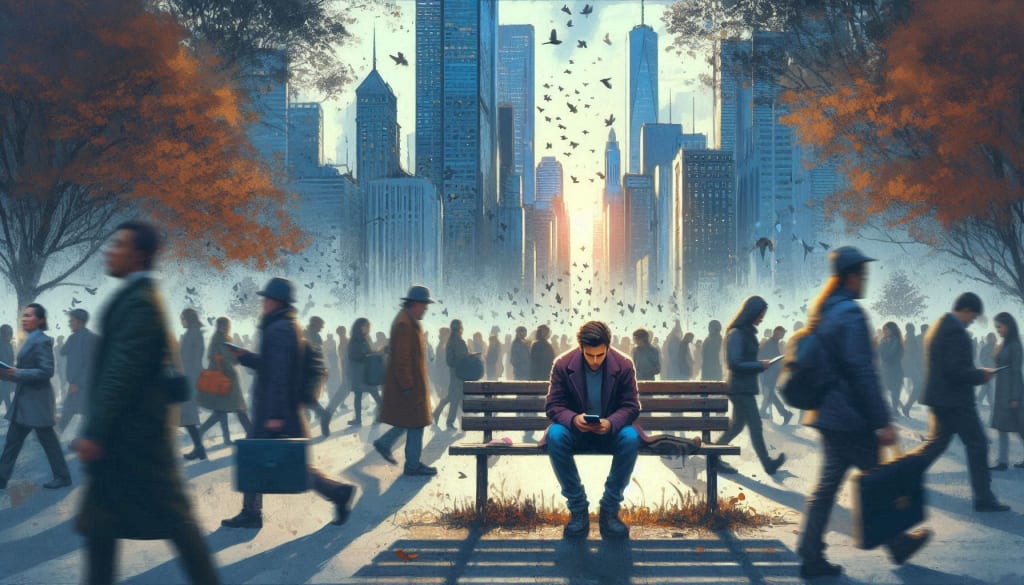
Everybody experiences loneliness from time to time—when we find ourselves alone at lunch, move to a new city, or when others seem too busy to spend time with us. However, what was once an occasional feeling has now become a chronic condition for millions. In the UK, 60% of 18 to 34-year-olds report frequent loneliness. In the US, 46% of the entire population regularly feels isolated. Despite living in the most connected era in human history, an unprecedented number of us feel alone.
It is important to understand that being lonely and being alone are not synonymous. One can be blissful in solitude or miserable in a crowd. Loneliness is a deeply personal, subjective experience. If you feel lonely, you are lonely. Contrary to common stereotypes, loneliness does not only afflict those lacking social skills. Research indicates that social skills have minimal impact on social connections in adults. Loneliness can affect anyone, regardless of wealth, fame, power, beauty, or personality—because it is a part of our biology.
Loneliness is as fundamental a bodily function as hunger. Just as hunger signals the need to nourish our bodies, loneliness signals the need for social connection. Our bodies evolved to care about social needs because, millions of years ago, social bonds were crucial for survival. Our ancestors who formed connections thrived, while those who did not were less likely to survive. Pain from rejection, an evolutionary adaptation, served as an early warning system to correct behavior and maintain social bonds. Those who experienced rejection as more painful were more likely to adapt and stay connected.

This finely tuned social mechanism worked well for most of human history until societal changes began to challenge it. The loneliness epidemic started during the late Renaissance when Western culture shifted towards individualism. The Industrial Revolution further accelerated this trend as people left their long-established communities for urban factories. Modern life continues to fragment our social bonds as we move for jobs, love, and education, often leaving our social networks behind. The average number of close friends in the US dropped from three in 1985 to two in 2011. As adults, we often prioritize work, family, and entertainment over maintaining friendships, inadvertently fostering feelings of isolation.
Despite our technological advances, our minds and bodies are still wired for social interaction. Chronic loneliness is among the most harmful experiences for humans, contributing to faster aging, deadlier cancers, accelerated Alzheimer's, and weaker immune systems. It is as deadly as smoking a pack of cigarettes a day and twice as deadly as obesity. When loneliness becomes chronic, it can become self-sustaining. Social pain, like physical pain, triggers defensive behaviors, making us more alert to social signals yet worse at interpreting them accurately. This can lead to a cycle of negative interactions, further isolating us.
Recognizing this vicious cycle is the first step to overcoming chronic loneliness. Feelings of isolation lead to tension and sadness, which make us focus on negative social interactions, altering our thoughts and behaviors. We begin to avoid social interactions, deepening our isolation. This process can end in depression and a mental state that prevents us from forming connections even when we desire them.
Acceptance is key. Loneliness is a universal human experience, not something to be ashamed of. Self-examination can help identify whether we are focusing on negative aspects of interactions or assuming the worst about others' intentions. By giving others the benefit of the doubt and risking openness and vulnerability, we can break the cycle of loneliness.

If self-reflection is insufficient, seeking professional help is a sign of strength, not weakness. Addressing loneliness as both an individual and a public health issue is crucial. While our world is filled with incredible achievements, none can substitute our fundamental need for connection. As humans, our well-being depends on the bonds we form with each other.
By building our modern world with an understanding of our innate need for social connection, we can create a society where loneliness is no longer a pervasive issue. Our collective effort to foster genuine connections will lead to a healthier, happier, and more connected world.
About the Creator
Reader insights
Nice work
Very well written. Keep up the good work!
Top insight
Eye opening
Niche topic & fresh perspectives
Keep reading
More stories from E.V.K and writers in Motivation and other communities.
Rise and Shine
How Becoming an Early Riser Can Transform Your Life Do you feel like every morning is a mad dash to get out the door? Are you not achieving as much as you'd like? It's time to follow the footsteps of some of history's greatest minds and become an early riser. Here's why and how to do it.
By E.V.Kabout a year ago in Motivation
Looking back: 2025 was a beast
It's difficult to know how to start this. I've suggested that it's been a tough one from my title and in many ways, it has; however, there is an argument that it's not been that extraordinary at all, merely this wonderful thing we call "life" with all its climaxes and pitfalls.
By Rachel Deeming26 days ago in Motivation
THE NATURE OF ABUSE
The nature of abuse is fundamentally defined by an imbalance of power and control, where one seeks dominance to achieve obedience within the powerless state of another. The path to restorative peace, emancipation, and freedom must reside within the state of truth. To become a catalyst of change one must force the mask to drop for transparency and accountability to emerge. The façade or persona others may project to the world, often conceals their core real true-self. True character is often revealed within moments of critical crisis, where someone who has experienced grave injustice, torture, ridicule, resistance to help, or silencing is forced to walk without assistance. Within moments of despair one enters into the ascended state of revelation, awakening, and enlightenment of the true self. One must acutely address and recognize where policy, legislation, legal frameworks, leadership, or lack of compassionate care or empathy may not be apparent. What resides or lies beneath, will always emerge to the surface within time, especially when another’s superficial mask drops. What is often revealed is the performative façade is no longer evident. Within the critical moments of relationships, genuine intent is demonstrated by compassion, understanding, support, and a willingness to set aside personal selfish interests for the common good of all. Unfortunately, within the realms of cruelty or manipulative intent, there can be a stark contrast to the reality initially being presented prior by the abuser, as the charm inevitably fades. Survivors of abuse can identify a change in character when loss of control is evident. Within the moments of absence, indifference, apathy, or silence, abusers are often challenged in the sense, that they must confront what they have inevitably become. Abusers are often publicly caught in a lie that they cannot explain away. A turning point emerges for a victim of abuse, when there is a shocking devastating realization that the person they confided in, was engaging in a performance act. This knowledge can be a catalyst for a victim to begin their healing journey and leave an abusive relationship, as it provides certainty, that their instincts and moral judgement were correct all along.
By ELISABETH BABARCI 4 days ago in Motivation
Wild Card Weekend Recap: What Happens Now?
I think I figured out why I love Wild Card Weekend so much. It's because it's the first playoff anything of the calendar year. The NFL season starts in the fall, and once upon a time, the champion was crowned either on or slightly before New Year's. The evolution of the NFL schedule has resulted in the playoffs starting just into the New Year, and currently, the final week of the season falls on the first weekend of the New Year, with Wild Card Weekend coming a week after that. So yes, chronologically, the NFL's Wild Card Weekend serves as the first playoff anything of the calendar year.
By Clyde E. Dawkins5 days ago in Unbalanced



Comments (2)
It is nice and well done.
Wow, thanks for this educative piece ,learnt few things here