
The Scorpion’s Children – A Powerful Lesson About Parents and Gratitude
A Reflection for Human Life
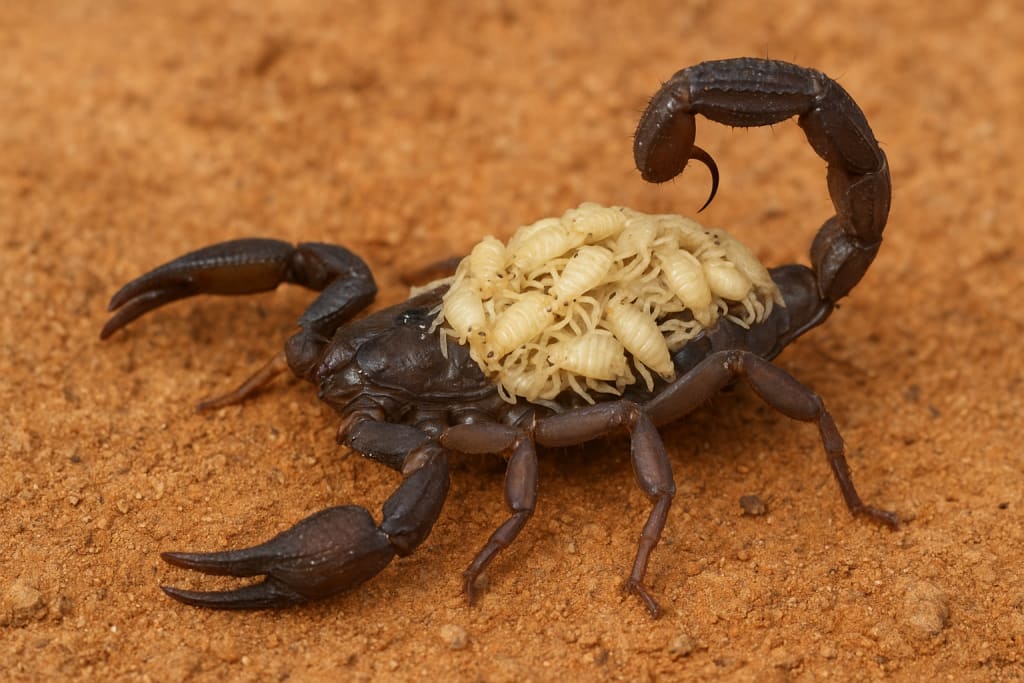
The Scorpion’s Children – A Lesson About Parents
How a creature’s sacrifice reflects the reality of human life
In the natural world, the scorpion gives us one of the most shocking examples of sacrifice. After giving birth, the mother scorpion allows her babies to climb onto her back. At first, this seems like protection — a mother carrying her young so they can survive. But the reality is heartbreaking.
Those very babies begin to eat the flesh of their own mother. She feels the pain but remains silent. Step by step, she grows weaker, yet she continues to carry them until she is no longer able to move. By the time the babies are strong enough to walk on their own, the mother scorpion has given her life. Her silence and sacrifice ensure their survival.
A Reflection for Human Life
When we hear this story, it feels cruel and unnatural. How could children feed on the body of their own mother? And yet, if we look around us, we find that many of us behave in a similar way toward our parents.
From the moment a child is born, parents sacrifice everything for them. They stay awake through sleepless nights, spend their hard-earned money on food, clothing, and education, and often put their own dreams aside to ensure a brighter future for their children. A father works long hours, sometimes in harsh conditions, while a mother gives up her comfort, health, and sometimes even her social life to raise her children.
But when those children grow up, the story often changes. Some become so busy with careers, relationships, or personal goals that they forget the ones who gave them everything. They may choose not to visit their parents, ignore their calls, or even place them in old-age homes, convincing themselves that they are too busy.
In these moments, are we not behaving like the scorpion’s children — feeding on the sacrifice of our parents, and then leaving them behind once we can stand on our own?
The Spiritual Reminder
The Holy Qur’an gives clear instructions about how we must treat our parents. It says:
“Do not even say ‘uff’ to your parents.”
“Lower to them the wing of humility out of mercy and say: My Lord, have mercy upon them as they brought me up when I was small.”
The Prophet Muhammad (peace be upon him) also said: “The pleasure of the father is the pleasure of Allah, and the displeasure of the father is the displeasure of Allah.”
Another narration reminds us: “Looking at your parents with love is equal to the reward of an accepted Hajj.”
These teachings highlight that honoring parents is not just a moral duty, but a spiritual obligation. Ignoring them, hurting them, or neglecting them is not only a betrayal of their love but also a sin before God.
Why Parents Matter
Parents are not just caretakers; they are the foundation of our lives. A child’s first teacher is the mother. The father’s sacrifices build the roof over the child’s head. Every comfort we enjoy has, in some way, come from the effort of our parents.
In today’s modern world, where independence is often glorified, people forget that success is rarely achieved alone. Behind every degree, every job, and every milestone, there are parents who gave up something so their children could achieve more.
To neglect them in their old age is to forget the very roots of our existence. It is to behave worse than the scorpion’s children — because unlike animals, we have the ability to choose love, respect, and gratitude.
Conclusion
The story of the scorpion’s children is not just about nature — it is a mirror for us to look into. If a scorpion can sacrifice her life for her young, how much greater is the sacrifice of a human mother and father? And if children abandon their parents after taking everything, are they not more ungrateful than the scorpion’s offspring?
💞 Respect your parents. Visit them, care for them, and make them feel valued. Do not wait until it is too late, because once they are gone, no amount of regret can bring them back.
About the Creator
Keep reading
More stories from Rahman Bsm and writers in Motivation and other communities.
The Power of Consistency
The Power of Consistency In a small, quiet village surrounded by fields and mountains, lived a young boy named Imran. He was known not only for his big dreams but also for his struggles. Life in the village was not easy. His family was poor, money was scarce, and sometimes even daily meals were uncertain. Yet, in Imran’s heart burned a strong desire—to rise above difficulties and achieve something meaningful in life.
By Rahman Bsm5 months ago in Motivation
Children Don’t Grow Up—They’re Pushed
We like to say children grow up too fast, as if time itself is to blame. As if childhood simply slips away on its own—quietly, naturally, without resistance. But that isn’t the truth. Children don’t grow up. They’re pushed.
By Imran Ali Shah5 days ago in Motivation
The Devil's Cut
“Comrade, finally you’re awake.” The voice was smooth, sensual. A flickering incandescent bar was all that lit the white, sterile room. All Vladimir remembered was everything going black. He tried to move his arms and found them strapped to the gurney.
By Matthew J. Fromm4 days ago in Fiction


Comments
There are no comments for this story
Be the first to respond and start the conversation.