
The Savior of Mothers: The Doctor Who Was Destroyed for Washing His Hands
In 1840s Vienna, a young doctor discovered that the medical elite were accidentally killing their patients. His cure was simple: soap and water. The establishment’s response was to destroy him

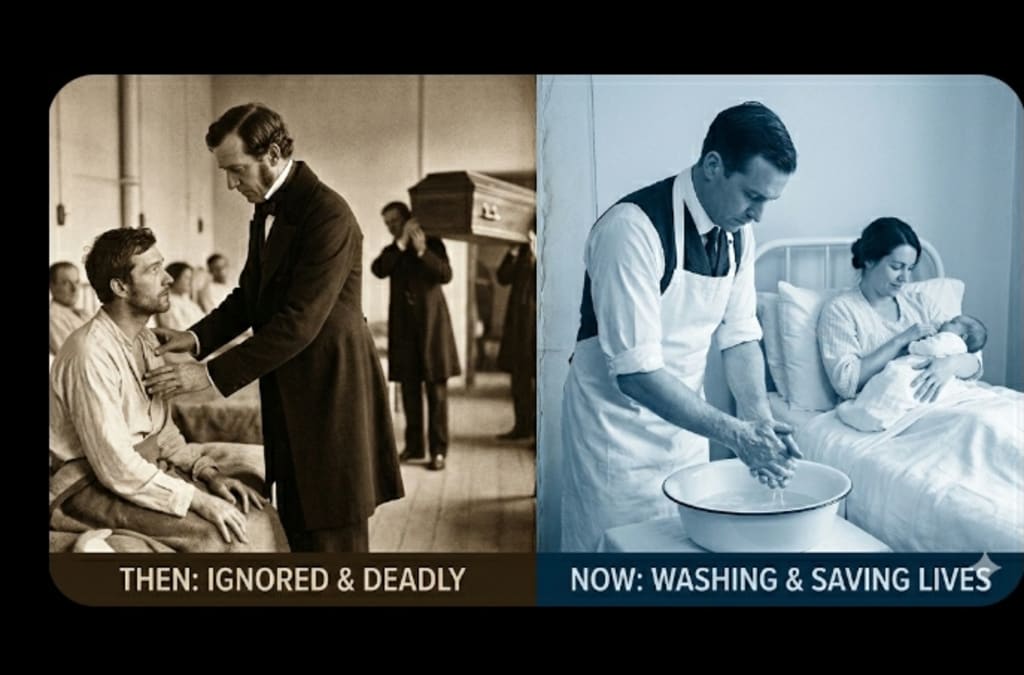
The tragic true story of Dr. Ignaz Semmelweis, who discovered the cause of childbed fever and the importance of handwashing, only to be rejected by the medical community and die in an asylum.
Vienna, 1846. It was the glittering capital of the Austro-Hungarian Empire, a city of waltzes, coffee houses, and high culture. It was also the home of the Vienna General Hospital, the most modern, advanced medical facility in the world.
But within the maternity ward of this cathedral of science, there was a secret horror.
Young women, healthy and strong, would walk into the hospital to give birth. They would deliver their babies successfully. And then, days later, they would begin to burn with fever. Their pulses would race. Their abdomens would swell. They would die in agony, delirious and terrified.
It was called puerperal fever, or "childbed fever."
The doctors, the most educated men in Europe, shrugged their shoulders. They blamed it on "miasma" (bad air). They blamed it on the weather. They blamed it on the "delicate nature" of the women. They called it an act of God.
But Dr. Ignaz Semmelweis, a 28-year-old Hungarian assistant physician, noticed something that God couldn't explain.
There were two maternity clinics at the hospital. They were identical. Same heating, same ventilation, same diet, same linens.
The First Clinic was staffed by medical students and doctors.
The Second Clinic was staffed by midwives.
In the Second Clinic (the midwives), the death rate was low—around 4%.
In the First Clinic (the doctors), the death rate was catastrophic. It frequently hovered around 10%, and in some months, it spiked to nearly 30%.
It was a statistical impossibility if "bad air" was the cause. The air was shared.
The reputation of the First Clinic was so terrifying that pregnant women in Vienna begged on their knees not to be admitted there. If they were assigned to the First Clinic, they would weep, believing they had been sentenced to death. Some women preferred to give birth in the dirty streets outside rather than enter the doctors' ward. Semmelweis noticed that these "street births" rarely resulted in fever.
How could a gutter be safer than the finest hospital in Europe?
Semmelweis was haunted by the wailing of the dying women. He was a man of obsessive conscience. He couldn't accept the "will of God" explanation when the midwives next door were saving lives.
He began a frantic detective process. He stripped away the variables.
Was it overcrowding? No, the midwives' clinic was more crowded.
Was it the climate? No.
Was it religion? A priest walked through the First Clinic ringing a bell to administer last rites to the dying. Semmelweis thought perhaps the terrifying sound of the bell was shocking women to death. He made the priest take a different route and silence the bell. The women kept dying.
He was hitting a wall. The answer was invisible.
Part I: The Corpse in the Room
The breakthrough came in 1847, born of tragedy.
Semmelweis's friend and colleague, Jakob Kolletschka, was performing an autopsy on a woman who had died of childbed fever. During the procedure, a student accidentally poked Kolletschka’s finger with a scalpel. It was a minor cut.
But days later, Kolletschka fell ill. His symptoms were horrifyingly familiar to Semmelweis. High fever. Swollen abdomen. Delirium. Agony.
Kolletschka died.
Semmelweis looked at the autopsy report of his friend. It was identical—pathologically identical—to the women dying in the maternity ward.
The lightbulb shattered the darkness.
Kolletschka didn't have a uterus. He hadn't given birth. Yet he died of "childbed fever." This meant the disease wasn't something unique to pregnant women. It was an infection. And it had been transferred directly into his blood by the scalpel.
Semmelweis looked at the daily schedule of the First Clinic.
Every morning, the doctors and medical students started their day in the morgue. They performed autopsies as part of their training. They dissected bodies that were rotting, filled with disease. They plunged their bare hands into putrefying flesh to learn anatomy.
Then, they wiped their hands on a rag, walked up the stairs to the maternity ward, and performed pelvic examinations on laboring women.
They didn't wash their hands. In 1847, no one did. Germ theory did not exist. Doctors believed that cleanliness was an aesthetic choice, not a medical necessity.
The midwives in the Second Clinic did not perform autopsies. They stayed in the ward. Their hands never touched corpses.
The realization hit Semmelweis like a physical blow. The "miasma" wasn't in the air. It was on their hands.
The doctors were the carriers. The healers were the killers.
He called them "cadaverous particles." Invisible bits of death that stuck to the skin and were transferred from the dead to the living.
Part II: The Chlorine Solution
Semmelweis didn't wait for permission. He ordered a basin of chlorinated lime solution (a harsh bleach) to be placed at the entrance of the First Clinic.
He issued a strict order: "Every student or doctor must wash their hands in this solution until the smell of the corpse is gone before touching a patient."
It was unpopular. The chlorine smelled terrible. It irritated the skin. The doctors grumbled. It took time. It was an insult to their dignity to suggest they were "unclean."
But Semmelweis stood by the basin like a guard dog, watching them scrub.
The results were instantaneous and undeniable.
In April 1847, before the handwashing, the death rate was 18.3%.
In May, handwashing began mid-month. The rate dropped.
By June, the death rate was 2.2%.
By July, 1.2%.
In 1848, there were months where the death rate in the First Clinic was zero.
For the first time in history, the doctors' ward was as safe as the midwives' ward. The terror of the First Clinic evaporated. Women stopped begging for their lives.
Semmelweis had solved the puzzle. He had saved the mothers.
Part III: The Semmelweis Reflex
In a rational world, Semmelweis would have been hailed as a hero. He would have been given a statue. The practice would have spread across Europe instantly.
But humans are not rational creatures. We are creatures of ego.
The medical establishment of Vienna did not applaud Semmelweis. They attacked him.
His theory was an existential threat to their identity. Semmelweis was effectively saying, "You, the wealthy, educated, upper-class gentlemen of science, have been murdering women with your dirty hands for decades."
It was a psychological pill too bitter to swallow.
His immediate superior, Professor Johann Klein, was furious. He viewed the handwashing mandate as insubordination. He resented the implication that his management had been lethal.
The doctors argued against him with "science." They said his theory lacked a theoretical basis (which was true—bacteria hadn't been discovered yet). They said the statistical correlation was a coincidence. They argued that "cadaverous particles" couldn't possibly be powerful enough to kill a person.
But the real argument was unspoken: Gentlemen are clean. Prostitutes and peasants are dirty. How dare you accuse us?
Semmelweis was not a diplomat. He was angry. He knew he was right. He called his colleagues "murderers" in open letters. He had no patience for their fragile egos when women were dying.
The conflict escalated. Despite the overwhelming data—the saved lives, the zero death rates—the hospital refused to renew Semmelweis's contract.
In 1849, he was fired.
He was effectively exiled from the medical community of Vienna. He returned to his native Budapest, bitter and broken.
Part IV: The Slow Death of Truth
In Budapest, he took a job at a small hospital. He implemented handwashing there. Once again, mortality rates plummeted. The cure worked everywhere it was tried.
But the international medical community refused to listen. Semmelweis published a book, The Etiology, Concept, and Prophylaxis of Childbed Fever. It was filled with tables, data, and undeniable proof.
It was widely ignored or ridiculed in medical journals. Famous doctors gave speeches mocking the "chlorine washing" as a waste of time.
Semmelweis watched from afar as the death rates in Vienna climbed back up after he left. The doctors stopped washing their hands. The women started dying again.
The knowledge that he could save them, but was being prevented by stupidity and pride, drove him mad.
He began to lose his mind. He would stop couples on the street and scream at them to ensure the doctor washed his hands before the birth. He wrote open letters to the world's leading obstetricians, accusing them of participating in a massacre.
"I have seen the truth," he wrote, "and it is being murdered."
By 1865, at the age of 47, Ignaz Semmelweis was a shadow of himself. He was drinking heavily. His behavior was erratic. His wife and colleagues believed he was losing his sanity.
In a cruel final twist, he was lured to a mental asylum in Vienna under the pretense of visiting a new medical institute. When he realized where he was, he tried to leave. The guards beat him severely.
He was put in a straitjacket and thrown into a dark cell.
Two weeks later, he died.
The cause of death? Gangrene. It started from a wound on his hand—likely caused by the beating. The infection entered his blood. It was septicemia.
Ignaz Semmelweis died of the exact same disease he had spent his life trying to prevent in women.
Part V: The Vindication
He was buried in a quiet grave. Few colleagues came to the funeral. His successor at the maternity clinic openly mocked his handwashing theories.
But science marches on, even if it steps over the bodies of its pioneers.
Just a few years after Semmelweis died, Louis Pasteur confirmed the germ theory of disease. Joseph Lister, the British surgeon, began using carbolic acid to sterilize surgical instruments, citing Pasteur's work.
Suddenly, the invisible "cadaverous particles" had a name: Bacteria. Streptococcus.
The world realized, with a collective gasp of horror, that Semmelweis had been right all along. The doctors were the killers. The "miasma" was on their hands.
Today, Ignaz Semmelweis is considered the "Savior of Mothers." There are universities named after him. His face is on stamps and coins.
But his legacy lives on in a concept known in psychology as the "Semmelweis Reflex."
It is the reflex-like rejection of new knowledge because it contradicts established norms, beliefs, or paradigms. It is the tendency of human beings to protect their ego rather than accept the truth.
Conclusion: The Cost of Being Early
The story of the midwife’s ward versus the doctor’s ward is not just a medical history lesson. It is a warning about the danger of expertise.
The doctors in Vienna were the experts. They had the degrees. They had the power. And because of that, they were blind. They couldn't see what was right in front of them because it didn't fit the picture of who they thought they were.
Semmelweis failed not because his idea was bad, but because he underestimated the human need to be right. He thought data would be enough. He didn't realize that when the truth accuses people of negligence, they will kill the messenger before they admit the mistake.
Every time you wash your hands before a meal, or a surgeon scrubs in before an operation, you are performing a ritual that one man died to give us.
We are safe today because he was willing to be destroyed by the truth.
About the Creator
Frank Massey
Tech, AI, and social media writer with a passion for storytelling. I turn complex trends into engaging, relatable content. Exploring the future, one story at a time
Keep reading
More stories from Frank Massey and writers in Motivation and other communities.
The Camden Experiment: How a City Fired Its Entire Police Force to Save Itself
The true story of how Camden, NJ, dismantled its corrupt police department and rebuilt it from scratch, leading to a historic drop in violent crime and a new model for community policing.
By Frank Massey 20 days ago in Motivation
I Watched My Friend Lose Himself and Then Find His Way Back
Some stories are hard to tell, not because they are dramatic, but because they are painfully real. This is the story of my friend, someone I grew up laughing with, someone who once filled every room with energy. Watching him slowly disappear into silence was one of the most difficult experiences of my life.
By Charles Jones5 days ago in Motivation
The steps to losing a child
Step One: Lose a child. Not what anyone wants to happen and nothing you can do to change it, but you can go through steps to becoming happy again. You can go through steps to loving again. You can go through steps to become a new you because after losing a child you will never be the same person you once were.
By Tabitha Hinkley3 days ago in Fiction


Comments
There are no comments for this story
Be the first to respond and start the conversation.