
The Honda Story: From a Small Workshop to a Global Giant
How One Man’s Dream and a Lot of Hard Work Built One of the World's Most Trusted Brands
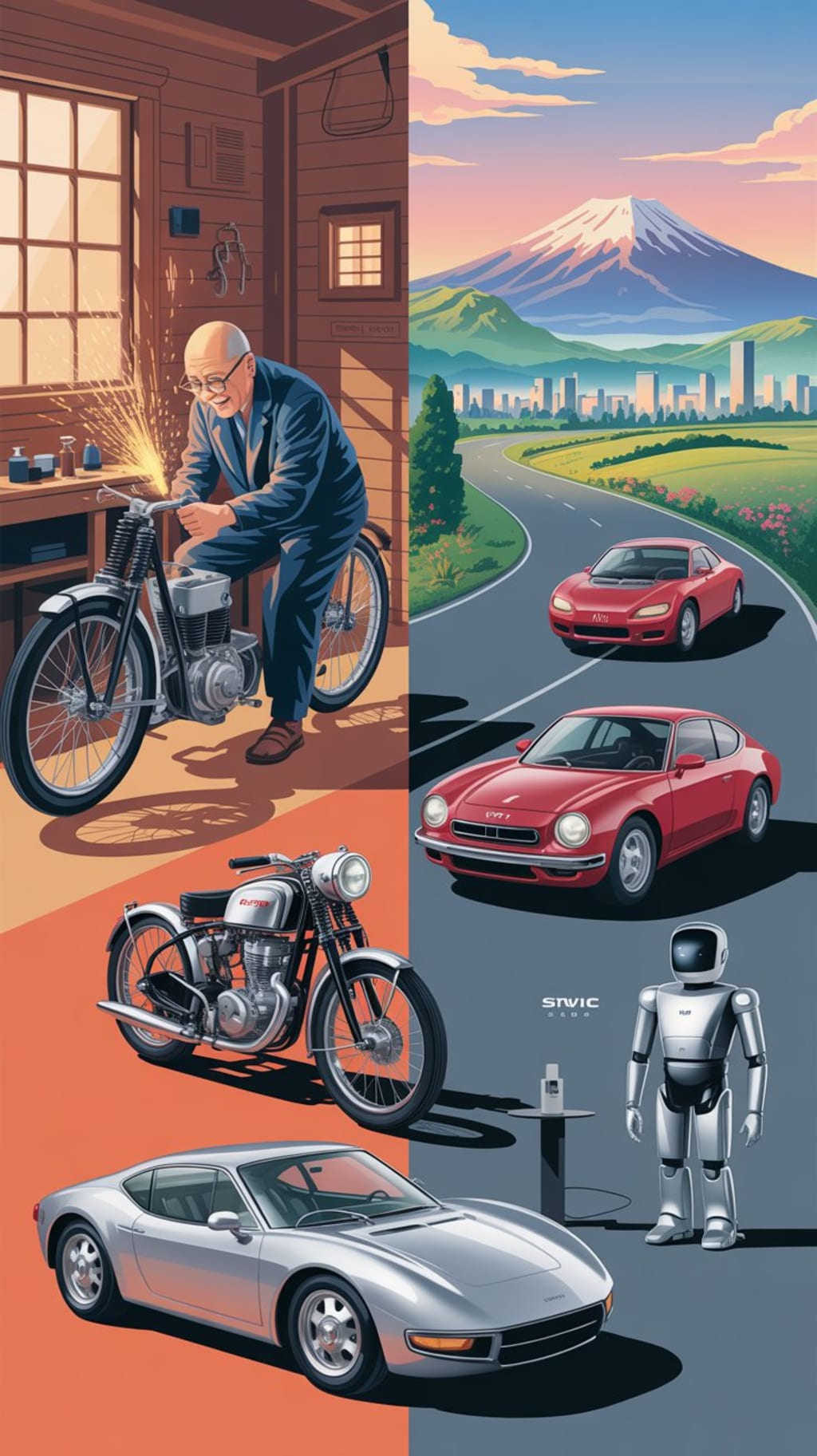
In the early 20th century, Japan was still recovering from war, and people were struggling to rebuild their lives. In the middle of this tough time, one man had a dream—not to become rich, but to create something useful, simple, and reliable. His name was Soichiro Honda.
This is the story of how Honda, a company that started with almost nothing, became one of the biggest names in motorcycles and cars across the world.
🛠️ A Humble Beginning
Soichiro Honda loved machines from a young age. As a child, he would watch blacksmiths and mechanics at work and dreamed of building things himself. He didn’t grow up with much money, and he didn’t have a formal education in engineering. But he had curiosity, passion, and endless determination.
In 1946, right after World War II, Soichiro Honda started a small workshop called the Honda Technical Research Institute in a tiny shed. At first, he didn’t make cars. He found small engines and attached them to bicycles. These “motorized bikes” helped people move around when gas was hard to find.
They were simple, affordable, and reliable—just what people needed. Soon, the idea caught on.
🏍️ Building the First Motorcycles
By 1949, the Honda team built their first complete motorcycle, called the Honda Dream D-Type. It was light, smooth, and easy to ride. People loved it.
That motorcycle marked the beginning of Honda’s journey into becoming a household name in Japan—and later the world.
By the 1950s, Honda had become the largest motorcycle manufacturer in Japan. But Soichiro Honda had bigger dreams. He wanted to build cars too.
🚗 Entering the Car World
In 1963, Honda released its first car—the T360 mini truck and the S500 sports car. These cars were small but smart, designed for people who needed simple and affordable transportation.
Many people didn’t believe that Honda could succeed in the car business, especially against big companies like Toyota and Nissan. But Honda didn’t give up.
Over time, they introduced more cars that were fuel-efficient, reliable, and fun to drive. Models like the Civic, Accord, and later the CR-V became global favorites.
🌍 A Global Brand
In 1959, Honda set up a branch in the United States, becoming the first Japanese car and motorcycle company in America. Many thought Americans wouldn’t want small, Japanese vehicles—but they were wrong.
In the 1970s, during a gas crisis, Honda’s fuel-efficient cars became very popular. People wanted cars that saved money and worked well. Honda delivered exactly that.
Today, Honda sells its cars, motorcycles, and engines in over 150 countries. It builds cars in many parts of the world, including the U.S., India, and Europe.
🧠 Innovation and Technology
Honda is not just known for cars and bikes. The company also creates robots, jet engines, and even solar technology. They are always looking for new ways to solve problems and help people.
One of their most famous robots is ASIMO, a walking humanoid robot that can climb stairs and carry things.
Honda also focuses on clean energy and has built hybrid and electric cars like the Honda Insight and the Clarity. They aim to reduce pollution and make transportation better for the environment.
🙌 The Honda Spirit
What makes Honda different from many other companies is its spirit. Soichiro Honda believed in learning by doing. He said, “Success is 99% failure.” He was not afraid to make mistakes, as long as he kept trying.
Honda’s story is a perfect example of how hard work, creativity, and never giving up can turn a small dream into something huge.
💬 Final Words
From a bicycle engine in a shed to millions of cars on the road, the Honda journey shows what’s possible when someone dares to dream. It teaches us that even the biggest successes can come from the smallest beginnings.
Honda isn’t just a brand—it’s a symbol of passion, innovation, and the power of never giving up.
About the Creator
Keep reading
More stories from CodeCraft By Rashid and writers in Motivation and other communities.
One More Step
The Power of One More Step Once upon a time, in a small village surrounded by hills and forests, lived a young boy named Ethan. Ethan was 14 years old. He lived with his mother in a small house made of bricks and mud. His father had died when he was very young. His mother worked as a cleaner in a nearby town to feed and educate him.
By CodeCraft By Rashid8 months ago in Motivation
I Fulfilled My Mother’s Dreams, Not My Own
I used to believe that love meant sacrifice. That if I gave enough of myself away, it would somehow turn into happiness—for everyone involved. So when my mother talked about her dreams, the ones life never let her finish, I listened. And slowly, without realizing it, I picked them up and carried them as if they were my own.
By Imran Ali Shah2 days ago in Motivation



Comments
There are no comments for this story
Be the first to respond and start the conversation.