
The Girl Behind the Wig: How Sia Furler Turned Screaming into Singing
She wrote hits for Beyoncé and Rihanna in her sleep, but for years, she couldn't write a reason to stay alive. The story of how a homeless, addicted songwriter became the faceless voice of a generation

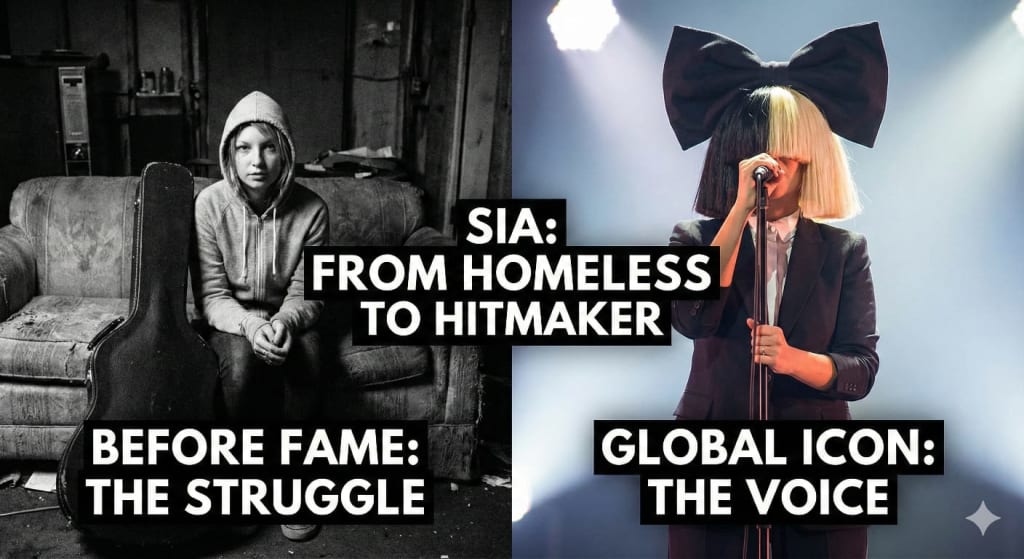
The raw, untold story of Sia, the global superstar who battled addiction, homelessness, and the death of her soulmate to reinvent herself as the mysterious, wig-wearing icon of pop music.
Introduction: The Invisible Pop Star
In 2014, the world was introduced to a strange phenomenon.
A woman stood on stage at the Grammy Awards. She had a voice that could crack the sky—a voice full of gravel, pain, and soaring power. But she was facing the wall.
Or she was wearing a massive, two-toned blonde and black wig that covered her entire face, leaving only her mouth visible to the microphone.
People were confused. Was it a gimmick? Was it arrogance? Was it performance art?
It was none of those things. It was a shield.
Sia Furler was hiding. Not because she was shy, but because she was a survivor of a war that almost killed her.
Most people see the wig and think "mystery." But if you peel back the layers of synthetic hair, you don't find a marketing strategy. You find a woman who spent decades in the trenches of addiction, grief, and mental illness, trying to find a way to be heard without being seen.
This is the story of how the most famous woman in the world made herself invisible to save her life.
Part I: The Call That Ended Her Youth
Sia was born in Adelaide, Australia, in 1975. She was born into art—her father was a musician, her mother an art lecturer. The house was chaotic, filled with creativity and instability.
Sia had a voice from the beginning. It was unique—raspy, soulful, sounding like it belonged to a 60-year-old blues singer, not a teenage girl.
In her early twenties, she fell in love. His name was Dan Pontifex. He was her soulmate. They made a plan: they would move to London together and conquer the world.
Dan went first. Sia stayed behind to finish some work.
Weeks later, just before she was set to board the plane to join him, the phone rang.
It was Dan’s mother.
Dan had been hit by a taxi in London. He was dead.
The world stopped. The future they had built in their heads evaporated in a single second.
Sia got on the plane anyway. She flew to London, not to start a life, but to attend a funeral.
She moved into Dan’s old apartment with his grieving friends. They didn't know how to process the loss. So, they didn't.
They drank.
For the next six years, Sia Furler didn't really exist. A ghost existed in her body, fueled by alcohol and drugs (Xanax and OxyContin). She mourned her dead love by trying to join him in oblivion.
Part II: The High Functioning Disaster
During this "dark period," Sia actually had a music career. She sang backup for Jamiroquai. She released solo albums that got critical acclaim but sold poorly. She even had a minor hit with the song "Breathe Me," which was used in the finale of the TV show Six Feet Under.
To the outside world, she was a quirky, rising indie artist.
Inside, she was dying.
She was diagnosed with Bipolar II Disorder. The highs were manic and creative; the lows were a black hole.
She medicated the bipolar disorder with painkillers and vodka. She became "the difficult artist." She would show up late. She would be erratic.
She hated the fame. Even the small amount of fame she had—being recognized in a coffee shop, having critics dissect her lyrics—made her skin crawl. She felt exposed. She felt like a raw nerve ending that the world kept poking.
She realized that fame was toxic for her mental health. It made her anxious. It made her want to use more drugs to cope with the anxiety, which created a feedback loop of destruction.
Part III: The Suicide Note
By 2010, Sia had hit the wall.
She had changed managers. Her album sales were stagnant. Her addiction was out of control.
One night, she decided she was done. Not done with music. Done with living.
She wrote a suicide note. She ordered a massive quantity of narcotics. She checked into a cheap hotel room.
She wanted to go out quietly. She even left instructions for the dog walker and the hotel staff so they wouldn't be traumatized by finding her body.
She sat on the bed, pills in hand, ready to turn the lights out.
Then, the phone rang.
It was a friend. He didn't know what she was doing. He just called to check in. To say hello.
That tiny, mundane interruption broke the trance.
A small voice in her head—the songwriter, the survivor—whispered: Wait.
She put the pills down. She decided to give life one more chance. But she made a vow.
I will never be famous again. I will never show my face. I will just write songs for other people. I will be the ghost.
Part IV: The Hit Machine
Sia got sober. She joined a 12-step program. And she retired as an artist.
She told her manager: "I don't want to tour. I don't want to do press. I just want to write."
So, she became a machine.
She would walk into a studio in Los Angeles, sit on a sofa, and churn out global smash hits in 20 minutes.
She wrote "Diamonds" for Rihanna in 14 minutes.
She wrote "Pretty Hurts" for Beyoncé.
She wrote for Katy Perry, Britney Spears, Celine Dion, Maroon 5.
She became the most sought-after songwriter in the world. She was the secret weapon of the pop industry.
She was rich. She was successful. And best of all, she was anonymous. She could go to the supermarket and buy milk, and nobody cared. She had hacked the system.
She had found a way to monetize her pain without selling her soul.
Part V: The Accidental Titanium
But talent like that is hard to keep in a box.
In 2011, French DJ David Guetta asked her to write a topline (lyrics and melody) for a track. She wrote "Titanium." It was intended for Alicia Keys or Mary J. Blige.
Sia recorded a "demo" vocal—just a rough guide to show the other singers how it should sound.
Guetta took the demo. He loved the rawness of her voice. The crack in the high notes. The desperation.
Without asking her, he released the song with Sia’s vocals on it.
Sia was furious. She had worked so hard to disappear.
"I’m a retired pop star!" she told him.
But "Titanium" exploded. It went to Number 1 all over the world. It was undeniable.
Suddenly, the world wanted to know: Who is that voice?
Part VI: The Invention of the Wig
Sia had a problem. She had a massive hit, and the record label was demanding an album.
She still had severe social anxiety. She still feared that fame would trigger a relapse.
So she made a deal with the devil (the music industry), but she rewrote the contract.
"I will give you an album," she said. "But I will not show my face. I will not do photoshoots. I will not stand center stage."
The executives laughed. "You can't sell a pop star without a face. Image is everything."
Sia disagreed. "Mystery is everything."
She bought a blonde bob wig. She cut the bangs so long they covered her eyes and nose.
She released the album 1000 Forms of Fear.
The lead single was "Chandelier."
Part VII: Swinging from the Chandelier
Most people think "Chandelier" is a party anthem. You hear it at clubs. You hear people screaming "I'm gonna swing from the chandelier!" while taking shots.
But if you listen to the lyrics, it is one of the darkest songs ever to hit the radio.
1, 2, 3, 1, 2, 3 drink
Throw 'em back 'til I lose count
I'm gonna fly like a bird through the night
Feel my tears as they dry
It is a song about the desperation of alcoholism. It is about the "party girl" who is terrified of the silence that comes when the party stops. It is a suicide note set to a dance beat.
Sia didn't appear in the video. Instead, she hired an 11-year-old dancer named Maddie Ziegler.
Maddie wore the wig. Maddie performed a frantic, disturbing, beautiful dance in a dirty apartment.
The video broke the internet. It has billions of views.
Sia had done the impossible. She had created a piece of art that was globally consumed, deeply personal, and yet, she remained hidden.
Part VIII: The Meaning of the Crack
Why do we love Sia?
It’s not just the melodies. It’s the voice.
In a world of auto-tuned, perfectly polished pop stars, Sia sounds like she is bleeding. Her voice cracks. It breaks. It strains.
She sounds like she is singing for her life—because she is.
When she sings Elastic Heart, she is singing about the resilience required to survive the death of her boyfriend and the years of drug abuse.
I've got thick skin and an elastic heart
But your blade, it might be too sharp
She turned her trauma into a texture. She took the ugliest parts of her life—the homelessness, the couch-surfing, the pill-popping—and she sublimated them into sound.
Part IX: The Price of Freedom
Sia eventually revealed her face more often, but on her own terms. She took control.
She proved that you don't have to follow the rules.
The industry told her: "You are too old." (She had her biggest hits in her late 30s and 40s).
The industry told her: "You need to be sexy." (She wore oversized suits and a wig).
The industry told her: "You need to be available." (She was a ghost).
She proved them all wrong.
But the journey wasn't a straight line. She still battles chronic pain (Ehlers-Danlos syndrome) and PTSD. She is not "cured."
She is simply managing.
And that is the most relatable part of her story. We are not all looking for a fairy tale ending where everything is perfect. We are looking for a way to manage the pain and still create something beautiful.
Conclusion: The Scaffolding of Survival
Sia Furler’s story is a masterclass in alchemy.
She took the lead of her life—the heavy, poisonous lead of grief and addiction—and she turned it into gold (and platinum records).
But she didn't do it by pretending the lead didn't exist.
She didn't write "happy" songs. She wrote honest songs. She wrote about the party girl who is crying in the bathroom. She wrote about the person who feels like a house of cards.
She reminds us that your "flaws"—your cracks, your breaks, your history—are not things to be hidden. They are the source of your power.
If Sia had never been an addict, she could never have written "Chandelier."
If she had never lost Dan, she could never have written "Breathe Me."
She used her worst moments as scaffolding to build her highest heights.
The Lesson
There are two ways to deal with pain.
You can let it silence you. You can let it drive you into the dark, into the bottle, into the ground.
Or, you can scream.
You can scream until it becomes a melody. You can scream until the whole world sings along with you.
Sia chose to scream.
And in doing so, she taught us that even if you want to hide your face, you must never, ever hide your voice.
Because the thing you are most afraid to say is usually the thing the world most needs to hear.
About the Creator
Frank Massey
Tech, AI, and social media writer with a passion for storytelling. I turn complex trends into engaging, relatable content. Exploring the future, one story at a time
Keep reading
More stories from Frank Massey and writers in Motivation and other communities.
The Fury of the Late Bloomer: How Samuel L. Jackson Conquered Hollywood from Rock Bottom
The powerful true story of Samuel L. Jackson, who overcame severe addiction and career stagnation to become the highest-grossing actor of all time, proving it's never too late to rewrite your legacy.
By Frank Massey about 20 hours ago in Motivation
One Hard Thing
Stop me if you’ve heard this one before: You have the number, you know your schedule- you’ve even picked out the perfect day and time to make this appointment. Shoot, you’ve even picked out alternative days and times just in case their schedules can’t accommodate you!
By Taylor Rigsby15 days ago in Motivation
Important Lessons in my 30’s
Our lives flash by very quickly if we blink. I’ll start by saying that when I was seven, I wanted nothing but to be an adult. I wanted to have a car to drive, and I wanted to have a job to go to and pretend that I had an important business meeting. I wanted to eat whatever I could and live on microwave popcorn. I thought that’s all adults wanted to do, and that’s all they had to do. I think we were all told the same thing, we get a degree, get a job, buy a house and have two to five children and we will figure out the rest like our parents did. That reality has been washed away by inflation and our bad economy. However, we cannot keep thinking these negative thoughts. I have learned a few lessons in my early thirties that I will share with you all.
By Ada Zubaa day ago in Motivation


Comments
There are no comments for this story
Be the first to respond and start the conversation.