
The Fury of the Late Bloomer: How Samuel L. Jackson Conquered Hollywood from Rock Bottom
At 40, he was an addict. At 41, he was in rehab. At 45, he was a global icon. The story of the man who proves that your life doesn’t end just because your youth did

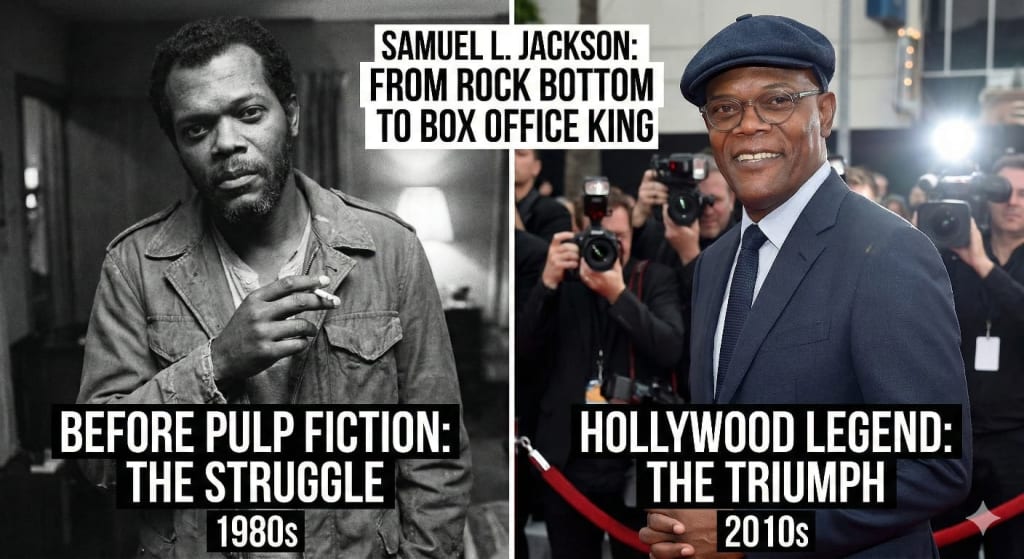
The powerful true story of Samuel L. Jackson, who overcame severe addiction and career stagnation to become the highest-grossing actor of all time, proving it's never too late to rewrite your legacy.
Introduction: The Invisible Man
In Hollywood, there is a very specific expiration date. If you haven't "made it" by 25, people start looking at their watches. If you haven't made it by 30, they start looking at the door.
By the time Samuel L. Jackson was 40 years old, he hadn't just missed the boat. The boat had sailed, sunk, and become a coral reef.
He was a ghost in the machine. A talented, intense theater actor in New York who was known by his peers but ignored by the world. He was the guy you saw in the background of a scene and thought, He looks familiar, before forgetting him instantly.
He was working. But he wasn't living.
He was living in the basement of a brownstone in Harlem. He was angry. He was frustrated. And he was slowly killing himself with a cocktail of alcohol and crack cocaine.
Today, when we see Samuel L. Jackson, we see the coolest man on the planet. We see Nick Fury. We see Jules Winnfield. We see a man who commands the screen with a single glare.
But the road to that glare wasn't paved with red carpets. It was paved with rock bottom.
Part I: The Stutter and the Rage
Samuel Leroy Jackson was born in Washington, D.C., in 1948, but he grew up in Chattanooga, Tennessee, under the care of his grandmother. His father was an alcoholic who lived away from the family and later died of alcoholism.
It was a foreshadowing Samuel didn't see coming.
As a child, Samuel had a debilitating stutter. He couldn't get the words out. Other kids mocked him. Teachers pitied him.
To fix it, he developed a coping mechanism that would become his trademark. He learned that if he used a curse word as a breaker—specifically, motherf----r—it released the tension in his jaw and allowed him to speak the rest of the sentence fluently.
The curse wasn't anger; it was a tool. It was a rhythmic reset button.
He fell in love with acting in college at Morehouse. He found that when he was in character, the stutter vanished completely. On stage, he could be anyone. He could be powerful. He could be articulate.
He moved to New York City in 1976. He married LaTanya Richardson, a fellow actor and a woman of immense strength. They had a daughter, Zoe.
On paper, he was doing everything right. He was doing Shakespeare in the Park. He was originating roles in August Wilson plays. He was the understudy for Bill Cosby.
But off stage, the darkness was creeping in.
Part II: The Functioning Addict
There is a myth about addicts. We think of them as people living under bridges, disheveled and incoherent.
Samuel L. Jackson was a "functioning" addict. That is the most dangerous kind.
He showed up to rehearsals. He learned his lines. He did the work.
But mentally, he was gone.
He started drinking to numb the rejection. Then came the drugs. First weed, then acid, then cocaine, then crack.
"I was crazy," he later admitted. "I was doing crack and still doing plays. I’d be on stage and I’d be sweating, and the audience thought it was just intense acting. It was the drugs leaving my body."
He felt he was in control. He told himself the lie every addict tells: I can stop whenever I want. I just need it to get through the stress.
But the "stress" was his career stalling. He was watching his friends—Denzel Washington, Laurence Fishburne, Wesley Snipes—become superstars.
Denzel was winning Oscars. Samuel was playing "Gang Member #2" in a movie that went straight to VHS.
Bitterness is a poison. He drank it daily.
Part III: The Kitchen Floor
* Samuel was 42 years old.
He had just been cast as the understudy for a Broadway play called The Piano Lesson. It was a huge opportunity.
But he was spiraling. He was smoking crack all day. He was neglecting his family.
One afternoon, his wife LaTanya and his 8-year-old daughter Zoe came home. They walked into the kitchen.
They found Samuel passed out on the floor. He was surrounded by drug paraphernalia. He was unconscious, drooling, a shell of a man.
LaTanya could have left him. She could have taken Zoe and walked out the door. No one would have blamed her.
Instead, she kicked him awake.
"Get up," she said. "You are going to rehab. Today."
Samuel tried to argue. He tried to lie.
But then he looked at his daughter. He saw the terror in her eyes. He realized that to her, he wasn't a great actor who was misunderstood. He was just a junkie on the floor.
That image broke him.
He checked into a rehabilitation center in upstate New York.
Part IV: The Silence of Rehab
Rehab is not a spa. It is a prison where you are the warden and the inmate.
For the first time in twenty years, Samuel was sober. The fog lifted.
But with the clarity came the horror. He had to face the time he had wasted. He had to face the talent he had squandered.
He sat in group therapy, listening to other men talk about their ruined lives. He realized he was one bad decision away from being dead or homeless.
While he was in rehab, something strange happened.
Spike Lee, the director, called. He had a role for Samuel in his new movie, Jungle Fever.
The role?
A crack addict named Gator.
It felt like a cruel joke from the universe. Samuel had just spent weeks trying to kill the addict inside him, and now Hollywood wanted him to resurrect him for a paycheck.
His counselors told him not to do it. "It's a trigger," they said. "You'll relapse."
Samuel thought about it. He looked at the script.
He realized he didn't need to act. He just needed to remember.
He took the role.
Part V: The Catharsis
When Jungle Fever came out in 1991, audiences were stunned.
The character of Gator was terrifying. He was pathetic, manipulative, and heartbreakingly real. The scene where he dances for his mother, trying to charm her out of money for drugs, is one of the most painful scenes in cinema history.
Samuel wasn't acting. He was exorcising a demon. He was showing the world the man he used to be so he would never have to be him again.
The Cannes Film Festival created a special "Best Supporting Actor" award just for him.
He was 43.
It was a start. But it wasn't the explosion.
He was sober now. He was focused. He was hungry.
But he was still a "character actor." He was still the guy you called to play the sidekick or the villain.
He needed a miracle.
Part VI: The Burger and the Bible
In 1993, a young video store clerk named Quentin Tarantino was casting his second movie, Pulp Fiction.
He needed an actor to play Jules Winnfield, a hitman who quotes the Bible before he executes people.
Samuel auditioned.
He walked into the room with a burger and a drink in his hand. He was tired. He was hungry. He didn't care if he got the part or not.
When the casting director called his name, Samuel took a bite of the burger, stared at him with intense, burning eyes, and delivered the lines with a mixture of menace and humor that terrified everyone in the room.
Tarantino knew instantly. That’s the guy.
The role of Jules Winnfield is not a normal role. It requires a specific rhythm. It requires a man who can be funny about a foot massage one minute and terrifying about the vengeance of God the next.
Samuel L. Jackson was 45 years old when he filmed Pulp Fiction.
Most actors at 45 are planning their retirement. Samuel was just getting started.
Part VII: The Explosion
Pulp Fiction premiered in 1994.
It changed cinema. And it launched Samuel L. Jackson into the stratosphere.
The monologue—Ezekiel 25:17—became legendary. Kids in suburbs were reciting it.
“The path of the righteous man is beset on all sides...”
Suddenly, the phone didn't stop ringing.
Die Hard with a Vengeance.
A Time to Kill.
The Long Kiss Goodnight.
Jackie Brown.
He was everywhere.
But unlike the young stars who burn out, Samuel had stamina. He had spent 20 years in the dark; he wasn't going to waste a second of the light.
He said "Yes" to everything. Action movies? Yes. Dramas? Yes. Cartoons? Yes. Snakes on a Plane? Hell yes.
He became the hardest working man in Hollywood.
Why?
Because he remembered the kitchen floor. He remembered the silence of the phone. He worked with a frantic energy, as if he was trying to make up for lost time.
Part VIII: The Jedi and the Spy
Then came the franchises.
George Lucas called. "Do you want to be in Star Wars?"
Samuel said, "I want a purple lightsaber."
He got it. Mace Windu.
Marvel called. "We want you to be the glue of the entire universe."
Nick Fury.
By the 2010s, Samuel L. Jackson had achieved a statistical impossibility.
He became the highest-grossing actor of all time.
His movies have made over $27 billion worldwide. More than Harrison Ford. More than Tom Cruise. More than Robert Downey Jr.
The man who was smoking crack in a Harlem basement was now statistically the most successful face in the history of the moving image.
Part IX: The Unbreakable Sober Streak
Through it all—the billions, the fame, the Oscars (he finally got an honorary one)—Samuel kept one thing sacred.
His sobriety.
He hasn't had a drink or a drug since 1991.
He speaks openly about it. He doesn't hide his past.
"I didn’t become famous until I got sober," he says. "That’s not a coincidence."
He realized that his talent was a gift, but his addiction was a wall he had built around it. Once he tore down the wall, the talent was free to breathe.
He is still married to LaTanya. They have been together for over 40 years. In Hollywood, that is a miracle bigger than Star Wars.
Part X: The Lesson of the Late Bloomer
We live in a culture that fetishizes youth. We possess "30 Under 30" lists. We obsess over the wunderkinds who make millions before they can rent a car.
This makes the rest of us feel like failures.
If you are 35 and you haven't "made it," you feel like it's over.
If you are 45 and you are starting over, you feel shame.
Samuel L. Jackson destroys that narrative.
He proves that life is not a sprint. It is a war of attrition.
He proves that your 20s can be a mess. Your 30s can be a disaster. And you can still own your 40s, 50s, and 60s.
He proves that "talent" is not enough. You need clarity.
As long as he was numb, he was mediocre. The moment he faced his pain, he became magnificent.
Conclusion: The Righteous Path
Today, Samuel L. Jackson is 75 years old. He is still working. He is still yelling. He is still the coolest man in the room.
But when you look at him, don't just see the movie star.
See the survivor.
See the man who chose to get up off the kitchen floor.
See the man who looked in the mirror at 42 years old, saw a failure, and decided to edit the script.
His story is a reminder to anyone who feels "behind" in life.
You are not behind. You are just in the prequel.
The real movie starts when you decide to wake up.
As Jules Winnfield said:
"I’m trying, Ringo. I’m trying real hard to be the shepherd."
Samuel L. Jackson stopped being the sheep. He became the shepherd of his own destiny.
And that is a role worth playing.
About the Creator
Frank Massey
Tech, AI, and social media writer with a passion for storytelling. I turn complex trends into engaging, relatable content. Exploring the future, one story at a time
Keep reading
More stories from Frank Massey and writers in Motivation and other communities.
The Invisible Man: How Bryan Cranston Conquered Hollywood by Letting Go of Success
The Myth of the Overnight Success If you look at the landscape of American pop culture today, Bryan Cranston is a titan. He is the face of Breaking Bad, the show often cited as the greatest television drama in history. He is a multi-time Emmy winner, a Tony winner, and an Oscar nominee. He carries an air of gravitas and authority that feels permanent, as if he was born sitting on the throne of Hollywood acting.
By Frank Massey 2 days ago in Motivation
One Hard Thing
Stop me if you’ve heard this one before: You have the number, you know your schedule- you’ve even picked out the perfect day and time to make this appointment. Shoot, you’ve even picked out alternative days and times just in case their schedules can’t accommodate you!
By Taylor Rigsby15 days ago in Motivation



Comments
There are no comments for this story
Be the first to respond and start the conversation.