
The Father He Lost, the Father He Became: Ronaldo's Emotional Journey with Family
The Father He Lost, the Father He Became: Ronaldo's Emotional Journey with Family

The Father He Lost, the Father He Became: Ronaldo's Emotional Journey with Family
Genre: Emotional / Personal Essay
For all his goals, his trophies, his abs carved like marble, Cristiano Ronaldo remains, above all else, a son who lost his father too soon—and a father striving to fill the gap that once hollowed him out.
We see the medals. We cheer the goals. But behind the spotlight, there is a quiet, often overlooked truth: Ronaldo’s greatest win is not on the pitch. It’s at home. With his children. With the love he gives now, perhaps in place of the love he yearned to receive just a little longer.
This is the story of the father he lost. And the father he became.
A Son in the Shadows of Struggle
Cristiano Ronaldo dos Santos Aveiro was born in Madeira, Portugal, in 1985—the youngest of four in a working-class home. His father, José Dinis Aveiro, worked as a municipal gardener and part-time kit man for a local football club. But life was not easy. José struggled with alcoholism—a slow, painful spiral that left an undeniable mark on young Cristiano’s heart.
In interviews, Ronaldo rarely hides the complicated truth. He has spoken candidly about how his father was kind, never violent, but absent in the ways that mattered most. "He never really saw how great I became," Ronaldo once said in a tearful interview. “I don’t know him 100 percent.”
José passed away in 2005 from liver failure. Ronaldo was just 20. On the cusp of becoming a global icon. On the brink of everything. But his father didn’t live long enough to witness any of it—none of the Ballon d'Ors, the Champions League triumphs, the Euro 2016 fairytale, or the title of “GOAT” whispered across continents.
It is this absence—this hole left unfilled—that Ronaldo has carried deeper than any rivalry or defeat.
Grief, Drive, and the Silent Motivation
They say grief becomes part of your DNA. For Ronaldo, it became a force. A quiet flame that fueled him not only to succeed, but to prove something to a man who was no longer watching.
Every drop of sweat in training. Every gym session past midnight. Every celebration with tears in his eyes. Was it a tribute? A conversation with someone only he could still feel?
For years, Ronaldo would avoid alcohol, not just as a nod to his discipline, but perhaps also as a silent rebellion against the disease that took his father. His work ethic became legendary. His discipline, unmatched. But beneath that perfectionism was always a boy who wished his father had been proud—and present.
Becoming a Father
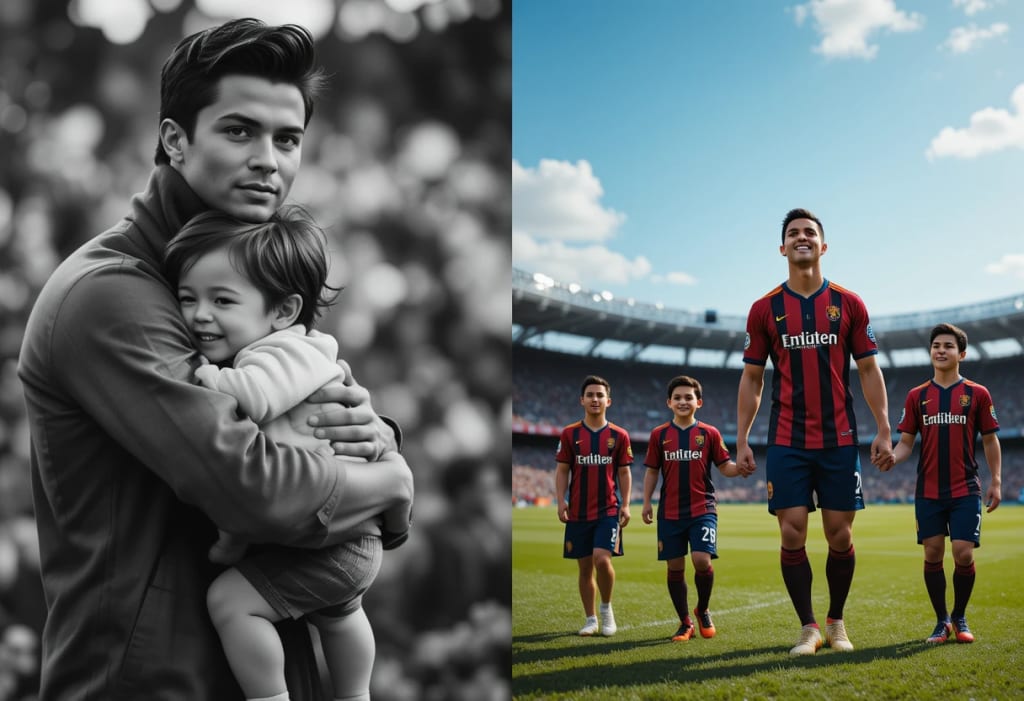
Then, everything shifted again in 2010 when Cristiano Ronaldo Jr. was born. For the first time, Ronaldo was no longer just a son mourning a loss—he was a father forging a new beginning.
He kept his son close from the very start. Critics called it unusual—raising him without revealing the identity of the mother, shielding him fiercely from the press. But what they missed was that this was Ronaldo’s redemption. His vow. To never be distant. To never be absent. To never let history repeat itself.
Over the years, we saw a different side of Ronaldo. The side that tucked his son into bed. The side that brought him on stage to award ceremonies. The side that sat proudly next to him during interviews and whispered encouragements before kickoff.
When twins Eva and Mateo were born via surrogate in 2017, and later Alana Martina with longtime partner Georgina Rodríguez, Ronaldo’s family grew—but so did his heart. From training sessions with his children to birthday parties full of balloons, Ronaldo's Instagram began to look less like that of a football superstar and more like that of a devoted dad with a camera roll full of smiles.
The Father He Never Had
What’s striking is not just that Ronaldo became a father—but the kind he chose to be.
He isn’t perfect. Fame and football demand time, travel, and sacrifice. But he’s there—in the small moments. Helping with homework. Cheering from the sidelines. Guiding his son through early steps in football. The boy who once longed for a present father is now showing up every day in the lives of his children.
There’s something deeply poetic in that. A full-circle journey. From loss to love. From silence to laughter.
And when he tears up during interviews that mention his father, it’s not just sadness—it’s a reflection. A reminder. That the best way to honor the father you lost is to become the one you wished he could be.
Legacy Beyond Football
Cristiano Ronaldo will be remembered for many things:
The goals.
The records.
The gravity-defying headers.
The unforgettable moments under the brightest lights.
But maybe his truest legacy won’t be in stadiums.
It’ll be in a dinner table full of children’s voices. In the bedtime stories. In the hand that holds his son’s shoulder before his first match. In the quiet resilience of a man who rewrote his story.
The father he lost will always be part of him. But the father he became? That’s who he chose to be.
And in that choice, there is healing. There is strength. And perhaps, finally—peace.
About the Creator
Keep reading
More stories from waseem khan and writers in Motivation and other communities.
Cristiano Ronaldo vs. the World: How Critics Became His Fuel
Cristiano Ronaldo vs. the World: How Critics Became His Fuel Genre: Opinion / Motivational Cristiano Ronaldo has never been everyone's favorite. He was never the golden boy that always fit the mold, nor the one the media protected like fragile glass. From his early days in Portugal to his worldwide dominance, one constant has followed him like a shadow: doubt. Yet if there's one thing Ronaldo has mastered more than the step-over or the knuckleball free kick, it's turning criticism into fuel.
By waseem khan6 months ago in Motivation
Influential Women Magazine Celebrating Purpose-Driven Women
Influence in today’s world is no longer defined by popularity alone. It is shaped by purpose, values, and the ability to create meaningful impact. Women across the globe are leading businesses, movements, and communities with intention and integrity.
By influentialwomenmagazineabout 7 hours ago in Motivation


Comments
There are no comments for this story
Be the first to respond and start the conversation.